

Photonic devices, which rely on light instead of electricity, have the potential to be faster and more energy efficient than today’s electronics. They also present a unique opportunity to develop devices using soft materials, such as polymers and gels, which are poor conductors of electricity, but are easier to manufacture and more environmentally friendly. The development of these potentially squishy, flexible photonics, however, requires the ability to manipulate light using only light, not electricity.
In soft matter, that’s been done primarily by changing the physical properties of optical materials or by using intense light pulses to change the direction of light. Now, an international team of scientists has developed a new way of controlling light with light using very low light intensities and without changing any of the physical properties of materials.
Igor Muševič, a professor of physics at the University of Ljubljana who led the project, says that he first got the idea for the device while at a conference in San Francisco, listening to a talk by Stefan W. Hell about stimulated emission depletion (STED) microscopy. The imaging technique, for which Hell won a Nobel Prize in Chemistry in 2014, uses two lasers to produce an extremely small light beam to scan objects. “When I saw this, I said, this is manipulation light by light, right?” Muševič recalls.
His realization inspired a device into which a laser pulse is fired. Whether or not this beam makes it out of the device depends on whether or not a second pulse is fired less than a nanosecond afterwards.
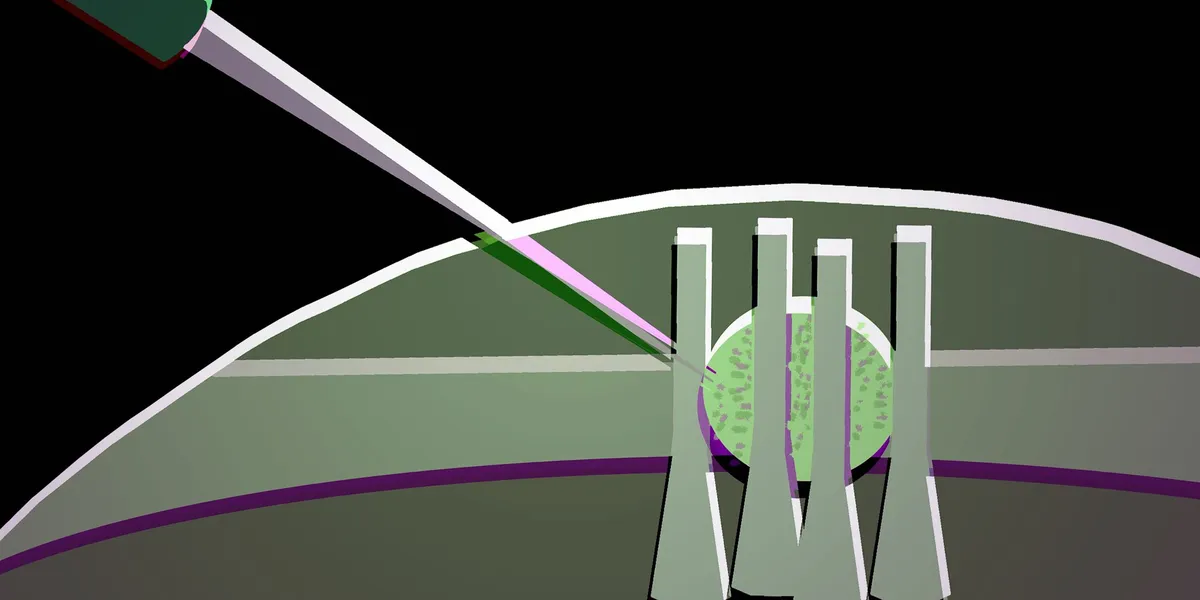
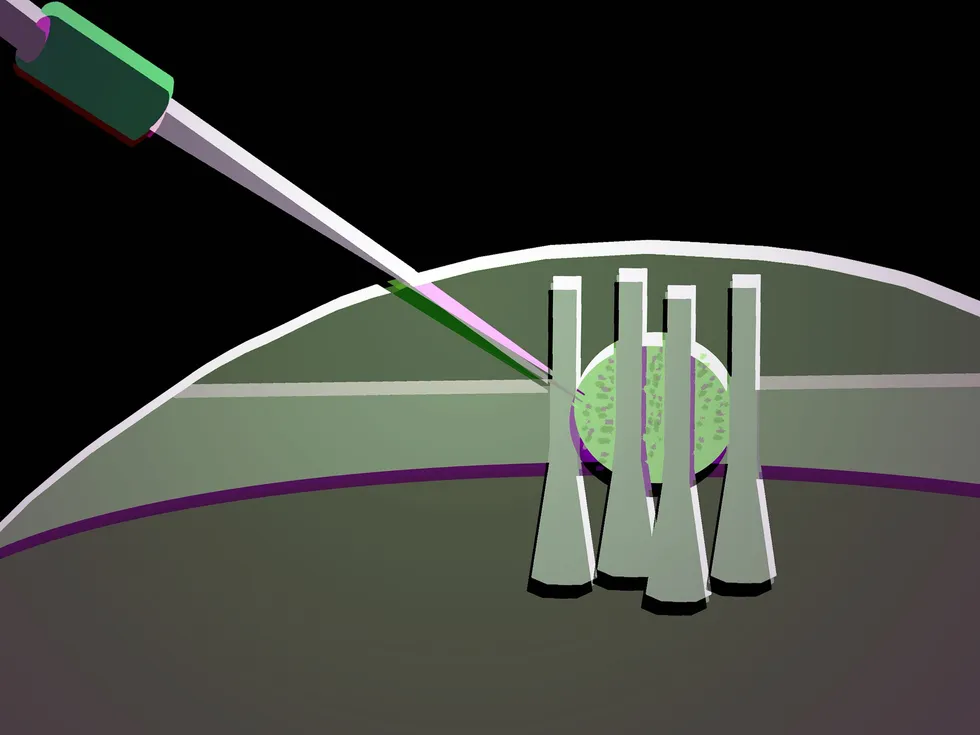
The device consists of a spherically-shaped bead of liquid crystal, held in shape by its elastic material properties and the forces between its molecules, infused with a fluorescent dye and trapped between four upright cone-shaped polymer structures that guide light in and out of the device. When a laser pulse is sent through one of the four polymer waveguides, the light is quickly transferred into the liquid crystal, exciting the fluorescent dye. In a process known as whispering gallery mode resonance, the photons inside the liquid crystal are reflected back inside each time they hit the liquid’s spherical surface. The result is that light circulates inside the cavity until it is eventually reflected into one of the waveguides, which then emits the photons out in a laser beam.
The team realized that sending a second laser pulse of a different color into the waveguides before the liquid crystal started emitting light from the first laser pulse resulted in stimulated emission of the excited dye molecules. The photons from the second laser pulse, which had to be fired into the waveguides after the first laser pulse, interact with the already-excited dye molecules. The interaction causes the dye to emit photons identical to those in the second pulse while depleting the energy from the first pulse. The second laser beam, called the STED beam, is amplified by the process, while the light from the first pulse is so diminished that it isn’t emitted at all. Because the outcome of the first laser pulse could be controlled using the second laser pulse, the team had successfully demonstrated the control of light by light.
According to the Ljubljana team, the energy efficiency of the liquid crystal approach is much better than previous soft-matter techniques, which had typically involved using intense light fields to change material properties of the soft matter, such as the index of refraction. The new method reduces the energy needed by more than a factor of a hundred. Because the STED laser pulse circulates repeatedly in the crystal, a single photon can deplete many dye molecules of the energy from the first laser pulse.
Miha Ravnik, a theoretical physicist also at the University of Ljubljana who worked on the project, explains that control of light by light is essential in soft-matter photonic logic gates. “You can very much control when [light] is generated and in which direction,” Ravnik says of the light shined into the polymer waveguides. “And this gives you, then, this capability that you create logical operations with light.”
Aside from its potential in photonic logical circuits, the team’s approach presents several technical advantages over photonics made from silicon or other hard materials, Muševič says. For example, using soft matter greatly simplifies the manufacturing process. The liquid crystal in the team’s device can be inserted in less than a second, but manufacturing a similar structure with hard materials is difficult. Additionally, soft matter devices can be manufactured at much lower temperatures than silicon and other hard materials. Muševič also points out that soft matter presents an opportunity to experiment with the geometry of the device. With liquid crystals “you can make many different kinds of cavities,” says Muševič. “You have, I would say, a lot of engineering space.”
Ravnik is excited for the potential of the team’s breakthrough, particularly as a step towards photonic computing and even photonic neural networks. But, he recognizes that these developments are far down the line. “There’s no way this technology can compete with current neural network implementation at all,” he admits. Still, the possibilities are tantalizing. “The energy losses are predicted to be extremely low, the speeds for calculation extremely high.”
From Your Site Articles
Related Articles Around the Web
