

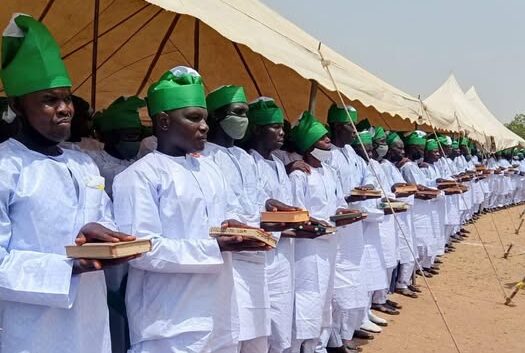
A human rights lawyer, Maxwell Opara, has sued the Nigerian government and the army to stop the reintegration of repentant insurgents into the Nigerian society.
He filed the suit on 23 April at the Federal High Court in Abuja.
The defendants in the suit are the Nigerian Army, the Attorney-General of the Federation, Lateef Fagbemi, and President Bola Tinubu, listed as first to third respondents respectively.
Mr Opara also sought an order of mandatory injunction compelling the Attorney-General of the Federation (AGF) to initiate and pursue criminal prosecution of over 700 repentant Boko Haram insurgents.
He said their prosecution would be in accordance with the Terrorism (Prevention and Prohibition) Act, 2022, the Administration of Criminal Justice Act (ACJA), 2015, and other relevant laws.
He urged the court to answer, among other questions, “Whether the reintegration of the said repentant insurgents violates the right of Nigerian citizens to life, dignity of the human person, and personal liberty as guaranteed under Sections 33, 34, and 35 of the Constitution of the Federal Republic of Nigeria, 1999 (as amended), by exposing them to renewed threats of violence from persons whose criminal culpability has not been judicially determined?”
PREMIUM TIMES reported that on 17 April in Gombe State, the federal government announced the graduation of 744 ex-insurgents and victims of violent extremism under the Operation Safe Corridor deradicalisation programme.
The military said the participants completed rehabilitation, vocational training, counselling and ideological reorientation. Officials said the process prepares them for return to civilian life after surrender.
The Chief of Defence Staff, General Olufemi Oluyede, said the programme supports reintegration into society as part of Nigeria’s non-kinetic counter-insurgency strategy. He added that the aim was to reduce insecurity by disengaging participants from extremist ideology and reintegrating them into their communities.
However, the graduation has continued to generate mixed reactions, with supporters describing it as a pragmatic approach to peacebuilding, while critics insist it raises unresolved questions about justice and reconciliation in conflict-affected regions.
The suit
Mr Opara, in the suit, sought an order directing the Nigerian Army to immediately suspend the Operation Safe Corridor reintegration programme pending the hearing and final determination of the suit.
The lawyer raised seven questions for determination.
Among other requests, he asked the court to determine whether the reintegration of over 700 repentant insurgents into Nigerian society without criminal prosecution, judicial conviction or sentencing is consistent with the Constitution and the ACJA, 2015.
He sought a declaration that the reintegration of the repentant insurgents into society without prior prosecution and judicial conviction is unlawful, unconstitutional and a violation of the rule of law.
Mr Opara also asked for a declaration that the first and second respondents lack legal authority to grant de facto immunity or amnesty to individuals accused of terrorism, murder, kidnapping and other violent crimes without legislative authorisation and judicial oversight.
“A declaration that the actions of the first respondent in releasing and reintegrating the said insurgents constitute a violation of the doctrine of separation of powers and an usurpation of judicial authority,” he added.
In the affidavit in support of the suit, Mr Opara, who described himself as a public interest litigation lawyer, attached the official press release of the Nigerian Army as Exhibit A.
He said over 700 persons identified as former members of the Boko Haram terrorist group had been released and reintegrated into society.
He added that they were not subjected to criminal prosecution, trial or conviction by any court of competent jurisdiction before their release.
He also stated that many of the said individuals are reasonably suspected to have participated in acts constituting terrorism, murder, kidnapping and other grave offences under Nigerian law.
He said judicial powers are vested exclusively in the courts.
He said the reintegration of untried insurgents poses a real and substantial risk to public safety. And added that failure to prosecute persons accused of serious crimes erodes public confidence in the justice system and the rule of law.
Mr Opara urged the court to grant his prayers in the interest of justice, national security and the rule of law.
