

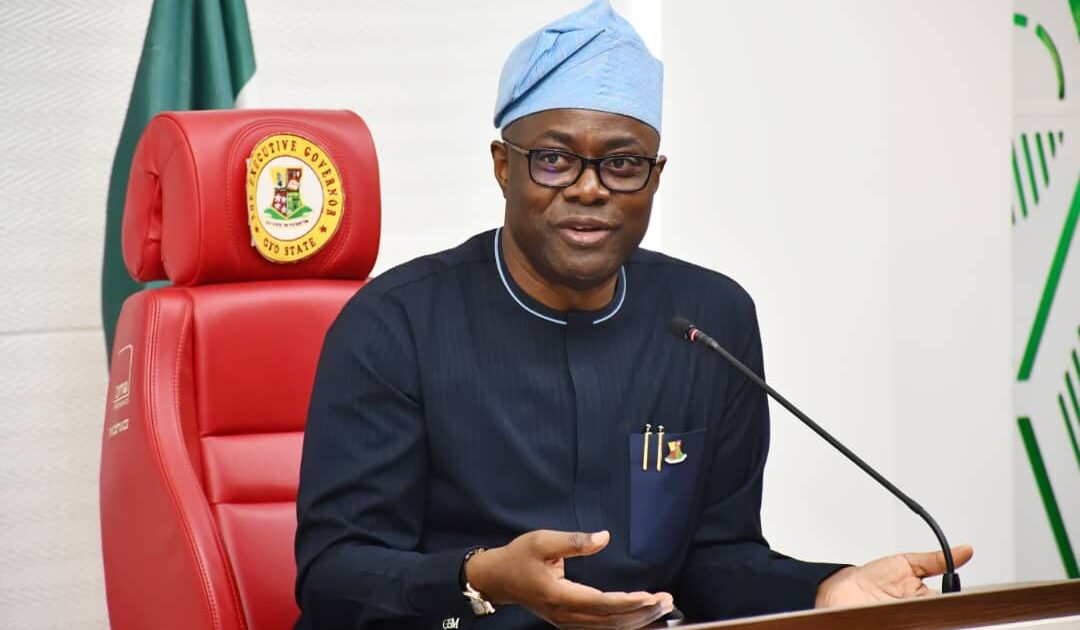

At a dialogue hosted by Harvard University, Kennedy School Mossavar-Rahmani Centre for Business and Government on Wednesday, April 22, 2026, Oyo State Governor, Engr. Seyi Makinde, spoke on the theme “Industrialisation and Leadership in Africa: Ensuring Continuity in Hard Times”, offering reflections on governance, institution-building, education, opposition politics, and the future of development in Nigeria.
Speaking in a candid and reflective tone, Makinde argued that industrialisation in Africa ultimately “rises or falls on leadership”, stressing that long-term development must be anchored not in personalities but in durable public institutions. According to him, Africa’s progress depends on building “strong institutions and not strong men”, while ensuring that public officials remain “loyal to the state, not to individuals”. This, he says, will be the guiding principle for a successor.
The governor also emphasised the importance of institutional thinking over personal rule, advocating what he described as “institutionally more than individualisation”. In the same vein, he said confidence itself should be seen as a form of infrastructure, remarking that “confidence is a kind of infrastructure”.
On constitutional and governance reform, Makinde said he supports a single six-year tenure for elected executives, presenting the view as part of a broader rethink of how leadership continuity and accountability should be structured. He also reiterated his belief that the opposition remained essential to democratic development, saying he believes “opposition is the way to go”. He added that he did not believe in a “captured state” and was open to working with the opposition “if it happens”. In a striking political remark, he also said he was “open to the Presidency if the opportunity and call open up”.
The Oyo State governor used the occasion to make a strong case for decentralisation, especially in relation to taxation, education, and internal security. Referring to discussions at a recent executive council meeting, he expressed disagreement with aspects of current tax arrangements, arguing that taxes that ought to be collected by state governments were being centralised. He maintained that both the federal and state governments had coordinated responsibilities, while noting that there is “a lot of interference”.
On education, Makinde argued that none of the sectors should remain within the purview of the Federal Government. He tied this position to his personal story, recalling that his mother had been a telephone operator at the same Government House where he now serves as governor.
“Education is key to giving me more leverage in it,” he said, using his own journey to underscore why investment in education remains central to social mobility and state-building.
The governor also called for policies that would make the environment more conducive for members of the diaspora to return and contribute to development. On regional and international economic strategy, he pointed to Oyo State’s role in continental trade, asserting that Oyo was the only state that was a partner on the African Free Trade Agreement.
Turning to infrastructure and legacy projects, Makinde said one of the things he would focus on in the year before leaving office is ensuring continuity around major road projects, including the circular road. He said the 31-kilometre stretch would be ready by the end of January, expressing confidence that the next administration would continue the work and “just build,” rather than struggle for funds to conclude it. In his framing, the responsibility to build enduring systems “is in our hands.”
The governor also spoke about future urban and housing development plans, including what he referred to as Omituntun Part Three, which he described as an opportunity to start from a “clean slate”. Referring to Ilu Titun Business District as “a virgin land”, he said the vision includes provision for “100 estate for middle income earners” and a land-swap infrastructure model.
In discussing public policy and hindsight, Makinde suggested there are decisions he would now redesign. He remarked that he “would have borrowed more if he knew the federal government would devalue the naira this much”, implying that more aggressive financing might have accelerated development outcomes under the right conditions.
He also touched briefly on security and subnational policing, referencing ‘Amotekun’, an effort among the South-West governors pioneered by the late Rotimi Akeredolu and himself, and state police conversations, while reinforcing his broader point that lasting development requires capable state institutions and clearer constitutional responsibility-sharing.
Overall, Makinde’s speech was a forceful argument for institutional leadership, devolution of powers, educational investment, and continuity in governance. Across his remarks, a central theme emerged clearly: Africa’s industrial and democratic future will depend less on strong individuals and more on whether leaders can build systems that outlast them.
Timi Olagunju is a lawyer, public policy expert and a Mason Fellow, Harvard University
