

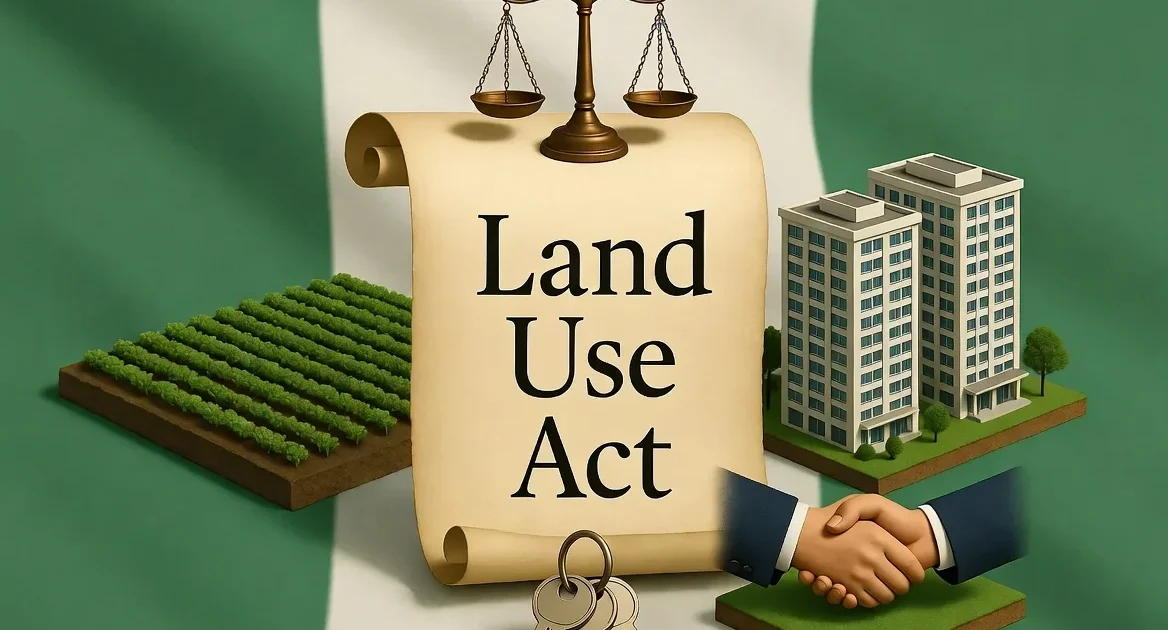

Picture this: A man buys land somewhere in Lagos. He pays in full, takes possession, and begins building. After some years, he tries to use the property as collateral for a business loan. The bank’s solicitors raise a problem: the governor’s consent was never obtained for the original transaction. His title is vulnerable, his ability to mortgage the property is impaired, and the transaction that he has built his financial life around exists in a legal grey zone that arguably should never have existed in the first place. He is not a victim of fraud; rather, he is a victim of a legal framework that makes ordinary property ownership in Nigeria structurally precarious.
Now, this scenario is not merely hypothetical. Versions of it play out across Nigerian cities every year, and they share a common statutory root. Its name? The Land Use Act of 1978.
The Act, promulgated under the military government of General Olusegun Obasanjo, vests all land in each state in the governor, who holds it in trust for the people. Individuals do not own land in Nigeria in the conventional sense. They hold rights of occupancy, statutory or customary, granted by the state. Under Sections 21 and 22 of the Act, any sale, mortgage, or transfer of land requires the governor’s consent before it is legally valid.
The Act’s original purpose was, ostensibly, not cynical. Before 1978, Nigeria’s land tenure system was a fragmented patchwork of customary arrangements that varied by ethnicity, region, and tradition. Urban land had become a speculator’s playground, the activities of land grabbers, otherwise known as omonile, were on the rise, and access to property was deeply unequal. With this context in mind, the military government’s instinct to centralise and democratise land administration was logical and well-founded. The problem is that good intentions rarely ever survive bad institutional design.
Section 43 of the 1999 Constitution guarantees every citizen the right to acquire and own immovable property anywhere in Nigeria. Read that alongside the Land Use Act, and a constitutional tension emerges that the legal system has largely chosen to ignore. Citizens have a constitutional right to own property. But all the land that those citizens might own is vested in state governors. A right of occupancy is not ownership in the traditional freehold sense most people are familiar with; it is a state-created interest whose continued existence depends on a government-controlled legal regime. The property right the Constitution promises, and the property right the Land Use Act delivers, are not the same thing. The gap that exists here is the foundational weakness of Nigeria’s entire property rights architecture.
Nigeria’s mortgage market is not underdeveloped because Nigerians do not want homes; it is underdeveloped because the institutional foundations for a functioning mortgage market do not exist in a form that inspires lender confidence. Per the World Bank, Nigeria’s mortgage-to-GDP ratio is approximately 0.6 per cent, among the lowest in the world. Even more strikingly, a significant proportion of land holdings remain outside the formal titling system, limiting their utility as collateral and constraining access to credit.
To say the Act is solely responsible for this would be dishonest. High interest rates, inflation, income constraints, and a predominantly informal workforce all contribute, but the Act is one of the foundational institutional obstacles, and it operates through a specific mechanism: when title is uncertain, land cannot easily serve as collateral; when land cannot serve as collateral, credit is inaccessible; when credit is inaccessible, wealth cannot be built, transmitted, or grown across generations. The governor’s consent requirement, combined with titling difficulties, opaque registration processes, and the costs of perfecting a transaction through multiple bureaucratic layers, produces a system in which the majority of Nigerian property value sits outside the formal financial system.
The critique of the Land Use Act is frequently framed around governors who abuse their powers, and the abuses are real. Consents have been withheld for political reasons, land has been revoked and reallocated to politically connected parties, and “ordinary” applicants have waited years for approvals that should take weeks, often navigating informal payment demands at every stage.
Tempting as it may be to say otherwise, the deeper problem goes beyond a few bad governors. The Act makes abuse structurally invisible. When a governor’s consent is a discretionary executive act, there is no legal standard against which a refusal or a delay can be measured. A governor who ignores a consent application for eighteen months has not obviously violated any statutory provision, especially as the Act does not specify timelines, does not require reasons, and does not establish a meaningful right of appeal against inaction. What was designed as a safeguard became an instrument of extraction precisely because discretion should not be left unfettered without mechanisms for accountability.
Some have argued that at this stage, land reform is too complicated or too politically costly to achieve. This argument, however, is weakened considerably by Rwanda’s experience. As the UK’s Department for International Development noted in a 2014 review of Rwanda’s Land Tenure Regularisation Programme, the country successfully registered approximately 10.3 million land parcels between 2009 and 2013.
World Bank research subsequently found that the programme generated significant gains in tenure security and investment incentives while strengthening the legal infrastructure necessary for land transactions and access to credit. Rwanda’s experience demonstrates that large-scale land administration reform is not a theoretical aspiration but an achievable policy objective when supported by political commitment and institutional capacity. It is worthy to note that Rwanda does not boast a particularly large economy, especially when compared to Nigeria. It did this through institutional will and administrative design, not economic advantage. If Rwanda could undertake such reforms with far fewer resources, it is difficult to argue that the barriers facing Nigeria are primarily technical rather than political.
The case for repealing the Land Use Act outright is understandable, but impractical and probably counterproductive. The Act is entrenched in the 1999 Constitution under Section 315, meaning any amendment requires the full constitutional alteration process. More importantly, the problems the Act was designed to address have not disappeared. A repeal without replacement architecture could produce a speculative market that excludes the urban poor more comprehensively than the current system does.
Targeted reform is the more defensible and achievable path. Three changes would do the most work.
First, the Act should be removed from constitutional entrenchment and converted into ordinary legislation. This alone would allow amendment through the normal legislative process rather than requiring a supermajority of state assemblies. The Federal Government’s 2025 Land Reform Task Teams and current legislative proposals for a National Land Commission are steps toward this; they need to become law, not recommendations.
Second, the governor’s consent should be converted from a discretionary political act into a mandatory administrative certification. Where all statutory requirements are satisfied, consent should be deemed granted automatically within a defined timeframe. What is currently a political favour should become a bureaucratic confirmation, reviewable by a court on defined grounds if withheld or delayed.
Third, the governor’s power to revoke rights of occupancy must be tightly constrained. Permissible grounds should be exhaustively listed in statute, not left as open-ended “public purpose”. Every revocation should require published justification, independent valuation, prompt and adequate compensation calculated on market value rather than merely the value of improvements, and a right of appeal before a specialised land tribunal.
The Land Use Act has not only complicated land transactions, but it has weakened the property-rights infrastructure on which individual wealth creation, credit access, and intergenerational economic mobility depend. For nearly five decades, Nigerian property law has maintained a gap between the ownership the Constitution promises and the occupancy it actually delivers. That gap costs ordinary Nigerians, not in abstract economic terms, but in loans they cannot access, assets they cannot pass to their children with certainty, and wealth they cannot build on land they believe is theirs.
In the illustration painted at the start of this piece, the man who bought land in Lagos believed he was purchasing certainty. What he acquired instead was a legal interest dependent on approvals, consents, and administrative discretion. That distinction may seem purely technical until one remembers that entire economies are built on citizens’ ability to convert property into security, credit, investment, and opportunity. Nearly fifty years after the inception of the Land Use Act, the question is no longer whether the system can be defended, but whether Nigeria can afford to keep building prosperity on uncertain foundations.
Alabi is a lawyer and co-founder of Trellis Africa, a compliance infrastructure firm
