

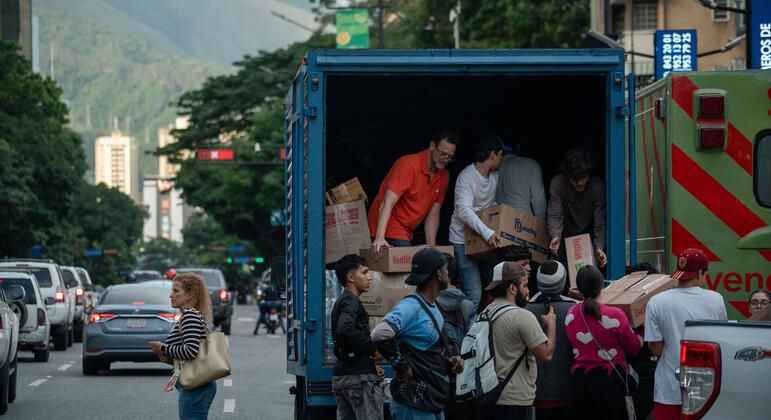
The confirmed death toll is at least 1,450 people but that number is likely far short of the actual figure, as tens of thousands more are still believed to be missing. At least 3,200 people have been injured, with numbers rising all the time.
In one of the worst-hit locations, the coastal state of La Guiara, Mireya Quesada Sojo described the huge challenge facing civilian rescuers like her. All around are great piles of collapsed debris and twisted masonry where Mireya’s relatives were living when the magnitude 7.2 and 7.5 quakes hit, less than a minute apart.
“At first, we started digging with our bare hands, trying to recover our family members,” she says, looking up from a baseball cap fixed atop greying hair, spectacles, dust-covered jeans and a T-shirt. “We know they are no longer alive, but we just have to be able to see them again, even if it’s sad. So, we are asking for assistance to see if we can dig them out. People have come to help and we are deeply grateful.”
Since the very first hours of the crisis, the UN aid coordination office, OCHA, has helped to coordinate the international response provided by 27 countries and involving more than 2,200 rescuers and 140 search dogs.
In addition to search and rescue coordination, the agency provides support for information management, logistics and communications. Non-governmental and private sector partners are also on site, providing urgently needed shelter, water, food, medicine and protection.
OCHA also continues to work closely with the Government, the military and civil protection at coordination centres including in La Guiara, where the UN has set up three field hospitals and teams are preparing support for people unable to return home.
House of cards
According to the UN Children’s Fund, UNICEF, about 1.8 million people need humanitarian assistance including 680,000 youngsters.
In comments to the media at the weekend, the UN emergency relief chief described the damage to roads, airports and buildings as “overwhelming”. Tom Fletcher also said that an initial estimate of 50,000 people missing remained “terrifyingly plausible”, although not all of those who have yet to be found are trapped under the rubble.
In total, some 6.76 million people could be affected by the earthquakes, including two million in Caracas alone, the UN agency for migration, IOM, has warned. It highlighted the scale of the disaster on Monday using satellite mapping analysis from Microsoft showing that 31.5 per cent of buildings in Catia La Mar, a major port city in northern Venezuela, have been damaged.
Early assessments such as these help humanitarian responders identify which communities need help most urgently, including the delivery of life-saving assistance.
Latest official assessments indicate that nearly 190 buildings collapsed when the earthquakes hit on 24 June, with more than 770 impacted in total. Witnesses have reportedly likened these structures to “houses of cards” or “layered pastries” whose destruction has left thousands homeless or trapped beneath the rubble.
