

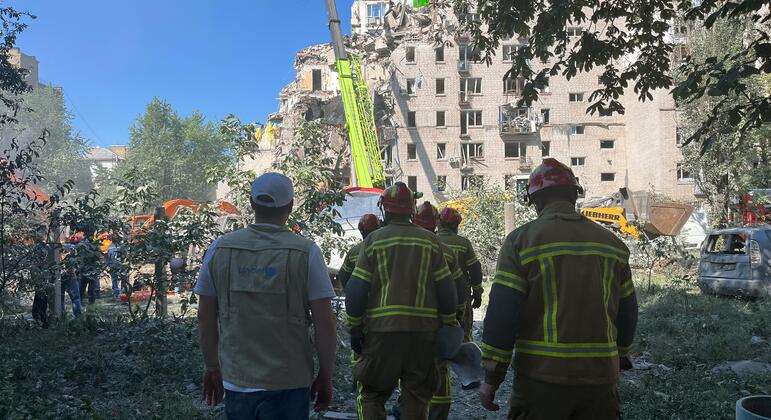
According to reports, at least 18 people died in the capital, where densely populated residential areas sustained significant damage and several neighbourhoods had to be evacuated.
“Search and rescue operations are ongoing to save people trapped beneath the rubble of collapsed residential buildings, including a 15-year-old girl and her family,” said Matthias Schmale, the UN’s top aid official in Ukraine.
In a statement condemning the violence, Mr. Schmale noted that many of Kyiv’s three million residents spent up to 11 hours in bomb shelters or taking cover at home “to the terrifying sounds of war”.
In addition to those killed in Kyiv, nearly 90 people were injured, including several children, in what the city’s mayor described as the “most massive attack”, while national media reported apartment blocks and a hotel set ablaze.
Medics hit
Among those injured were several health workers and ambulance drivers after an ambulance station was struck and several vehicles were damaged.
Nearly every part of the capital sustained damage, Mr. Schmale explained, with multiple homes, a hotel, market and other civilian facilities destroyed or damaged.
Between December 2025 and May 2026, civilian casualties increased by 40 per cent compared with the same period a year earlier, according to the UN Human Rights Monitoring Mission in Ukraine.
Deadly pattern
“Civilians in Kyiv and across the country should not be bracing for yet another attack; they are protected under international humanitarian law,” Mr. Schmale stressed.
He noted that the latest attacks on densely populated areas across Ukraine are part of a “continuing deadly pattern”, while in Russia and occupied Ukrainian Crimea, a growing number of swarm drone attacks attributed in media reports to Ukrainian forces have caused major disruption to oil facilities and closed Moscow airports.
Across Ukraine, aid organizations provide emergency support to nearly one million people affected by strikes by Russia, whose full-scale invasion began on 24 February 2022.
This vital relief includes first aid, shelter, protection, cash assistance and mental health support – a widespread but largely unseen consequence of the war.
“The loss and fear caused by this and every other attack intensify the psychological trauma countless people have to bear,” said Mr. Schmale. “The longer the war goes on, the deeper these invisible scars become.”
Secretary-General António Guterres strongly condemned the overnight attacks and reiterated his appeal for urgent de-escalation, leading to a full, immediate and unconditional ceasefire.
“Any attacks against civilians and civilian infrastructure, wherever they occur, are a clear violation of international humanitarian law and must stop immediately”.
‘Another night of horror for families’
The UN Children’s Fund (UNICEF) is also deeply saddened by reports of a seven-year-old girl killed in the Dnipro region on Thursday.
Speaking to UN News after visiting some of the affected sites, UNICEF Chief of Communications and Advocacy Toby Fricker described the severe damage he’d witnessed to residential buildings and a nearby kindergarten.
Mr. Fricker said that “spending nights in shelters during the war in Ukraine is having a serious impact on children’s well-being”. Many families lack nearby shelters and must travel or seek safer places like metro stations, which has become a normalized but abnormal part of life after years of war.
