

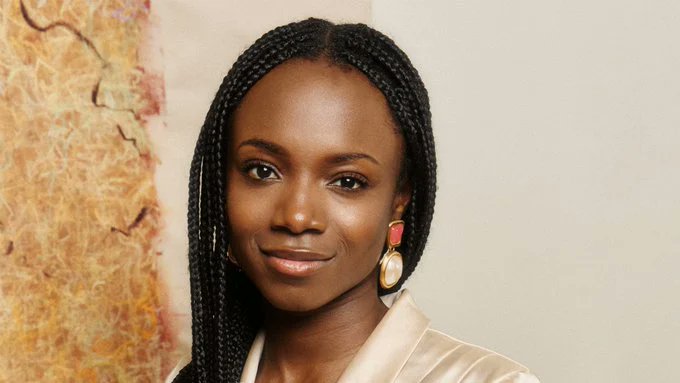
Nigerian-American engineer Yinka Ogunbiyi has secured $7 million to commercialise HaloBraid, a robotic salon device developed to reduce the time and physical effort required to braid textured hair.
The seed funding round was led by Seven Seven Six, the venture capital firm established by Reddit co-founder Alexis Ohanian. AlleyCorp and Bling Capital also participated in the investment.
The capital will support further product development, manufacturing preparations, professional testing and partnerships with salons ahead of the device’s planned introduction later in 2026.
HaloBraid is designed to work alongside professional braiders rather than perform an entire hairstyle independently.
The stylist separates the hair, introduces any required extensions and begins each braid manually before transferring the unfinished portion to the device.
The machine then completes the repetitive three-strand section from the middle to the end of the braid. According to Halo, the device can perform this stage up to five times faster than a stylist working entirely by hand.
The technology currently supports conventional box and knotless braids but cannot create cornrows, work directly against the scalp or determine the artistic pattern of a hairstyle.
This limitation keeps the hairstylist at the centre of the service while transferring the most repetitive part of the process to the machine.
Ogunbiyi developed the idea after attempting to braid her own hair during the COVID-19 lockdown. The process took four days and prompted her to examine whether engineering could reduce the time associated with professional braiding.
Her team subsequently produced more than 600 prototypes while studying how different materials and mechanical systems could handle human hair without excessive pulling or discomfort.
Ogunbiyi is a biomechanical engineer with bachelor’s, master’s and MBA degrees from Harvard University. Before establishing Halo, she co-founded Desora, a consumer-hardware company where she worked on patented smart cooking appliances.
The investment gives Halo the resources to move from product development into commercial deployment within a global salon-services industry estimated at approximately $270 billion.
Long braiding appointments limit the number of customers stylists can serve in a day. They also expose braiders to repeated hand and wrist movements associated with fatigue, carpal tunnel syndrome and early-onset arthritis.
Reducing a six- or eight-hour appointment could allow salons to increase customer turnover without requiring stylists to work longer hours. Alternatively, braiders could maintain their existing income while reducing the physical strain associated with each appointment.
The product has attracted interest from thousands of professional stylists and salons across major American cities.
Halo plans to provide the device to participating professionals without an upfront purchase price and earn a percentage of the revenue generated from HaloBraid appointments.
The model could reduce the financial barrier to adoption because salon operators would not need to make a large initial investment.
However, its commercial success will depend on the percentage Halo collects, maintenance requirements, reliability and whether customers accept machine-assisted braiding.
The company will also need to prove that the device can produce consistent results across different hair textures, braid lengths and salon environments.
For investors, HaloBraid represents an attempt to introduce robotics into an underserved segment of the beauty industry. While substantial capital has entered skincare, cosmetics and general haircare, textured-hair tools have received comparatively limited technological investment.
The device’s advantage lies in addressing a clearly defined operational problem rather than attempting to replace the entire salon experience.
HaloBraid is expected to begin appearing in selected salons in September 2026. Its performance during the initial rollout will determine whether the technology can move beyond novelty and establish a scalable business within professional haircare.
