

Websites have long kept personalized information about their customers, and it can be useful. Bath & Body Works might alert you to a sale on its three-wick candles, or your local theater can tell you when the musical Six comes to town.
Few shopping sites have more information about customers than Amazon — currently on day two of its October Prime Day sales — which knows your book preferences, your shoe size and even which cereals you might buy at Whole Foods. But there’s something unnerving about seeing your Amazon personal purchase history distilled into a dossier of factoids — especially when some of them are wrong.
The Amazon About You page, a list of facts the company gathered from your purchases, made the news Tuesday after a post by Threads user fangirlinmegan was picked up by TechCrunch. In the Threads post, the user points out that, in addition to Amazon knowing that she “prepared for a Bluey-themed 2nd birthday celebration” and “consistently repurchases cat hairball treatment,” the giant shopping site has declared, under product preferences, that she “has flat buttocks.”
“I mean it ain’t wrong, but damn did you have to call me out like that?” she wrote on Threads.
How to find out what Amazon knows about you
Naturally, that sent other Amazon customers running to check out what personal data Amazon’s About You page keeps about them. It’s easy to find.
On your phone, log in to Amazon, tap the icon that looks like a little person (or chess pawn) in the bottom menu bar, then tap “shopping preferences,” then “about you.”
On a laptop or desktop, log in and hover over where it says “Hello” and shows your name in the upper-right corner of the page. Click on “account” under the “your account” heading, and then look far down under “ordering and shopping preferences,” and click on “your shopping preferences.” Once there, scroll down to “manage your information” to see your Amazon About You page.
An ‘established coffee routine’
My personal Amazon dossier was pretty boring. It knows that I “consistently replenish household essentials,” which was probably gleaned from my recurring Subscribe and Save orders for Bounty paper towels and Charmin. It knows what city I live in and that I have one child, though it underestimated said child’s age by almost a decade.
It knows my family is “invested in the Apple ecosystem.” (Yes, and ouch.) Actually, my little summary makes me sound pretty classy. I did not know that my devotion to coffee and reading meant that I had an “established coffee routine” or that I “value classic and literary fiction.”
I also apparently “maintain a comprehensive beauty routine.” If “comprehensive beauty routine” means slapping on lipstick when I remember, and occasionally trying out a free foundation sample from Sephora… nailed it!
A fish called Ziggy
I may be boring, but other people have fairly hilarious Amazon dossiers. CNET Editor-in-Chief David Katzmaier shared a screenshot of what Amazon knows about him, and hoo, boy, did it really dig deep into his aquarium situation. The e-commerce behemoth knows he has a fish tank with a waterfall and a pond with goldfish that eat only algae, owns a snail, has a fully grown blue crayfish and even has a betta fish with bent fins.
It’s intriguing to track how Amazon garnered this information. If you buy fish accessories, just like I buy coffee and books, it’s not a huge leap to figure out you own fish. But the specificity (bent fins? the color of the crayfish?) is a bit shocking to see.
Most entertaining on Katzmaier’s list is Amazon’s confident declaration that he “owns a goldfish named Ziggy.” How exactly would it know the name of a goldfish? I can see how it might know the name of a cat or dog, as people do order ID tags, personalized beds or even Christmas stockings for their furry friends. But for a fish? And to make it more intriguing, he says the goldfish is not named Ziggy. But he knows where Amazon might have picked up that idea.
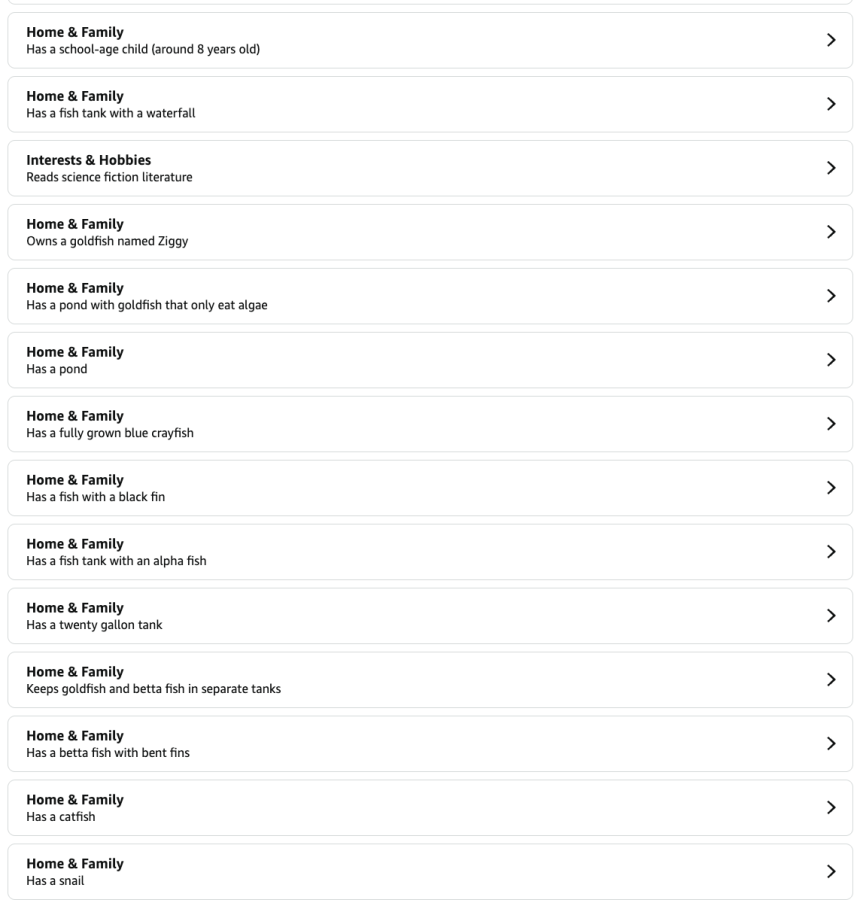
“We don’t actually have any fish named Ziggy, but my kid changed one of our Alexa smart speakers’ wake words to ‘Ziggy’ so I think that explains it,” he said. “The rest of this list is accurate.”
Amazon isn’t exactly hiding that it collects and curates this info. An Amazon representative pointed me to an article published in May on the company’s Amazon News site that shows and explains the preferences page.
And if you don’t want Amazon thinking about the shape of your butt, or are seeking privacy for Ziggy the goldfish, you can make those changes. I found it easy to delete or update some of the information Amazon had on me that I didn’t want used for personalization. Once you’re on your preferences page, clicking a specific statement lets you delete it.

See full bio
