

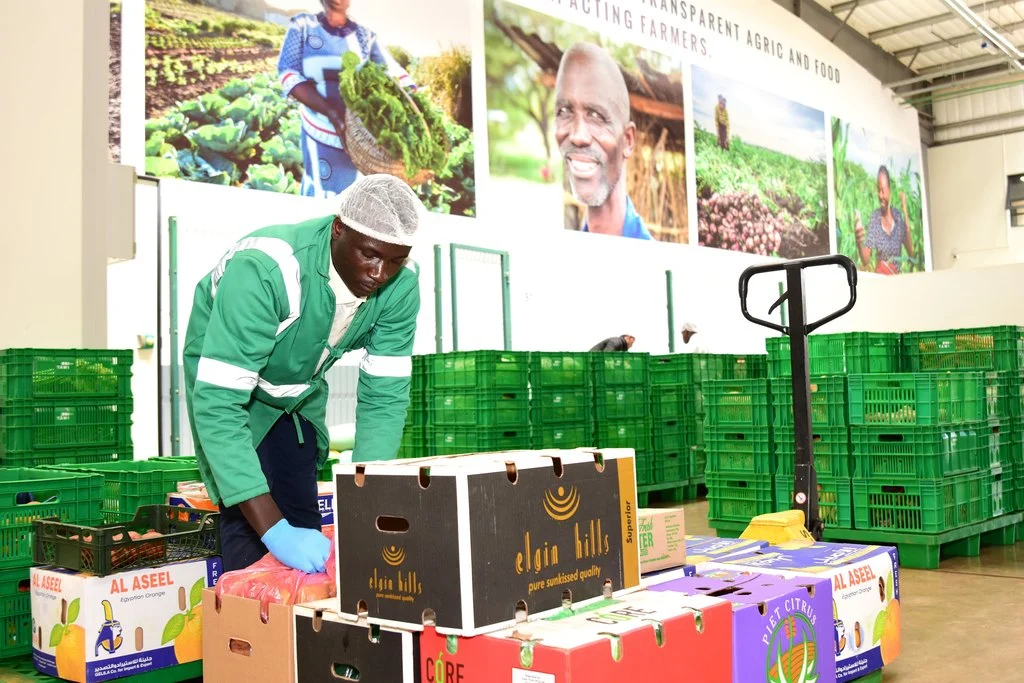
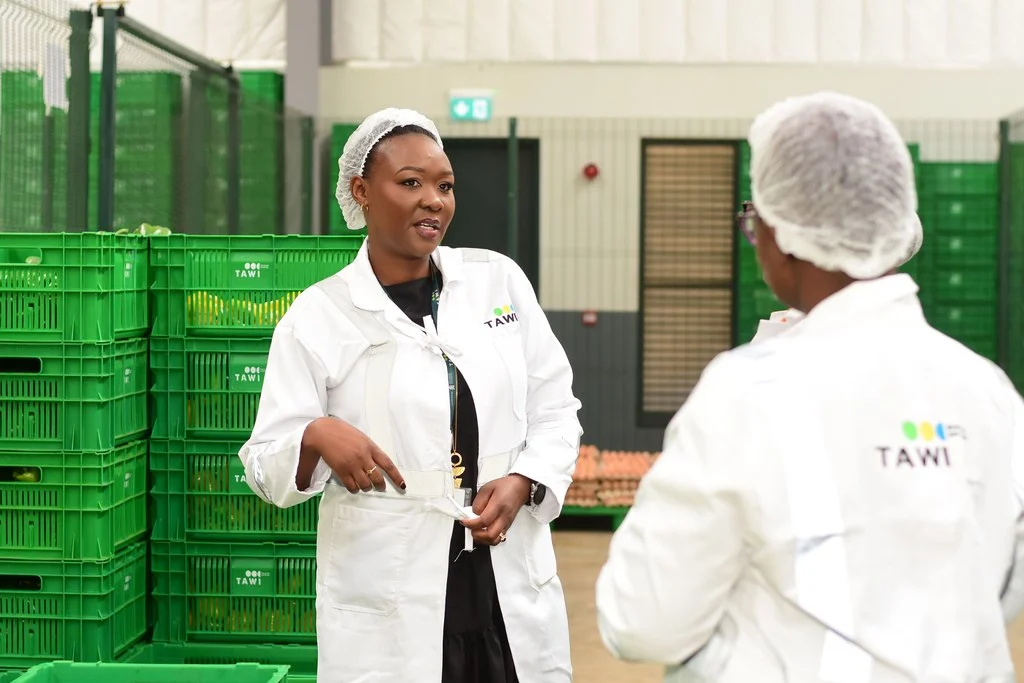
The trouble with arriving 15 minutes late to see Cherotich Rutto, Tawi Fresh founder and chief executive, is that she has the air of a strict school principal who would have noticed at minute one. That is before she says a word. It’s raining on Wednesday when I climb the stairs to her office, one flight above the working floor of the agritech’s godown in Tilisi, a mixed-use development 24 kilometres west of Nairobi.
We first met in Copenhagen in August, where she was speaking about climate innovation and resilient food systems. In Tilisi, she tells me about the sausages her grandmother, a nursery school teacher who raised her and her sister in Nairobi’s Lang’ata, could afford at the end of the month. There was also fresh produce from Taita Taveta, where her grandmother came from. She taught Rutto to pay attention to where her food came from.
“Banking came to me,” she says. She had studied economics and figured she would sell bank products for three months while she waited for an economist’s job. One month became another, and she went on to hold roles at Barclays and Standard Chartered Bank.
By the time she was pregnant with her first child, she and her husband were making weekend trips to their farm in Nanyuki. They put their savings into it and imagined handing it down to their children. When things went badly, they talked about it for the whole three-hour drive home. They lost money, but those weekends helped shape Tawi Fresh, which now supplies hotels, restaurants, schools, and other institutional buyers with produce from farmers.
We spend close to an hour talking about her grandmother, leaving the bank, what she learnt on those drives home, and building Tawi Fresh.
This interview has been edited for length and clarity.
Where did you grow up, and what sort of girl were you? Who from those days would say you haven’t changed a bit?
I grew up in Lang’ata. I was a very responsible girl growing up because I was raised by my grandmother. Who would say I haven’t changed? Everyone I went to primary school with. I think even high school. I’m just who I am.
One of the lessons my grandmother taught me was that you have to be authentic. In everything I do, everything I say, the way I behave and interact with people and build relationships, I’m very authentic. I think that was at the core of how I was raised. Very few people, if any, would say Chero has changed.
How did people talk about money in your house growing up?
There were no conversations around money because we didn’t have money. It was more like, when we get the money, then let’s have a conversation.
My grandmother was a nursery school teacher at a church in Lang’ata. She’d finished raising her own children, she had a small house she was renting, and now here we were, my sister and I, two grandchildren brought to live with her. The conversation was, “If we get the money, what are we going to do with it?” I remember at the end of the month we knew we’d get to eat a sausage. That’s what we talked about. When we get money, what are we buying?
What drew you to banking in the first place? Was there a point when you thought, “I could happily do this for the rest of my life”?
Banking came to me. I studied economics and after I finished, I was like, “What jobs do economists do?” Like many of us back in the day, I took my CV everywhere. All the banks, government offices, private companies. Then I got a call from an international bank.
I did the interviews and they said they were going to hire me. I’ll never forget walking into the room. There were almost 300 of us. In my head I was like, “As an economist, am I going to lead all these people?” Then they said, “Welcome to the bank. You’ve all been hired as sales agents.”
They would pay us a retainer for the first three months and after that it was all commission. I went home very clear that I’d be there for three months while I waited to hear back from one of the economist jobs I’d applied for. By month three, I wasn’t doing badly. I was performing, so I thought, okay, let me do month four. Then there was month six. Seventeen years later, I found myself still there.
You grew up in the city. Where did your interest in farming come from?
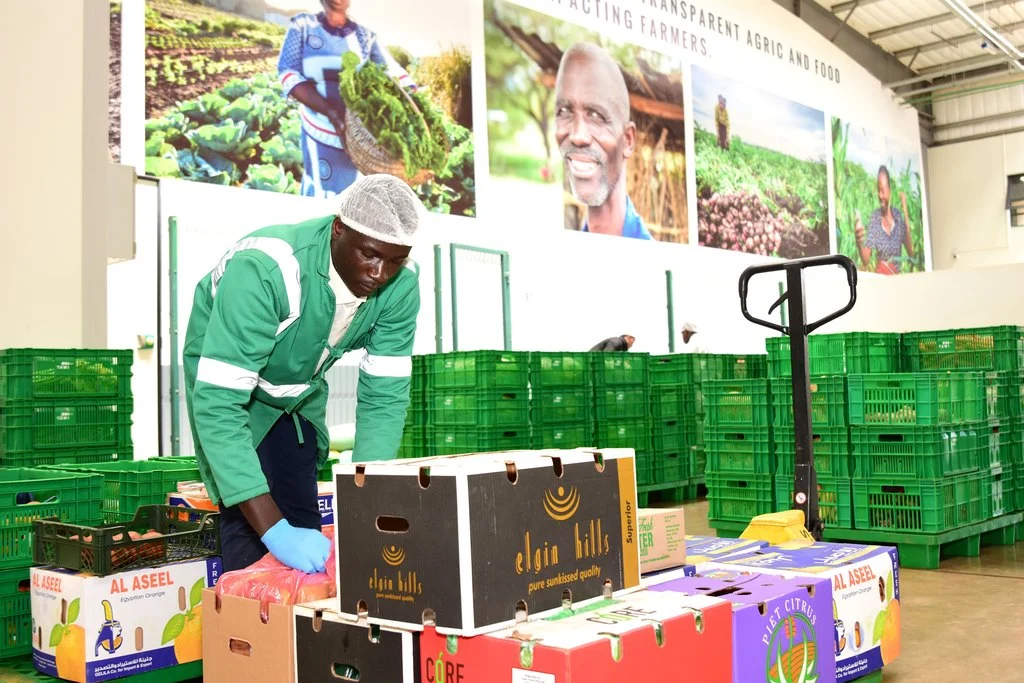
I’d trace it back to my grandmother. She taught us the value of food. She came from a farming background in Taita Taveta and there was always produce coming from there. She’d tell us, “Look at this produce. It’s good food, it’s healthy, and you know where it’s coming from.”
Growing up, we didn’t have those luxuries. We didn’t need meat every day. What could you have instead? We had spinach, we had sukuma. For me, it started with understanding what good food does for us. Then you start asking where the food comes from and how it’s grown.
You and your husband used to drive to the farm in Nanyuki after a week at work. On the drive home after a bad weekend, did you talk about what went wrong or agree to leave it at the farm?
The whole three hours you’re talking about it. You can imagine, we were putting in our savings. We were putting in everything. I’ll never forget those drives to and from the farm when I was pregnant with my first child. You’re thinking, of course, that you’re building a future for this child. One day they’ll grow up and you’ll be able to say, “This is a farm that produces this much, makes this much money, and we can hand it over to you.”
It never came to be. We made a lot of losses. So yes, the conversations were very tough. What kept us going was that we were both passionate about farming. To meet somebody who had the same passion was unusual for me. We both wanted to farm, and we were clear that it had to make money. We wanted to build an agribusiness. We said we had to make it work. But it didn’t work.
What did you miss about banking once Tawi became your full-time job? What were you relieved to leave behind?
The training, the mentorship, the leadership I encountered throughout my time at the Bank. There were leaders who truly believed in my capabilities, even in situations where I didn’t believe in myself as much. They picked me out from the crowd and gave me room to learn and grow.
The bank was also a good training ground. I still apply what I learnt there. You’re making money, yes, but you also have to look at the risks involved in doing business. And I miss my friends. I made good friends at the bank who are still my friends today. I treasure those friendships.
What I don’t miss is the routine. At the bank you know that if you do something a certain way, you’ll get a certain outcome. As an entrepreneur, every new day brings a new challenge and you have to tackle it differently. Entrepreneurship is building my resilience. The bank taught me discipline.
When you pitched Tawi to the Bank’s venture arm, what made the bankers hesitate? When you took the same idea to farmers, what made them hesitate?
It’s a global institution with a very strong brand. The difficult part was getting everybody around the table to understand a sector like agriculture in Africa, how much it contributes to our economies, and why it was worth investing in. I also had to make the case for the impact we could have, which to me went beyond whatever income we would make. It took a bit longer to convince them that this was the right space to invest in.
The farmers just thought we were jokers. That’s the reality. They thought we’d come and go. They’d seen people come and sell them a big story, even train them on how to grow crops and improve their yields. Then the farmers would produce their best onions and nobody would come back to buy them or tell them how to sell them.
We went to them and said, “We have demand for your onions. This is how we want you to grow them for this particular customer.” We started with demand. Once they saw that, the hesitation slowly faded. A school, a hospital or a restaurant places predictable orders. If you serve steak and mushrooms, you need someone producing mushrooms consistently throughout the year. Farmers can plan around that. They were like, “We know how to produce. What we need is the market.” That’s what they loved.
Do you remember the first order that made you think Tawi might actually work? What had the kitchen ordered, and how did you find out they wanted to buy from you again?
The first order came on September 22, 2022. We were still testing the market with about 20 businesses. We had a school, a caterer, a hospital, a restaurant. We wanted to understand what each of them needed.
The first order was from a caterer. It was about KES 3,600, I think. We were just excited that somebody trusted us enough to place an order. What we hadn’t anticipated was what it would sound like when we called a farmer to fulfill it. It was a kilo of onions, a kilo of tomatoes, I think a kilo of lemons, some carrots, some dhania. We called this guy we’d signed up and said we were ready. He was like, “One kilo? One kilo of tomatoes? Are you guys serious? You’ll come from Nairobi for that?”
We were doing the pickups ourselves then because we wanted to build trust with the farmers. I spent the whole night at the aggregation centre at the HCD,at JKIA , waiting for the order to go out the following day. I still have photos from that night.
Then the customer paid and ordered again. That showed us we were getting something right. One of the products wasn’t quite up to standard, and it also became clear that we needed a lot more demand if we were going to build trust with farmers. But they’d come back.
What difference has Tawi made to what farmers earn?
What we’ve seen is that farmers are making three times as much income after they join Tawi as they did before.
A broker can turn up with cash when a farmer needs it most. What do you understand better about brokers now that you’re in the business yourself?
You cannot do it without brokers. They’re there to stay. They’re a vital part of the ecosystem and they were there long before Tawi or any other platform existed. In some situations you have to find a way to work with them.
A broker comes and says, “I have cash. You can take it now.” Tawi says, “I’ll pay you after seven days, this is the quality I need, and I’m not going to pick everything.” Over time farmers have understood our standards. What they appreciate is the consistency. They know we’ll take a certain number of kilos every week throughout the year, so they can plan.
A farmer can set aside part of the farm for Tawi and still grow for the broker they’ve always worked with. That broker gives them cash to keep things moving on the farm. That’s how we’ve managed to coexist. Everybody has their space.
As Tawi grows, what gets harder about serving both kitchens and farmers?
You have to keep the buyer happy with consistency,traceability, timely deliveries and transparent prices. On the farmer’s side, you have to keep engaging with them about what buyers are looking for. That’s the data farmers lack. We can share it with them and help them grow for that demand.
For me, the most important thing is the Tawi team. As you grow, the team’s skills and discipline have to grow too. You need people who can keep giving buyers good service, keep talking to farmers and deliver on what you set out to do.
What did your family have to get used to when you became a founder? Is there anything they still tease you about?
A lot of travel. A lot of meetings. My children are like, “Another meeting? Another meeting after office hours?” At the bank it was properly eight to five unless there was an office function. Now as an entreprenuer, you might be talking to a customer or trying to close a deal with a partner or an investor early in the morning, late into the evening or over the weekend. However, I still create time for the people who are important to me, that is my husband, children, family and close friends. If you meet my friends, they’ll tell you I never miss my boys’ soccer games on Saturdays. Anybody who knows me knows not to book a meeting after that or I won’t show up. I set aside time to be with my children and family. I want them to feel I’m still part of their lives.
You went into farming to earn a little more. What do you want out of life now?
I want a lot more. [Laughs.]
I didn’t realise I had this in me. There are mornings when I wake up and think, “Oh my God, being an entrepreneur is tough?” Then a farmer comes and tells you what Tawi’s business model has done for them and their family and it humbles you instantly They say, “I wouldn’t have done it if you hadn’t come and shown me there was a market for my produce.”
We have more than 2,000 farmers, and 29% are youth. You hear from someone who lost their job during Covid and moved back home, where the family had land. They found out there was a market for what they could grow. They never went back to employment. Now they’re farming and employing other people in their community.
When I hear those stories, I think that’s what I want out of life. Even if I leave entrepreneurship one day, I’ll know one or two people’s lives changed because of the business we built. I can sleep easy with that.
