

At first glance, the Aria EV looks not much different than any other student-built electric prototype—no different than the battery-powered cars built by engineering students from dozens of universities every year. Beneath its panels, however, is a challenge to the modern auto industry: What if electric vehicles were designed to be repaired by their owners?
The Aria project began in 2024, when roughly 20 students assembled at Eindhoven University of Technology in the Netherlands under the university’s Ecomotive team structure, which operates like a small startup. Students apply, are selected, and spend a year developing a vehicle in a setting meant to mirror industry practice.
The goal, says team spokesperson Sarp Gurel, “was to make the car as accessible and repairable as possible.” Gurel, who graduated last July with a bachelor’s degree in industrial engineering and is currently working toward a master’s degree at Eindhoven, says the Aria EV is not yet road legal. Its purpose is to demonstrate that repairability can be embedded into EV architecture from the outset. With that objective in mind, the team focused first on the most challenging and expensive component in almost any EV: the battery.
Modular Battery Design in EVs
Aria’s total battery capacity is 13 kilowatt-hours (kWh), which is far below the 50 to 80 kWh packs common in mass-market electric sedans and SUVs. The scale is closer to that of a lightweight urban vehicle or neighborhood EV, which is more appropriate for a student-built prototype focused on concept validation rather than long-range highway travel.
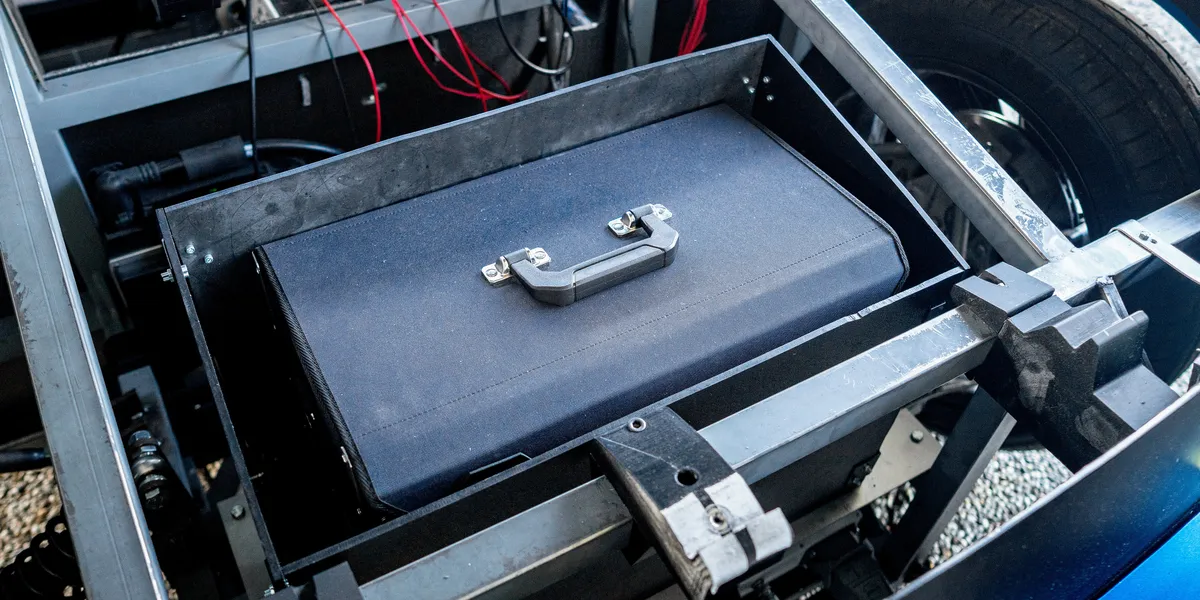
What distinguishes Aria is not the battery’s size, but its structure. Rather than housing the 13 kWh in a single sealed pack, the team divided the total capacity into six smaller modules. Each module weighs about 12 kilograms—much easier to handle than the 400 kilograms or more that’s typical of a conventional EV’s monolithic battery pack. This makes it feasible for a single person to remove, swap, and replace modules.
The modules sit in reinforced compartments beneath the vehicle floor and are secured using a bottom-latch system. When the vehicle is fully powered down, a latch can be made to mechanically release a module. Integrated interlocks isolate the high-voltage connection before a module can be lowered. This combination of hardware and software ensures that component-level replacement is straightforward and relatively safe, bringing the idea of “repairability by design” into a tangible, hands-on form. Even with this careful design, modular batteries introduce technical considerations that must be managed, particularly when integrating different modules over the vehicle’s lifespan.
Joe Borgerson, a laboratory research operations coordinator at Ohio State University’s Center for Automotive Research in Columbus, notes one complication: Mixing new and aged battery modules can create challenges. Borgerson has spent the past three years designing and building a battery pack from scratch as part of the U.S. Department of Energy’s Battery Workforce Challenge. “Our team is integrating a student-designed pack into a Stellantis vehicle platform,” he says, “which has given me deep exposure to both automaker design philosophy and high-voltage EV architecture,.”
To complement the their car’s hardware, the Aria team developed a diagnostic app that can be accessed via a dedicated USB-C port. When the user connects their smartphone, the app presents a 3D visualization on the phone screen that points out faults, locates problems, identifies the necessary tools to fix them, and provides step-by-step repair instructions. The tools themselves are stored in the vehicle. The system aims to reduce as many barriers as possible for users to maintain and extend a vehicle’s service life.
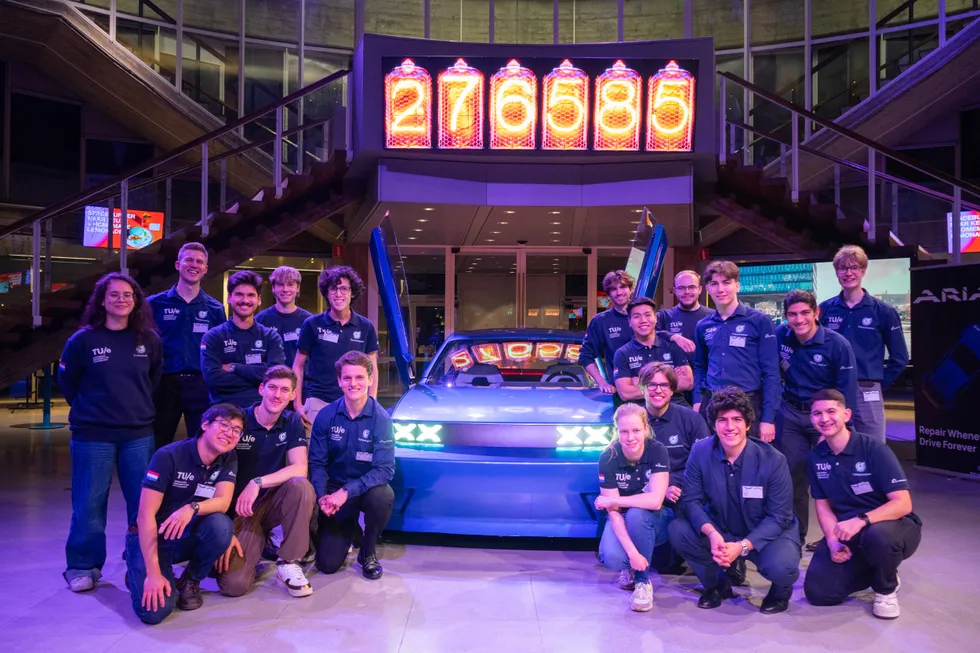 Students at Eindhoven University of Technology unveiled their Aria EV prototype in November.Sarp Gürel
Challenges of EV Modularity
While Aria prioritizes modularity, the broader EV industry trend is toward integrated, interdependent systems that simplify manufacturing processes and cut costs. This trend is true for the structural battery packs for EVs as well.
Unlike mainstream EVs, Aria treats energy storage as a replaceable subsystem. Whether it scales economically and structurally to larger, highway-capable EVs remains an open question. But designing a vehicle for repairability involves tradeoffs that ripple across every system in the car.
Borgerson says that dividing systems into removable units adds interfaces—mechanical fasteners, electrical connectors, seals, and safety interlocks. Each interface must survive vibration, temperature swings, and crash forces. More interfaces can mean added mass and complexity compared with tightly integrated battery structures. And these components take up space that would otherwise be used for energy storage.
Matilde D’Arpino, an assistant professor of mechanical and aerospace engineering at Ohio State whose research focuses on electrified powertrains and advanced vehicle architectures, notes that EV batteries are already modular internally—cells form modules, and modules form packs—but making modules externally replaceable changes validation requirements. High-voltage isolation, thermal performance, and crash integrity must remain robust even when energy storage is divided into removable segments. In other words, what seems like a simple way to make batteries user-friendly actually cascades into system-level design decisions influencing safety, thermal management, and vehicle structure.
Right-to-repair legislation in Europe and the United States could push automakers to reconsider sealed architectures for batteries and other components. Economic incentives could also emerge from fleet operators or long-term owners who benefit from replacing a fraction of a battery system rather than an entire pack. But adopting this approach would require changes across supply chains, certification processes, and service models.
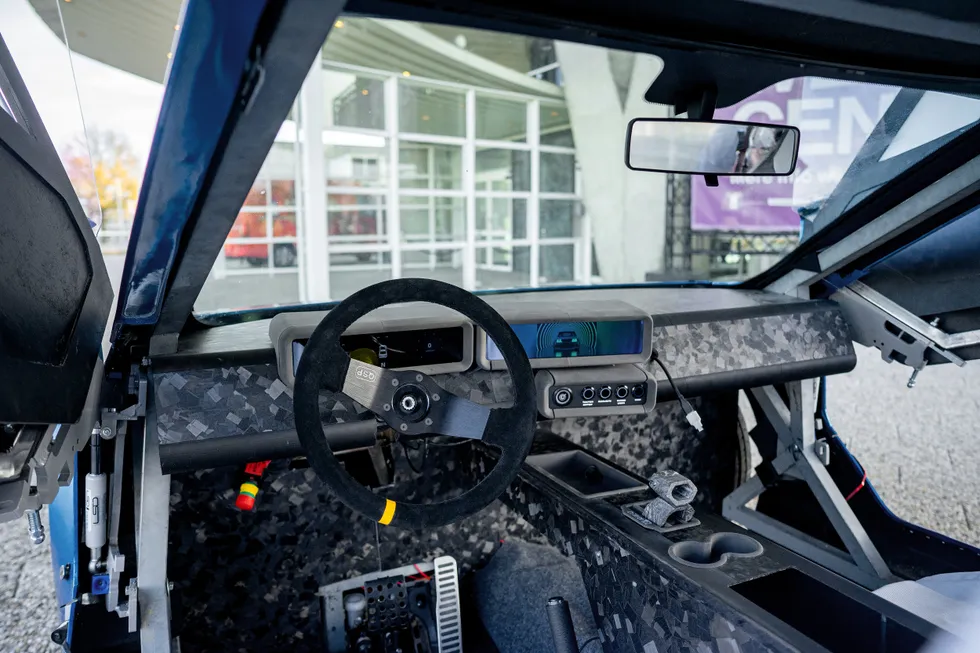 The Aria prototype isn’t ready to go toe-to-toe with production EVs, but it demonstrates some proof-of-concept ideas about repairability.Sarp Gürel
Consumer expectations are also shaping the boundaries of what designs like Aria’s can become. In the mainstream market, buyers consistently prioritize longer driving range and lower sticker prices—two factors that have defined competition among models such as the Chevrolet Bolt EV, the Hyundai Ioniq 5, and the the Tesla Model 3. Range anxiety remains a powerful psychological factor, even as charging infrastructure expands, and price sensitivity has intensified as government incentives fluctuate. Designing for modularity and repairability, as Aria does, must ultimately contend with these consumer priorities. Any added cost, weight, or complexity must be weighed against a market that still rewards vehicles that go farther for less money.
Ultimately, however, Aria inserts a different priority into the equation: repair as a core design requirement. Whether that priority becomes mainstream will depend less on whether it can be engineered—and more on whether regulators, manufacturers, and consumers decide it should be.
From Your Site Articles
Related Articles Around the Web
