

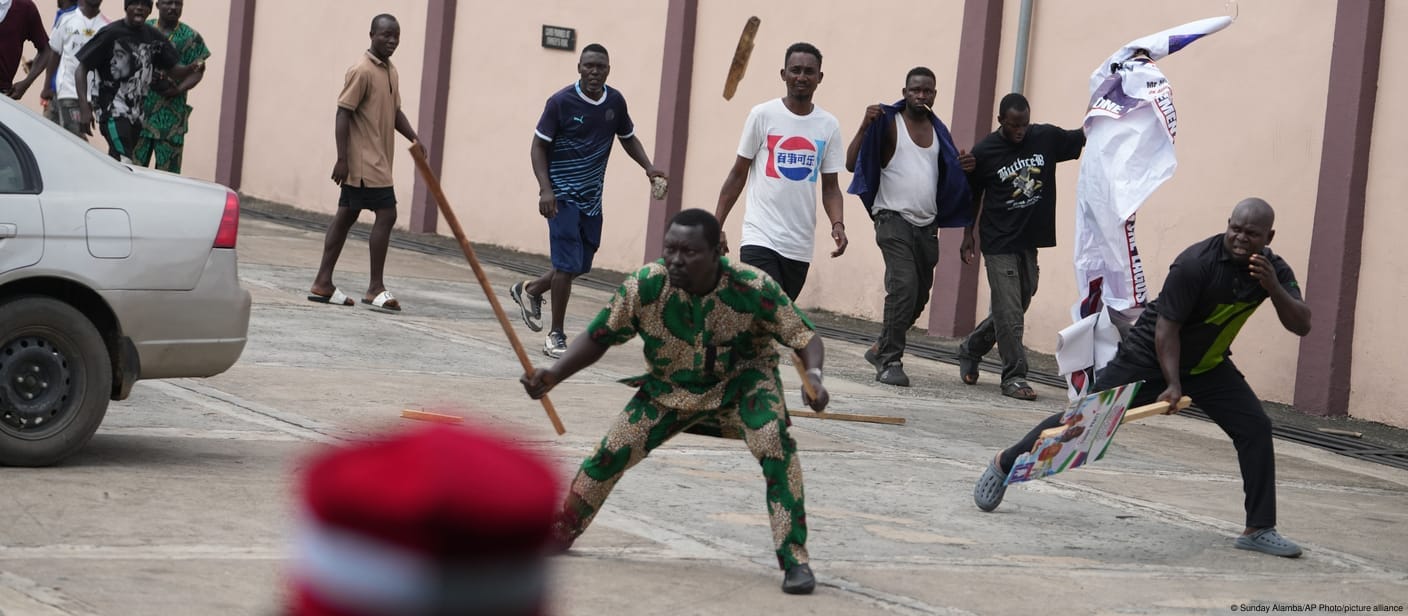
Police disclosed that two cutlasses, four knives, scissors and other dangerous weapons were recovered from the suspects.
In a related operation on November 13, another suspect, identified as Anasho, was arrested around Tunga for allegedly attacking a political campaign team and damaging vehicles, banners and other campaign materials.
A cutlass was also reportedly recovered by the police.
The Niger State Police Public Relations Officer, SP Wasiu Abiodun, told DAILY POST that the suspects were investigated and later charged to court.
However, a resident of Tunga, Saidu Bello, expressed concern over what he described as the repeated return of suspected political troublemakers to their communities after police arrests.
According to him, “Police will arrest these miscreants, only to see them walking freely in society and causing further problems in communities.”
Bello’s account raises questions about the subsequent handling of some suspects, although seeing an individual outside police custody does not, by itself, establish whether the person was released on bail, discharged or acquitted.
There have also been allegations that influential persons sometimes intervene in cases involving suspected political thugs.
The identities of those allegedly involved and the extent of their influence have not been independently established.
Opposition parties raise concerns over campaign materials
The Niger incidents have also drawn attention to complaints by opposition parties over access to public spaces for campaign materials.
In September, reports emerged that the Bida Local Government chairman, Usman Mohammed Manko, had directed the removal of opposition billboards.
One of the affected advertisements reportedly belonged to the NDC senatorial candidate, Muhammed Rabiu Sadiq.
The media team of the ADC House of Representatives candidate for Bida, Muhammad Abubakar Abacon, also questioned the removal of a billboard around the St. John area of the town, asking whether it was due to planning and approval issues or a local government directive.
Similarly, the Niger State chairman of the ADC, Hassan Musa, alleged on October 10 that the party had obtained approval to erect a billboard in Paiko, Paikoro Local Government Area, but was prevented from installing it.
The PDP governorship candidate in the state, Mohammed Mamman Nami, also alleged that Governor Mohammed Bago ordered the removal of his posters and banners after he criticised the administration.
The NDC governorship candidate, Yahaya Mohammed Adam, has also alleged intimidation and the destruction of the party’s campaign materials.
The APC, on its part, has complained about the vandalism of its campaign materials by aggrieved members and supporters.
The allegations have not all been independently verified, but they point to a wider dispute over the space available to political parties and candidates to publicise their campaigns.
Kano clash leaves five injured
In Kano State, police arrested eight suspects following a clash between supporters of the APC and the NDC in Bichi Local Government Area on November 15.
The incident reportedly left five people injured and 13 vehicles vandalised, while campaign banners and billboards were also destroyed.
Police spokesperson, Abdullahi Haruna Kiyawa said the clash occurred at about 4:45 p.m.
Items recovered included a locally fabricated weapon known as Gariyo, two cutlasses, hard sticks, a bottle containing a chemical solution and a substance locally called “Suck and Die”.
The police said the suspects were transferred to the State Criminal Investigation Department in Bompai for investigation and would be charged to court after the process was completed.
The NDC described the incident as an attack on the campaign convoy of its vice-presidential candidate, Rabiu Musa Kwankwaso, and its Kano governorship candidate, Aminu Abdussalam Gwarzo.
However, Kano State Commissioner for Information, Sanusi Bature Dawakin Tofa, disputed the claim that the incident was a deliberate attack on the convoy.
When contacted, Kiyawa told Daily Post that the investigation was ongoing and that the police would work to identify those behind the violence.
“The investigation is ongoing. We have to identify the sponsors and whatever that has to do with the case,” the Kano command’s PRO stated.
The police statement and the NDC’s account have placed the incident under investigation, but the identities of any alleged sponsors have not been publicly established.
FCT police release 78 suspects
In the Federal Capital Territory, the police announced the arrest of 78 suspects following an incident involving President Bola Tinubu’s motorcade after Jumu’ah prayers at a mosque in the Garki area of Abuja on November 13.
FCT Police spokesperson Josephine Adeh said the suspects attacked the departing motorcade with stones and other dangerous objects, damaging vehicles and injuring some security operatives.
The police said the arrests followed the initial response by security operatives and subsequent intelligence-led operations in the area.
However, the incident also generated accounts that some worshippers had booed the President and chanted slogans critical of his administration over security concerns.
The accounts of the protest and the police description of an attack on the motorcade are distinct aspects of the incident and should not be treated as proof of an organised political operation.
On November 16, the police said the President had directed the release of the 78 suspects through what the command described as presidential clemency.
Adeh said the suspects were undergoing the necessary release procedures and would be warned. The police did not announce that the suspects had been convicted of any offence.
DAILY POST sent a message to Adeh seeking further clarification on the arrests, the circumstances surrounding the release of the suspects and the status of the investigation, but she had not responded as of the time of filing this report.
The decision to release the suspects has raised questions about the handling of cases involving violence around political leaders and public officials, particularly where security operatives were reportedly injured and property damaged.
Anambra billboard controversy
A related dispute over political campaign space emerged in Anambra State following the removal of a billboard belonging to Senator Victor Umeh, which also carried the image of Peter Obi, the NDC presidential candidate.
The Anambra State Government said the billboard was not removed because of Obi’s image.
Commissioner for Information and Value Reformation, Law Mefor, said Umeh had paid the required senatorial signage fee, but Obi had not paid the separate fee applicable to presidential campaign materials.
The government maintained that the action was based on the Anambra State Signage Act, 2010.
However, the Coalition of South East Youth Leaders disputed the government’s position, claiming that Umeh had paid the stipulated N20 million senatorial campaign fee and obtained the required permit before the billboard was removed.
The group condemned the action and demanded its restoration and compensation.
The dispute illustrates how campaign regulations and their enforcement can become contentious during political competition.
While the government has cited compliance with signage requirements, the opposing claim raises questions about the application of those requirements and the circumstances surrounding the removal.
Peace Committee records 109 breaches
Beyond the individual incidents, concerns about the political environment have also been reflected by the National Peace Committee.
The committee, chaired by a former Head of State, General Abdulsalami Abubakar, recorded 109 breaches of the National Peace Accord across 26 states and the FCT between August 19 and October 27, 2026.
Its monitoring report identified 33 incidents of political violence and thuggery, 29 cases of misinformation and disinformation, 19 attacks on political activities and campaign assets, and 15 incidents involving intimidation and threats.
The committee noted that 57 of the 109 recorded breaches did not involve physical attacks, indicating that political tensions were also being expressed through threats, misinformation and other forms of intimidation.
The monitoring also showed that the concerns cut across different parts of the country, with Delta and Lagos each recording six incidents during the period under review.
The committee urged political parties to condemn violence and disown armed groups, while calling on security agencies to provide equal protection for lawful political activities and investigate those responsible for attacks.
Senate, SERAP seek stronger action
The Senate has also raised concerns over attacks on political leaders and supporters ahead of the 2027 elections.
On November 17, the Senate condemned political violence and called on the police to investigate reported attacks, identify those responsible and prosecute suspects where evidence supports charges.
The motion, sponsored by Senator Abdul Ningi, also called for stronger security arrangements and early-warning measures to prevent further incidents.
The Senate mandated its committees on National Security and Intelligence, Police Affairs, and INEC to engage relevant agencies and report back within four weeks.
Meanwhile, the Socio-Economic Rights and Accountability Project, SERAP, called on the Independent National Electoral Commission, INEC, to take stronger steps against political violence and intimidation.
In a letter dated November 14, SERAP urged the commission to obtain police investigation records, press for the conclusion of investigations and ensure that perpetrators and sponsors of attacks are identified and prosecuted where evidence permits.
The organisation also asked INEC to use its powers under Section 83 of the Electoral Act 2026 to demand explanations from political parties over reported violations.
Political analyst warns of threat to 2027 elections
A political analyst based in Minna, Bernard Mark, warned that rising hostility among political supporters and attacks on campaign activities could undermine the conduct of free and fair elections in 2027.
Mark said the political environment was becoming increasingly toxic, with animosity between opposing camps, attacks and inflammatory comments capable of pushing the country towards serious instability.
“I think we are really drifting. If there’s a lot of animosity on both sides, attacks and comments that are not supposed to be made, and it’s allowed to go that way, sincerely speaking, we may not have free and fair elections,” he argued.
He insisted that arresting suspected attackers without identifying and prosecuting those who allegedly sponsor or organise the violence would do little to discourage further incidents.
According to him, allowing perpetrators to escape accountability could encourage young people to believe that attacking opponents and destroying their campaign materials were acceptable ways of expressing political disagreement.
Mark maintained that Nigerians had the right to support candidates of their choice, associate with political parties and campaign freely.
He stated, “If you don’t like the person, don’t go there. But the issue of pulling down the other person’s poster or billboard, setting offices or vehicles ablaze is not a good development.”
He urged the government and security agencies to remain neutral in handling politically motivated violence, insisting that the law should apply to everyone, irrespective of political affiliation.
The analyst also warned that insecurity could discourage voters from participating in the 2027 elections, particularly if people feared attacks while attending political gatherings or travelling to polling units.
He said those behind the violence should be identified, arrested and prosecuted, regardless of their political connections, to serve as a deterrent to others.
Mark recalled previous election cycles, arguing that failure to hold those responsible for political violence accountable could encourage a recurrence ahead of the next general elections.
He further cautioned that political disagreements should not be allowed to turn Nigeria into a theatre of war, given the country’s large population and the potential consequences of widespread instability.
What the Electoral Act says
The Electoral Act 2026 contains provisions addressing political violence, intimidation and the conduct of political campaigns.
Section 95 requires the police to provide adequate security for peaceful political rallies and processions. It also states that registered political parties, aspirants and candidates should not be prevented from holding rallies, processions or meetings for their political activities.
Under Section 96(5), political parties, aspirants and candidates are prohibited from retaining, organising, training or equipping individuals or groups to use physical force or coercion in pursuit of political objectives.
Section 96(8) also provides penalties for individuals or groups who aid or abet such arrangements, while Section 97 prohibits threats of force or violence during campaigns to compel anyone to support or refrain from supporting a political party or candidate.
Section 83, meanwhile, empowers INEC to keep records of political party activities and demand information or clarification from parties over activities that may violate the Constitution or other laws.
However, enforcement remains a major test. Arrests of suspected attackers may address immediate incidents, but identifying those who organise, finance or direct violence is necessary to establish responsibility beyond the individuals found at the scene.
Questions over accountability
With the 2027 elections approaching, the incidents and complaints across the country have placed renewed attention on the responsibility of political parties, candidates, security agencies and electoral authorities to protect lawful political participation.
The central issue is not only whether suspects are arrested after attacks, but whether investigations establish who planned, financed or encouraged the violence and whether those found responsible face the consequences provided by law.
