

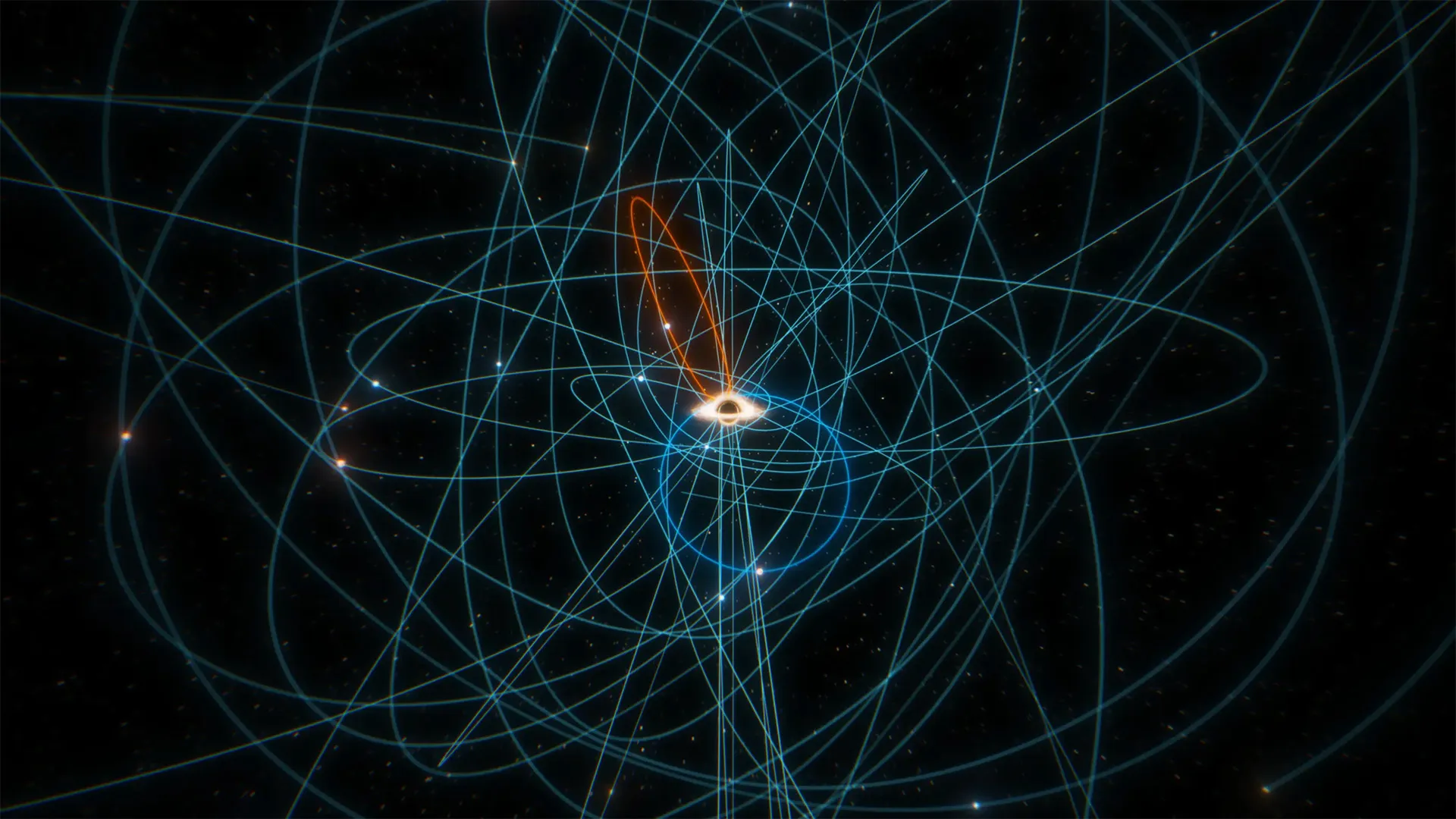
The universe is full of cool and interesting things, like black hole stars and nightmare planets that get scorched by their host star. Now researchers have found a star that moves ridiculously fast, and it’s right in our celestial backyard, whipping around the Milky Way’s supermassive black hole.
Say hello to S301, a star near the center of our galaxy that was discovered by researchers at the Max Planck Institute for Extraterrestrial Physics in Germany. It joins the massive catalog of more than 1.8 billion stars, but it has some properties that researchers believe make it special. The first, and most obvious, thing about S301 is that it’s the fastest-moving celestial object ever observed by science.
This superswift star hits a peak speed of around 15,500 miles per second, or about 55.8 million miles per hour. That happens, researchers say, after S301 accelerates as it nears Sagittarius A*, the black hole in the middle of the Milky Way, hitting that 15,500 mps mark as it makes a sharp turn to go around. It then slows as it takes a much wider loop back around to repeat its orbit.
To give you an idea of how fast that is, the prior candidate for the fastest-moving celestial object ever recorded was a low-mass star and its accompanying super Neptune planet that zip at approximately 1.2 million mph, which translates to about 333 mps.
Our solar system moves through space at about 500,000 mph, or approximately 140 mps, and the fastest human-made object ever created, the Parker Solar Probe, is cruising along at 430,000 mph. It still pales in comparison to the speed of light (186,282 mps), and the host of things that are almost that fast, like gravitational waves and black hole jets, but S301 beats out all other planets and stars observed by humans.
Lending a helping hand with black hole research
S301’s other notable quirk is its proximity to Sagittarius A* — 10 times closer to the black hole than the previous closest star, S2 — and according to the study, this is the speedy star’s true value. It’s so close that it can feel the effects from the black hole much more acutely than anything else humans know about. Researchers aim to study those effects to learn more about how black holes work.
This is important because looking at black holes is exceptionally difficult. Black holes have so much gravity that nothing can escape, not even light, so scientists have to measure the effects a black hole has on objects around it. A perfect example of this is the first picture of a black hole. You can’t actually see the black hole itself, but you can see the accretion disc that formed around it.
Researchers at the Max Planck Institute have already found and measured some of these effects on S301 and are hoping that observing and studying the star over the next decade can give them some insights about how black holes work. Since S301 is so close, researchers can test various theories that they were unable to before because no other known objects were close enough to feel these effects.
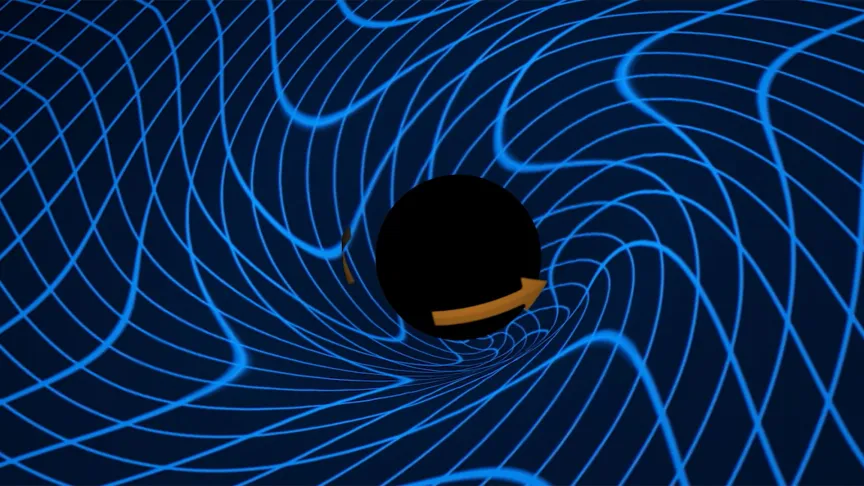
One such example is the frame-dragging, or Lense-Thirring, effect, which was predicted by Albert Einstein in his general relativity theory. It states that massive rotating objects (like supermassive black holes) drag spacetime around with them, creating a rotating wave of spacetime that can alter and interact with nearby objects.
Think of yourself standing in a swimming pool with one arm out, palm open, just below the water surface, and then spin. You’ll notice a wave form in front of your arm as your rotation pushes your arm through the water. Einstein’s theory states that rotating black holes have this same effect on the fabric of spacetime.
S301 is close enough to feel this effect, and researchers have already measured the Lense-Thirring effect on it.
“S301 is the first star to orbit directly in the region around Sagittarius A* where the frame-dragging effect is extreme,” Felix Mang, Ph.D. student and corresponding author of the study, said in a statement. “We’re not just measuring spacetime curvature; we are measuring how it gets distorted by the rotation of the black hole itself. That is unique.”
The biggest challenge to studying S301 is that it’s extremely dim, about two billion times dimmer than Betelgeuse, which is the 10th brightest star in the sky. The crew at the Max Planck Institute employed a small army of instruments and methods to detect it in the first place, including the Gravity instrument on the Very Large Telescope and the Micado instrument on the Extremely Large Telescope, both located in Chile and part of the European Southern Observatory.
