

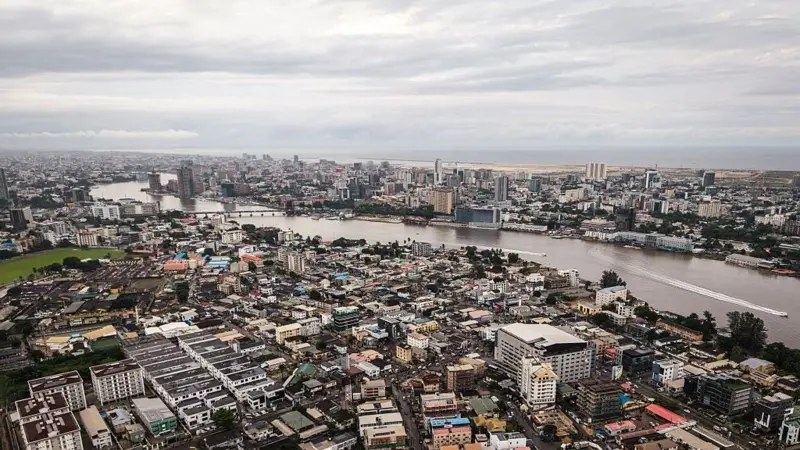

Lagos and several other major African coastal cities are sinking at rates that could worsen flooding risks, with some experiencing land subsidence of up to six millimetres annually, a new study has found.
The study, titled Sinking Cities: Latent Flood Risk in Africa’s Coastal Megacities, published on Friday, examined land movement in 20 major coastal cities across the continent using satellite radar data.
The researchers found that Alexandria, Egypt, had the highest median sinking rate of about 6mm per year, followed by Lagos, at 5mm annually.
In simpler terms, Lagos sinks by about half a centimetre or roughly the thickness of three stacked US pennies every year, according to the study.
Luanda, Angola, was also sinking significantly, at approximately 3.8mm per year.
The findings showed that the sinking rates in Alexandria and Lagos were substantially higher than those represented in the 2021 estimates of the United Nations’ Intergovernmental Panel on Climate Change.
Oluwaseyi Dasho led the study, alongside Manoochehr Shirzaei, Leonard Ohenhen, Sonam Sherpa and Rafael Almar.
He said “the effects of subsidence are often invisible in everyday life, but over decades they can substantially increase flood exposure.”
The researchers warned that the combination of sinking land and rising sea levels could expose more than seven million people, over one million buildings and assets worth approximately $180bn to flooding across the 20 cities by 2050.
“Lagos emerges as the most vulnerable city in terms of population exposure, with its 7.2 million low-lying residents exposed to 2.59 million in 2020, increasing to 4.07 million by 2100,” the study said.
“Alexandria also shows high exposure, with 1.89 million people at risk in 2020 (44% of its low-lying population), rising to 2.26 million by 2100 (52%).
“Other cities with significant exposure include Monrovia, Douala, Abidjan, and Dakar, with Douala experiencing the sharpest increase, from 480,115 in 2020 (21%) to 797,699 by 2100 (35%). In contrast, Mogadishu, Mombasa, and Cape Town exhibit relatively low exposure; for example, Mogadishu had only 9,136 exposed individuals in 2020 (4.5% of its low-lying population).
“The lowest exposure rates occur in Djibouti, Durban, and Tripoli.”
It was found that the extent of land subsidence varied considerably within individual cities, with some neighbourhoods sinking faster than others.
In Lagos, the researchers identified comparatively stable central districts, while the rapidly urbanising eastern and western outskirts experienced accelerated subsidence.
They attributed the pattern to possible factors including unregulated groundwater extraction, the weight of buildings on unconsolidated alluvial sediments and the settlement of reclaimed land.
The researchers used data from the European Space Agency’s Sentinel-1 satellites to measure vertical land movement across the cities.
The satellites use radar signals that bounce off the Earth’s surface and return to the spacecraft.
By comparing signals collected during repeated visits, scientists can detect even small changes in land elevation.
The study identified excessive groundwater extraction as a major contributor, explaining that removing too much water from underground can cause soil layers to compact and the land surface to sink.
The researchers recommended measures such as providing alternative water sources and adopting less water-intensive agricultural practices to reduce some of the human-driven causes of subsidence.
Shirzaei said, “Whatever we cannot mitigate, we try to adapt to it.”
He explained that adaptation could involve building flood defences or relocating critical infrastructure to higher ground.
