

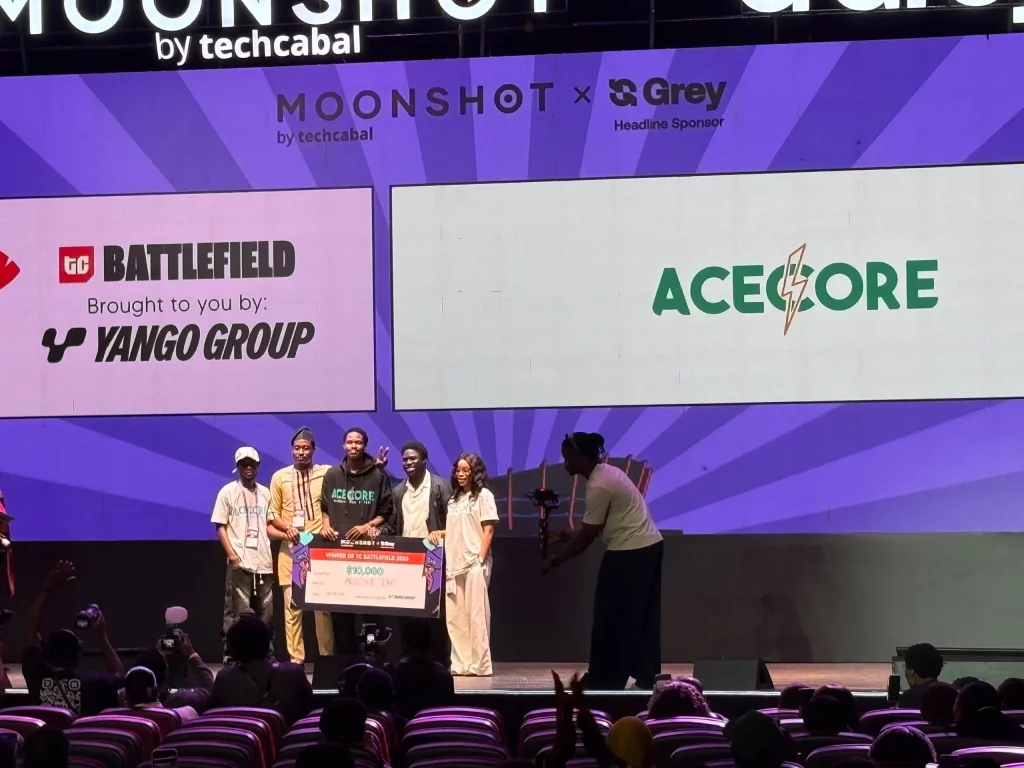
A battery manufacturer, a lender serving small retailers, and a developer of underwater robots took the top three spots at TechCabal (TC) Battlefield during Moonshot in Lagos on October 29. Two of the three winners are building hardware in a country that relies heavily on imports for its technology products.
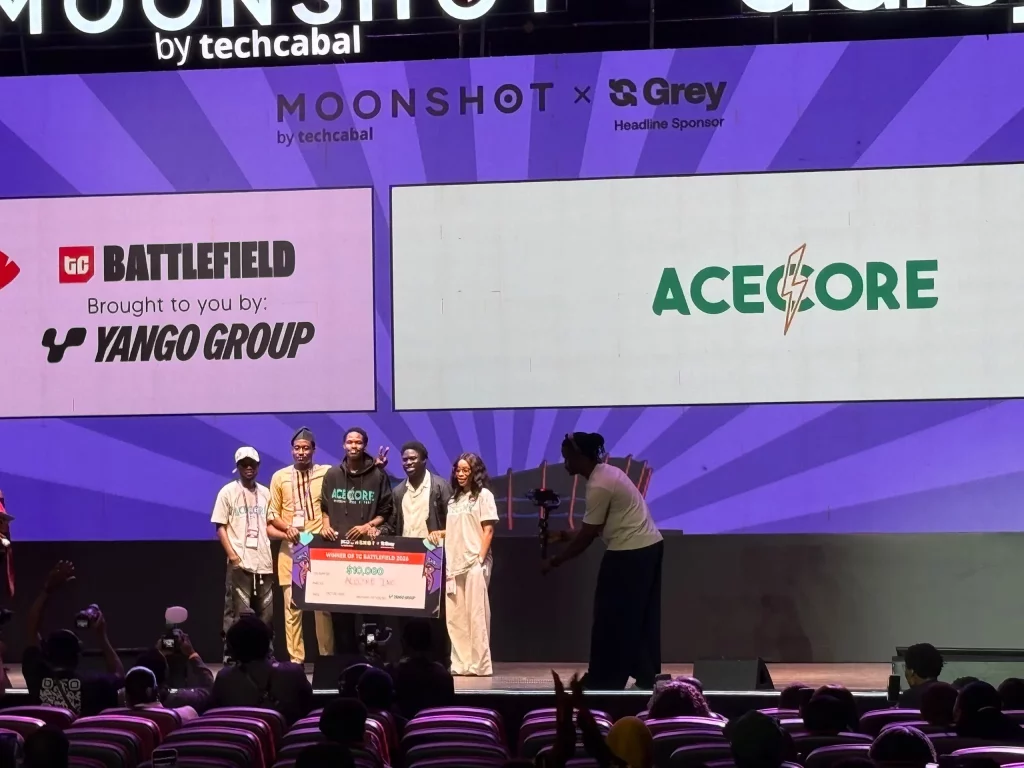
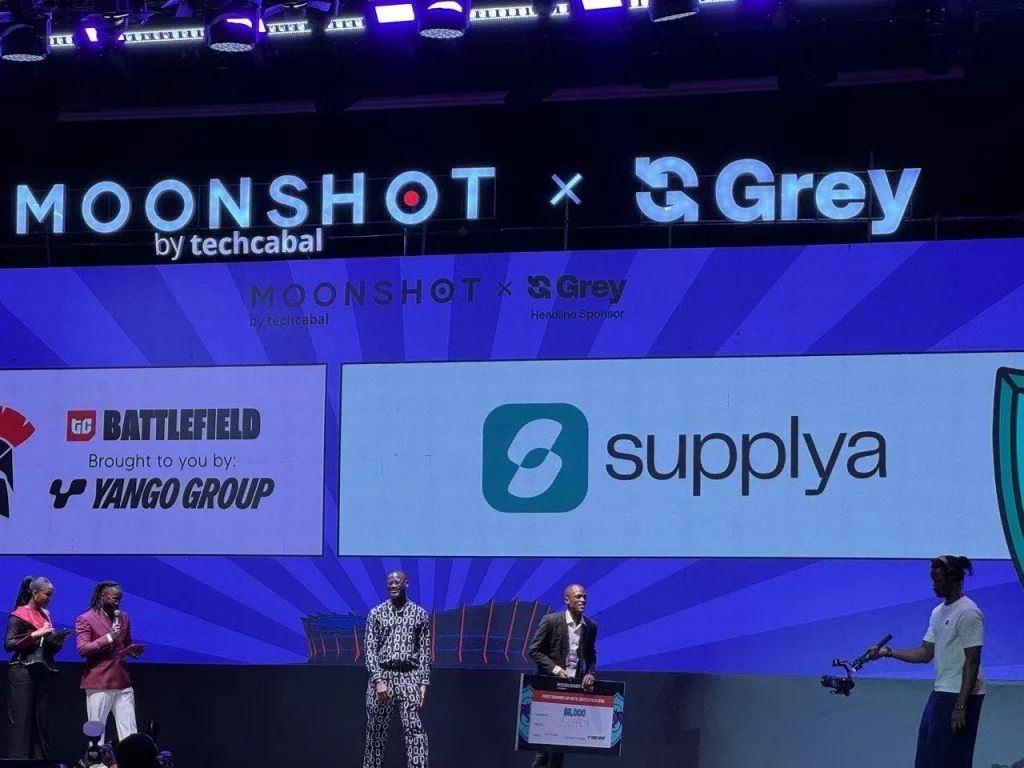
The annual competition brought ten startups before a panel of judges to pitch their businesses. Acecore won the $10,000 first prize, followed by Supplya, which received $5,000, and Navidyn, which took home $2,500. Supplya and Navidyn also earned places in Antler’s residency programme, giving them access to a potential $250,000 in pre-seed funding.
Acecore
Acecore started in Oyigbo, a town in Rivers State, where founder Caleb Iwuoha, an agricultural engineer with certificates in electrical and mechanical engineering, was assembling battery systems in a shed in 2024. He says monthly output has grown from 8kWh to more than 320kWh, and the company now runs a workshop and showroom. Iwuoha told the judges the casing and battery software were “all built here in Nigeria by our very own hands.”
The PowerCell is a battery backup that stores electricity from the grid or solar panels and powers a home or business when the grid goes down. A wall-mounted cabinet holds the battery, an inverter that turns the stored power into the kind of power appliances use, and a charge controller that protects the battery from overcharging.
Most buyers would otherwise wire those parts together separately or run a generator. An app called PowerCore tracks consumption and flags maintenance. A 5kVA, 10kWh unit, which can power several appliances at once while holding 10kWh of energy, starts at $5,250, and Sterling Bank, SunFi and Earthbond finance customers who cannot pay upfront. The company holds MANCAP certification and says it has $164,000 in purchase orders from buyers including Chopbox, PartyRice and Skydiamond Homes.
It names Lumos and Greenage Technologies among its rivals and says it undercuts the market by 10% to 20%. Its own comparison, $5,250 against $6,200 for a competitor’s cabinet of the same size, works out at roughly 15%, and one judge noted that imported Chinese systems land in Nigeria at a similar price. Iwuoha put his margin at 62%, leaving about $2,000 to build each unit.
The stronger case is local manufacturing in an imports-heavy market. Nigeria imported 1,721MW of Chinese solar panels in the year to June 2025, the second-highest in Africa, according to Ember.
Acecore does not say where its battery cells come from. The company projects 170 units and $892,000 in revenue for 2026, a figure that is consistent with its stated unit price. But it also reports $2.58 million from 340 units over ten months, implying a much higher average price than its own pricing supports. At its stated price, those 340 units would generate closer to $1.79 million. The $138,000 it reported for 2025 represents local purchase orders (LPOs)—commitments from buyers to purchase, not cash the company has collected.
Supplya
Founded in 2021, Supplya is led by chief executive Opeyemi Kehinde, who has a decade of experience in sales operations, and chief operating officer Joy Adeniran, an e-commerce entrepreneur.
It began as a marketplace where small retailers order directly from manufacturers and pay 30 days later at no interest. Chief technology officer Osama Okunbo previously worked at Access Bank, one of Nigeria’s largest commercial lenders. The company dates its current lending record from October 2024 and now calls itself a credit layer for informal commerce.
Retailers order stock through the platform, often over WhatsApp, and the credit attaches to the goods and not to cash, which the company says stops borrowers from diverting loans. Repayment comes from daily sales, and field officers who collect payments also sign up new shops. Ten manufacturers supply the platform, including Planet Bottling Company and Flour Mills of Nigeria.
The repayment record is the strongest of the three. Supplya claims it has financed more than $150,000 of inventory since October 2024, with 98% repaid over 18 months and defaults below 1%, across more than 120 monthly active retailers. These are encouraging figures on a small book, and Nigerian lenders know a portfolio can look excellent until it grows or the economy turns.
The World Bank said in December 2025 that fewer than one in 20 Nigerian small businesses can access bank credit, and PwC’s 2024 survey put the figure at about 4%. Omnibiz and TradeDepot, which Supplya names as rivals, supply goods, while the company wants retailers to buy from several vendors.
Supplya currently earns a 3% to 8% margin on the stock it sells. The company says its next revenue lines will be a 2% fee on credit used and a 1% commission on each marketplace sale. It is raising $250,000 in pre-seed funding and plans to put 45% of it, about $112,500, into expanding its credit pool. This would add roughly three quarters to the more than $150,000 of inventory it has financed since October 2024.
Navidyn
Navidyn built the robot before the company. Mechatronics engineer David Ojabo, according to the company, led core development of the prototype, which finished second at the 2025 Coderina University Challenge, known as COUCH, under the name Neuronaut Robotics at Nile University of Nigeria. The team says it also won first place at the 2025 SPE Africa Energy Challenge and placed second at the Red Bull Basement Nigeria final in April 2026.
Atabot is an observation-class remotely operated vehicle, or ROV, rated to 50 metres with a battery that lasts 36 minutes. Navidyn plans to rent it at $4,000 a day, add lump-sum fees for bigger jobs, and sell machines later. It will start with small and medium-sized offshore operators in shallow water, and wants $800,000 to finish a product, land a first recurring contract, and fund 18 months. It forecasts profit in year two and $1.82 million in operating profit by year five.
“Now it’s time to invest in advanced AI and robotics,” the cofounders told the judges.
Navidyn’s case rests on a shift in who owns Nigeria’s oil. Shell, ExxonMobil, TotalEnergies, Eni and Equinor have sold onshore and shallow water assets worth about $6 billion across 26 oil blocks to mostly Nigerian buyers since 2023, according to the Nigeria Extractive Industries Transparency Initiative. The local content regulator wants Nigerian firms to supply 70% of the industry’s goods and services by 2027, and it puts the current level at about 61%.
Its own competitor map lists Marine Platforms, Tilone, GOSL, Tallsea and Subsea 7, and Marine Platforms ordered two work-class ROVs from UK-based Forum Energy Technologies last October. Renting by the day puts Navidyn in the same business as operators that already own vessels, crews and imported fleets, and work-class machines handle jobs Atabot cannot yet do.
Navidyn’s list of 50 target companies splits into 23 small, 22 medium and 13 large, which adds up to 58. Ogaji also works as a lead engineer at a Texas-based drone manufacturer. At the pitch, the founders said that a Sahara Group representative offered a $5,000 inspection job before the product was ready. Securing more commitments like this will be important as Navidyn moves towards commercialising its technology.
The verdict
Acecore looks closest to a working business. It has orders, a workshop, and banks willing to finance buyers. What it has not shown is cash. Its $164,000 in purchase orders are promises to buy, and a price only slightly below imports leaves little room for error. It is worth backing if those orders turn into paid and delivered units.
Supplya has the best repayment record of the three, but $150,000 of financing is a small book. We do not yet know how borrowers will behave once it starts charging fees. It is worth watching closely.
Navidyn has the boldest idea and the least to show for it. It has a prototype rated to 50 metres, no reported revenue, and a team that only formed this year. A first paid inspection job would change that.
