

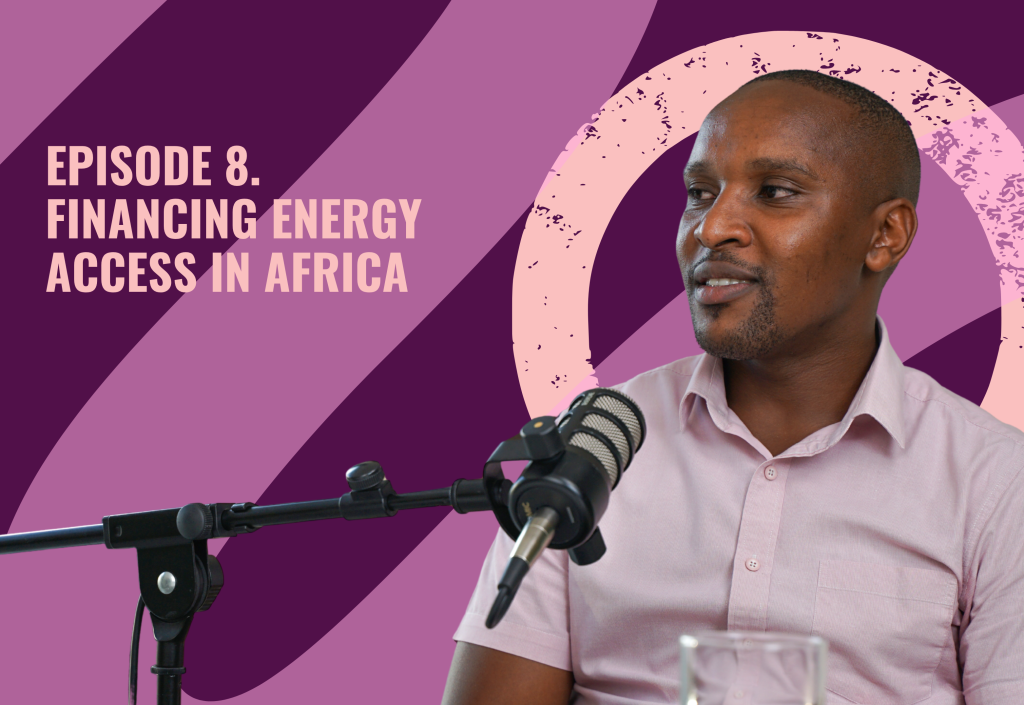
This article is based on a conversation from Voices & Visions, a podcast produced through a partnership between Tutto Passa Agency and TechCabal, which explores the people and ideas shaping Africa’s innovation economy.
Africa’s electricity problem becomes harder, not easier, as the number of people without power reduces.
The first households are relatively straightforward to connect. They live close enough to existing distribution infrastructure, consume enough electricity to justify the investment, and often have predictable incomes that allow utilities or solar companies to recover their costs.
The people left behind tend to be different. They may live hundreds of kilometres from major transmission lines, move with livestock, live in refugee settlements, or survive on incomes too irregular to qualify for conventional financing. Extending a power line to them can cost more than the electricity they are likely to consume over the next few years.
Benjamin Gitonga, a director at climate finance platform Nithio, argues that reaching these customers will require governments and development financiers to accept something markets are designed to avoid: funding customers before they are economically attractive.
“There has to be concessional funding for these projects to actually be successful,” Gitonga said on the latest episode of Voices & Visions.
The problem is circular. People need electricity to generate income, but energy companies need customers with income before they can justify supplying electricity.
Breaking that loop may be one of the hardest parts of Africa’s energy transition.
The economics gets worse
Kenya illustrates the problem. Successive governments have spent years extending the national grid, including through the Last Mile Connectivity and rural electrification programmes. But Gitonga points to populations whose lifestyles make it particularly difficult to implement conventional electrical infrastructure.
For example, a pastoralist family may not remain in the settlement where a grid connection has been installed.
“You have communities whose core activity, as far back as the old ages, is pastoralism. So they’ll move from one place to another,” Gitonga said. A power line can reach a town such as Lokichar—a small trading centre in north-western Kenya—while some residents subsequently move elsewhere with their livestock.
Solar panels, batteries and portable systems make more sense in such places than extending poles indefinitely. But replacing the grid with decentralised energy does not remove the financing problem.
A household solar kit might include a panel, a battery, lights, a television, and a radio. Companies can sell such products through pay-as-you-go (PAYGO) arrangements, with customers putting down a deposit and making small payments over time.
Kenya’s mobile money infrastructure has helped make that model possible.
“Pay a deposit, then pay maybe small daily, weekly, or monthly instalments to whoever is the asset financier,” Getonga said. “This is very successful in Kenya because of the mobile money, M-Pesa.”
But PAYGo only works when customers can pay.
That distinction becomes important as companies push deeper into poorer and more remote communities. Getonga describes bankability in simple terms: the “willingness and the ability to pay”. A household might be asked to find only KES 10 ($0.077) each day, but the financing model still assumes it can reliably find that KES 10 for months or years.
The poorest households break that assumption.
Someone has to pay first
Consider a person without electricity, a phone, formal credit, or meaningful disposable income.
The standard commercial solution is almost impossible to apply. They cannot borrow for a solar kit because they lack income. But without electricity, their ability to create additional income may also be constrained.
As Gitonga puts it, the person effectively needs either money, an energy product, or some form of financing before the market can begin working.
“Somebody has to provide the funding,” Gitonga said.
This is where concessional finance matters.
Gitonga uses refugee settlements in northern Kenya as an example. A newly arrived refugee may possess little more than what they carried across the border. There is almost no commercial case for selling that person an expensive energy asset on day one.
Yet, providing electricity can spur economic activity that eventually makes the customer commercially viable.
A small amount of power might initially provide lighting and phone charging. Later, someone could borrow money to open a barbershop. Earnings from that business could help finance a refrigerator or another productive asset.
“The first layer of contact when they get that energy access” can trigger another level of economic activity, Gitonga said.
This reverses the usual logic of infrastructure investing. Investors normally look for demand and build supply to serve it. In parts of Africa’s last-mile electricity market, supply may have to arrive before meaningful demand exists.
A light bulb is not enough demand
Mini-grids expose the problem even more clearly. Building generation capacity requires substantial upfront expenditure. But a newly electrified poor community might initially consume remarkably little electricity.
“What is the power demand? It’s only a bulb. It’s only a few phone chargers,” Getonga said of the refugee-camp example. “The demand is low.”
From a conventional investor’s perspective, those numbers are difficult to accept.
A company cannot spend heavily on generation and distribution while indefinitely waiting for consumption to increase. Yet if nobody builds that initial infrastructure, shops, workshops, refrigeration businesses, digital services, and other electricity-consuming businesses may never emerge.
This is why measuring electrification solely by the number of connections can miss part of the problem. The more consequential question is what people can do once electricity arrives.
For the easiest-to-reach customers, electricity follows economic activity. For some of the poorest, electricity may need to precede it.
That makes the last mile partly an economic-development project rather than simply an energy business.
Subsidies should create future customers
This does not mean every rural energy project should be permanently subsidised. A better way to think about concessional capital is that it absorbs risk during the period when commercial economics do not yet work.
Gitonga describes it as a “first touch”. People who are initially unable to afford distributed renewable energy products may require concessional financing to obtain them. Once the electricity enables new economic activity, their ability to pay for additional products can improve.
“As a kicker, then you need to provide the concessional funding for them to first get this product,” he said. “Then over time, they’re able to generate the ability to pay for the products, additional products.”
Badly designed subsidies can distort markets, encourage dependency, or crowd out companies willing to invest commercially. But refusing to subsidise anything can produce the opposite failure: markets never form because the customers with the greatest need are also those least able to signal profitable demand.
The challenge for governments and development institutions is therefore to subsidise the transition into a functioning market rather than permanently replace one.
Not all electricity customers are the same
A factory can calculate what it currently pays to Kenya Power, compare that with the cost of installing a solar system, and decide whether doing so will reduce its electricity bill. Its electricity consumption is relatively predictable. So is its capacity to pay.
That makes financing easier. Gitonga describes commercial and industrial solar as one of Kenya’s more mature renewable-energy segments because investment in it can generate returns for both sides: investors receive returns, while businesses benefit from lower energy costs.
A household surviving on an irregular daily income presents an entirely different proposition. Markets naturally chase the former. Public policy has to worry about the latter.
That is why Africa’s electricity transition cannot simply be reduced to attracting more private capital. Getonga argues that global capital already exists and will move toward risks investors consider acceptable.
The harder question is who finances the people who do not yet constitute an acceptable risk.
For Africa’s remaining unelectrified communities, the answer will probably be a mixture of government expenditure, development finance, guarantees, concessional loans, and private capital that enters as customers become more economically viable. The market can finish part of the job.
But somebody will have to pay to create the market first.
Listen to the full podcast on Spotify.
