

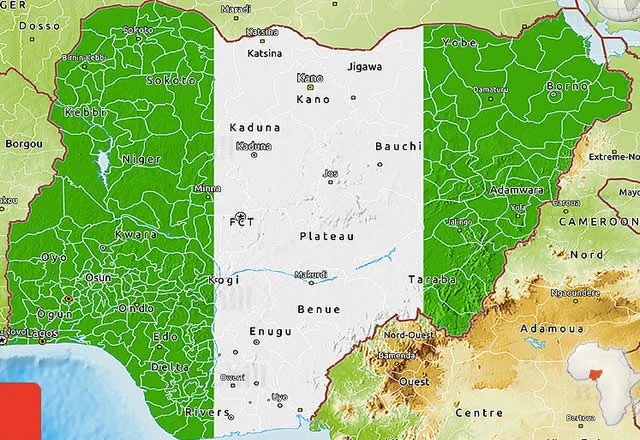

For more than four decades, I have lived and worked in Northern Nigeria. I first arrived in Kaduna in 1980 as a young NYSC professional and later settled in Abuja. During those years, I travelled widely across Kaduna State and neighbouring areas as part of a World Health Organisation–supported research effort on onchocerciasis. My work took me to rural communities such as Birnin Gwari, Kuduru, Lere, Galadimawa and Were—places of warmth, resilience and dignity.
Today, many of those same communities have become synonymous with insecurity. Areas that once welcomed researchers and development workers are now often described as “no-go zones” because of banditry and terrorism. It is a painful transformation to witness. I confess that I write these words with sadness. Yet I also write with hope that the trajectory can change.
Nigeria’s growing developmental divide between North and South is real and measurable. But it is not a destiny that cannot be altered.
Across multiple indicators—education, poverty, literacy and human development—the northern regions lag behind the southern ones.
According to Nigeria’s National Bureau of Statistics, poverty rates in the North-East and North-West are among the highest in the country, reaching 71.9 per cent and 64.8 per cent, respectively, compared with 12.1 per cent in the South-West and 21.3 per cent in the South-South.
Educational indicators show a similarly stark disparity. Recent data suggest literacy rates in southern zones exceed 80 per cent, while the North-West and North-East record literacy levels of roughly 44–48 per cent.
The contrast becomes even sharper when one looks at individual states. While states such as Imo and Lagos record literacy levels above 95 per cent, some northern states have literacy rates below 20 per cent, and in extreme cases even lower.
These statistics do not represent abstract academic debates; they reflect millions of young Nigerians whose opportunities are limited by circumstances beyond their control.
And because Nigeria is one nation, such disparities inevitably affect the stability and prosperity of the whole country.
To understand the present divide, we must acknowledge its historical foundations.
During colonial rule, the introduction of Western education followed very different trajectories in the North and the South. Missionary activity expanded schooling rapidly in southern Nigeria, producing an early generation of teachers, administrators and professionals.
In contrast, colonial administrators governed the North largely through existing emirate structures and introduced Western education more cautiously. By the time Nigeria achieved independence in 1960, the South had already built a substantial educational base.
This imbalance shaped the distribution of skilled manpower in the decades that followed.
Nigeria’s early leaders understood that education would determine the nation’s future.
Chief Obafemi Awolowo famously declared that he hoped to be remembered for laying “the basis for an irreversible revolution in education”.
His government’s introduction of free primary education in Western Nigeria demonstrated a belief that development begins in the classroom.
Similarly, Sir Ahmadu Bello, the Sardauna of Sokoto and Premier of Northern Nigeria, recognised the importance of unity and progress across the federation. He often warned that Nigeria’s stability depended on cooperation among its regions and peoples.
Prime Minister Sir Abubakar Tafawa Balewa also emphasised the necessity of national cohesion, reminding Nigerians that the country’s strength lay in the diversity of its peoples working toward common goals.
Their words remain relevant today.
In recent years, insecurity has compounded the developmental challenges of the North.
The Boko Haram insurgency in the North-East, banditry across parts of the North-West, and the proliferation of kidnapping have disrupted economic activity and forced many communities into survival mode.
Schools have been closed. Farmers have abandoned fields. Teachers and health workers have fled rural areas.
In regions where education was already fragile, the consequences are severe.
A child who loses access to schooling today may lose the opportunity to contribute productively to society tomorrow.
It would be profoundly mistaken to interpret the current challenges of Northern Nigeria as evidence of permanent decline.
The North possesses enormous potential.
Its vast agricultural land could make Nigeria one of Africa’s leading food producers. Its population—young, energetic and entrepreneurial—represents a powerful demographic advantage. Cities such as Kano, Kaduna and Maiduguri have historically been centres of trade and scholarship.
The North’s challenge is not the absence of talent. It is the absence of the enabling conditions that allow talent to flourish.
If Nigeria is serious about bridging the North–South divide, education must be the central pillar of reform.
Evidence across the world is unequivocal: societies that invest heavily in universal education experience sustained economic growth and social stability.
This means expanding access to basic education, strengthening teacher training, and ensuring that girls’ education receives the priority it deserves.
It also means modernising traditional Islamic educational systems so that young people can acquire both moral instruction and practical knowledge suited to the modern economy.
Education must become not merely a policy objective but a societal commitment.
Development cannot occur without security.
Restoring safety in northern communities will require a combination of effective policing, intelligence gathering, economic opportunity and community engagement.
The farmer must be able to return to his field. The teacher must be able to return to the classroom. The researcher must once again be able to travel freely to places like Birnin Gwari and Lere without fear.
Without security, every other reform becomes fragile.
The transformation of Northern Nigeria is not solely the responsibility of northerners. It is a national task.
Nigeria’s destiny is shared. The progress of the North strengthens the South, just as the prosperity of the South benefits the North.
What is required is not recrimination but resolve—resolve to invest in education, strengthen institutions, and create opportunities for young Nigerians wherever they may be born.
When I remember the villages, I once visited during my medical work—places of hospitality and dignity—I refuse to accept that their current situation is permanent.
Nigeria has overcome many challenges in its history. With visionary leadership and a renewed commitment to education and security, the narrative of Northern Nigeria can still be rewritten.
The question before us is simple.
Will we allow the divide to widen—or will we choose to build the bridges that our founding fathers once imagined?
The answer will determine the future of our nation.
Dokun-Babalola, a former National President of the Guild of Medical Directors, writes from Abuja via [email protected]
