

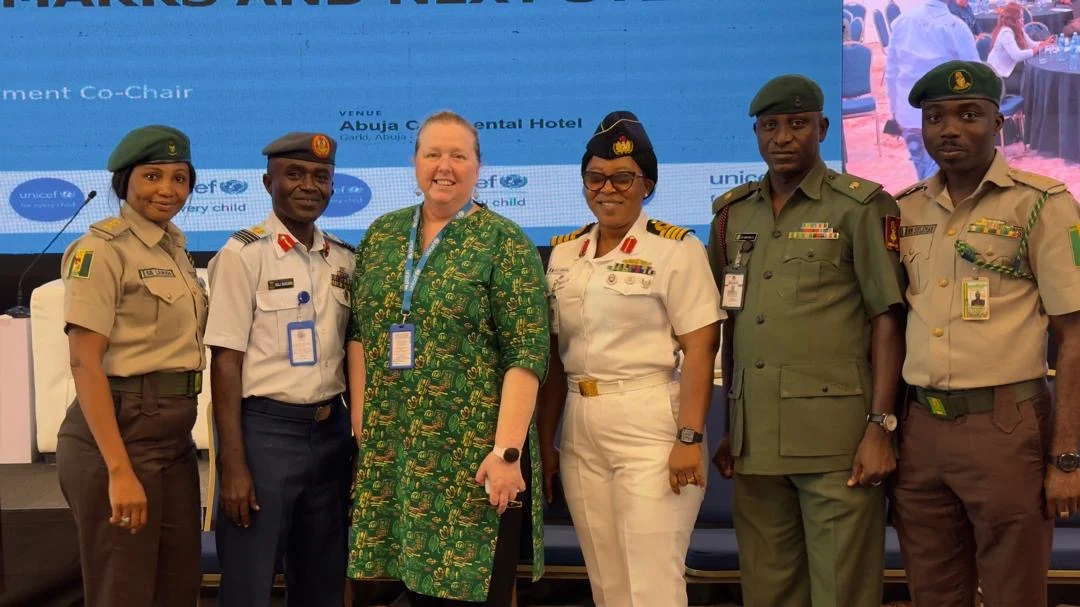

The United Nations Children’s Fund has unveiled plans to sharpen its child protection interventions in Nigeria, placing child abuse, child marriage and poor birth registration at the centre of its new country strategy as it seeks to reach millions of vulnerable children still excluded from essential services.
The organisation said the new priorities would shape its 2028–2032 Country Programme and strengthen government-led systems to ensure more Nigerian children are protected from violence, exploitation and harmful practices.
Speaking at the opening of UNICEF Nigeria’s Child Protection Mid-Year Review and consultations for the development of the new country programme in Abuja, the organisation’s Chief of Child Protection, Natalie McCauley, said evidence must drive future interventions rather than programme outputs alone.
According to a copy of her presentation made available to our correspondent on Friday, official national data show that six in 10 Nigerian children experience some form of abuse, while only two in five children under the age of five have their births registered, with significant disparities between urban and rural areas. She added that two in five young women in Nigeria were married before the age of 18, underscoring the need for stronger action.
“The urgency is clear. Official national reporting shows that six in 10 children experience some form of abuse; only two in five children under five have their births registered, with a wide urban-rural gap; and two in five young women were married before the age of 18. These figures are not merely statistics. They represent children whose safety, identity, education, health and future opportunities are at risk,” she said.
McCauley said the organisation was repositioning its child protection programme to focus on measurable improvements in children’s lives rather than simply reporting activities completed.
“A review is not simply an exercise in reporting activities or presenting numbers. It is about asking whether our work is changing children’s lives; whether the children facing the greatest risks are being reached; and whether the systems around them are becoming stronger, more accessible and more accountable,” she said.
She noted that UNICEF-supported programmes made notable progress in 2025 by strengthening the frontline child protection workforce, expanding community child protection structures, supporting nearly 120,000 children with protection services, accelerating birth registration and enabling more than 1,000 children to leave detention through diversion and other non-custodial measures.
Despite these gains, she warned that national achievements often conceal inequalities affecting children living in rural, conflict-affected and other vulnerable communities.
“A national result can conceal deep subnational disparities. A target can be achieved while the child in a remote community, the adolescent girl facing multiple risks, the child with a disability, the child on the move, or the child affected by conflict remains beyond the reach of services. Our task today is therefore not only to ask, ‘What did we deliver?’ but also, ‘Who did we not reach—and why?’” she said.
McCauley explained that UNICEF’s Strategic Plan for 2026–2029, described as the organisation’s final drive toward achieving the child-related Sustainable Development Goals by 2030, requires programmes to become more focused and deliver results at scale.
“We cannot attempt to do everything, everywhere, in the same way. We must identify the deprivations that are most severe, the locations where risks are concentrated, the solutions that have evidence of effectiveness, and the partnerships and financing required to take those solutions to scale,” she said.
She stressed that child protection should no longer be viewed as a stand-alone sector but as a prerequisite for national development.
“Protection is not an add-on to development; it is one of the conditions that makes development possible. A child who is afraid at home cannot thrive. A girl married too early is less likely to remain in school. A child without a legal identity may be excluded from health, education and social protection,” she added.
Addressing government officials and development partners during the consultations, McCauley said UNICEF was seeking genuine collaboration in designing its next country programme rather than endorsement of predetermined priorities.
“This consultation is not intended to seek endorsement of a plan that has already been written. It is an invitation to shape the next programme together. We need your challenge as much as your validation. We need to know what the evidence gets right, what it misses, which bottlenecks are most decisive, and which solutions can realistically be taken to scale,” she said.
She said the next programme would focus more deliberately on strengthening government institutions, expanding the social welfare workforce, mobilising domestic financing and improving access to quality child protection services across Nigeria.
McCauley also advocated stronger collaboration across sectors, noting that child protection cannot be addressed in isolation.
“A child does not experience life in sectors. The same girl may be out of school, at risk of child marriage, without a birth certificate, affected by malnutrition and living in a household under severe economic pressure. No single ministry, UNICEF section or organisation can address these deprivations alone,” she said.
She explained that stronger coordination should include integrated frontline services, shared geographic targeting, interoperable data systems, effective referral pathways and joint accountability among government institutions and partners.
She added, “Convergence must mean more than mentioning child protection in another sector’s plan. It should mean shared geographic and population targeting, integrated frontline platforms, functioning referral pathways, interoperable data systems, coordinated social and behaviour change, and budgets and accountabilities that reflect collective results for children.”
McCauley said the ultimate measure of success would be whether vulnerable children are safer and better able to access opportunities.
“The measure of our success will not be the number of plans we produce or meetings we hold. It will be whether a child at risk is identified before harm occurs; whether a survivor receives timely, respectful and effective support; whether every child is counted at birth; whether a girl can remain in school and choose her future; whether a child affected by conflict can recover and reintegrate; and whether families and communities have the support they need to protect their children.”
Nigeria continues to face one of the world’s most significant child protection challenges. According to UNICEF, millions of children are exposed to violence, child labour, trafficking, harmful traditional practices and displacement, while insecurity, poverty and humanitarian crises continue to heighten protection risks, particularly in the North-East and other fragile communities.
In recent years, the Federal Government, working with UNICEF and development partners, has expanded digital birth registration, strengthened social welfare and child justice systems, developed national action plans to end violence against children and child marriage, and increased support for children affected by armed conflict. The ongoing consultations in Abuja will inform UNICEF’s 2028–2032 Country Programme, which is expected to prioritise evidence-based interventions capable of reaching the country’s most vulnerable children at scale.
