
On a good day, a Nigerian entrepreneur rarely thinks about the mechanics of a phone call. A customer dials an 080 number, an automated greeting plays, a representative answers, an order is confirmed, or a complaint is resolved, and business moves forward.
On a bad day, the call does not connect. Or it connects only after several attempts. Or a business owner discovers that a former employee has departed with key customer conversations—and the customers themselves—stored on a personal mobile SIM.
For Mayowa Okegbenle and Opeyemi Shokunbi, founders of PressOne, the Lagos-based cloud-telephony company, the sharp disconnect between how business phone systems ought to function and how they actually operate in Nigeria presented a compelling market opportunity.
The core value proposition was simple: a small business with four, five, or ten employees should be able to run a professional phone network—complete with automated greetings, extensions, intelligent call routing, and complete interaction records—without requiring an enterprise IT budget or a bank’s capital.
“When you call a bank, you hear, ‘Welcome to the name of the bank. Press one for this, press two for that,’” Mayowa Okegbenle, PressOne’s co-founder and chief executive, said in an interview with TechCabal on Tuesday, September 8. “Why can’t everyone have that? Why is that reserved for banks and big companies?”
In Nigeria, the obstacle has historically been a combination of unreliable infrastructure, difficult economics, and a telecom ecosystem that is overly complex for small and medium-sized enterprises (SMEs).PressOne entered that market in 2021 and gained significant traction by 2022. However, the founders quickly discovered that acquiring customers was not their hardest problem. The true challenge lay in retaining them long enough to convert rapid adoption into a durable, profitable business.
That distinction is critical in a tech ecosystem that frequently mistakes user acquisition for long-term viability. PressOne’s trajectory offers a grounded lesson: in a subscription model where customers are unaccustomed to recurring charges, cash flow can fluctuate wildly, and service quality hinges on external telecom networks, signing up customers is merely the starting line.
From personal number to enterprise infrastructure
The concept behind PressOne originated from Okegbenle’s personal friction.
In 2019, while operating another venture, he grew frustrated with relying on his personal phone number as the primary business channel. A personal mobile line provided zero oversight or control. He could not monitor employee interactions, audit service quality, or protect customer relationships when staff turned over.
“I just couldn’t fathom the idea of using my personal line for your business,” he said. “I can’t see who is talking to customers, what they are saying. I can’t imagine it.”
Leveraging his software engineering background and accessible communications APIs, Okegbenle built a proprietary call-handling setup for his own operations.
While the software assembly was relatively straightforward, the broader market challenge was obvious: most small business owners lacked both the technical skill and the bandwidth to construct similar tools. That gap became PressOne’s target market.
The technology was relatively inexpensive, according to him. The harder part was that most small-business owners had neither the technical expertise nor the time to build it themselves. That gap became the opportunity PressOne was built around.
Cloud telephony—using Internet-based protocol systems to manage corporate calls alongside Private Branch Exchange (PBX) architecture — had existed globally for decades. However, Nigerian SMEs were often too small for major operators, unfamiliar with private network providers, and hesitant to adopt traditional landline numbers that local customers routinely ignore.
PressOne packaged this backend complexity into a plug-and-play service using familiar local mobile number formats.
A business could secure a number, configure a custom IVR greeting, onboard staff, and manage incoming and outgoing communications from a centralised dashboard.
“Our customers are typically non-consumers of that service,” Okegbenle said. “What we came to do in the market was, we actually created that market by introducing entrepreneurs and business owners to this.”
He compares PressOne’s strategy to the evolution of digital payments in Nigeria. Electronic transactions existed long before fintech startups brought them to informal merchants.
Early pioneers like Interswitch established the underlying rails by connecting ATMs and Point-of-Sale (PoS) terminals nationwide.
The breakthrough for the current generation of fintechs was not inventing new rails, but abstracting that complexity for a much broader merchant base.
PressOne aimed to mirror that transition in business communications.
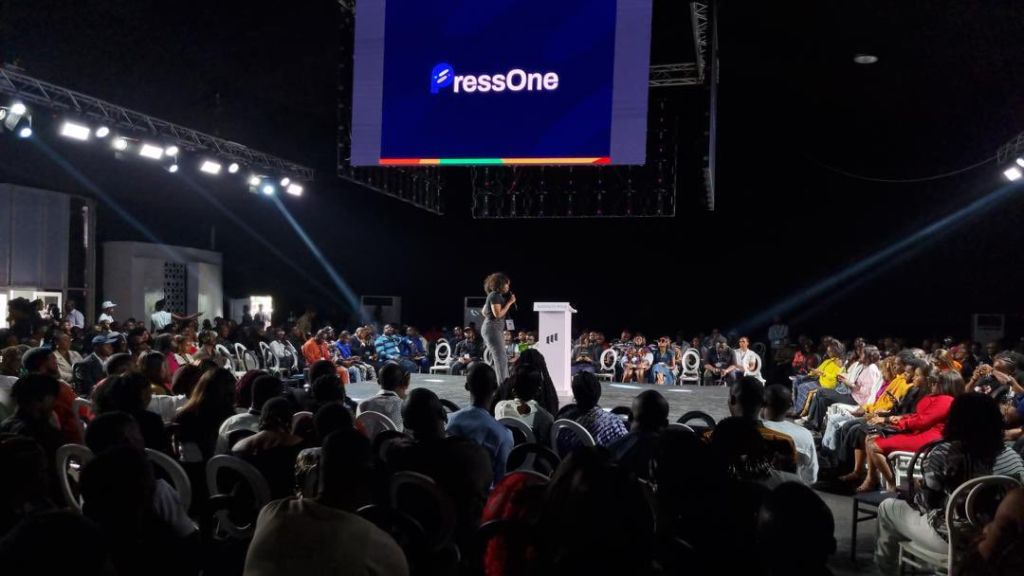
The telecom matrix behind the software
Cloud telephony in Nigeria is not merely a software layer; it sits at the complex intersection of PBXs, public switched telephone networks (PSTN), interconnection agreements, numbering resources, billing frameworks, and strict regulation.
A PBX system enables internal users to route calls through a shared infrastructure. To connect those calls to external networks, however, the system requires direct carrier access. This introduces a major trust barrier. Telecom operators are naturally cautious. Unregulated PBX networks can be exploited for caller-ID spoofing and “call masking”—a practice where international traffic is disguised as local calls to bypass international termination tariffs.
“The PBX is a notorious system because people use it for shady stuff,” Okegbenle said. “It’s called a trust issue.”
Operating local voice infrastructure also meant navigating the regulatory framework of the Nigerian Communications Commission (NCC). PressOne secured a call-centre licence in 2022 through a subsidiary—a targeted category under the Value-Added Services (VAS) framework—rather than pursuing broader telecom licences.
“The moment I needed to set up a PBX, you’ve set up a piece of infrastructure,” Okegbenle said. “Now you need some sort of licence to connect.”
When acquisition ceases to be the primary problem
PressOne spent its first year in 2021 fundraising, security regulatory clearance, and recruiting core technical talent. Its first network engineer joined around December 2021, a second engineer was hired in March 2022, and the platform officially went live by July 2022.
By 2022, organic interest began to compound. By August 2023, after obtaining a Mobile Virtual Network Operator (MVNO) licence through its subsidiary, PressOne had proven market demand.
“At some point, we could get 500 customers a week,” he said, referring to periods when promotional spending was switched on. “We had answered the question that this is going to be a business. So we don’t have a market problem.”
However, aggressive acquisition metrics can mask severe retention issues.
A new subscriber might sign up for a business number, record a welcome message, and add team members, only to abandon the platform the following month.
Others signed up through promotional campaigns without embedding the tool into their daily operational workflows.
In subscription software, customer acquisition can be bought through performance marketing. Customer retention must be earned continuously.
“In 2022, in terms of just pure numbers of customers, it was a peak year,” Okegbenle said. “But then, as they came, they left. So that’s a churn problem.”
The economics of churn and cloud costs
By 2024, PressOne pivoted its operational focus from raw user growth to cohort analysis, identifying specific early-stage user behaviours that correlated with long-term retention.
The core issue was not simply sending automated billing renewal reminders; it was ensuring the customer found enough immediate operational value to consider the subscription essential.
“We can acquire a hundred customers this week,” Okegbenle said. “We know which ones will stay just by their behaviour in the first three days.”
PressOne began tracking specific activation triggers: whether a business fully configured its routing rules, added active team members, or initiated outbound calls within 72 hours of registration.
This shift was directly tied to PressOne’s unit economics. The company adjusted its monthly subscription pricing upward over time, moving from approximately ₦1,500 ($1.13) to ₦6,000 ($4.54), and eventually stabilizing around ₦10,000 ($7.57).
Unlike pure SaaS companies where serving an additional user carries near-zero marginal cost, cloud telephony incurs immediate operational expenses upon onboarding. Phone numbers must be provisioned, interconnect channels maintained, carrier routing fees settled, and real-time media servers operated.
“Our marginal cost per user is definitely not zero,” Okegbenle emphasized. “Every single account brought onboard carries direct underlying costs.”
Hosting infrastructure represents another significant economic pressure point. Okegbenle pointed out that deploying equivalent cloud capacity locally can be substantially more expensive than using global public cloud providers.
Furthermore, local data centre contracts often demand large upfront capital commitments rather than flexible, pay-as-you-go models.
“You can easily spin up a basic instance on AWS for $10 today as a developer,” he said. “Local infrastructure setups rarely offer that level of flexibility or low entry thresholds.”
This highlights a key friction in Nigeria’s data localisation push. While hosting digital infrastructure locally enhances data sovereignty, lowers latency, and boosts operational control, the higher capital costs and rigid payment terms can strain early-stage startups attempting to scale efficiently.
When the carrier network is the bottleneck
For a voice platform, infrastructure hurdles extend beyond server hosting. A completed call must cross carrier networks that suffer from significant quality variability.
Okegbenle revealed that PressOne tracks call setup success rates across local networks, recording metrics well below mature international benchmarks.
While PressOne achieved a peak weekly success rate of 48% on specific routing channels, baseline operational performance frequently hovered between 30% and 31%. By contrast, tier-1 operators in South Africa (MTN, Vodacom, Telkom) deliver call setup success rates between 91% and 98%, while India averages over 90%.
To survive, Nigerian businesses naturally build redundancy into their operations, maintaining SIM cards from multiple mobile operators or keeping backup PoS terminals to process card payments when bank switches fail.
PressOne introduced a similar failover mechanism for business telephony. The platform provides real-time visibility into route performance, allowing merchants to acquire and switch between numbers across different carrier backbones depending on real-time network stability.
“Operating here is like living in an estate with unpaved roads—you end up buying a specialised vehicle just to navigate it,” Okegbenle said. “Every player in this market inherits the underlying infrastructure bottlenecks.”
Programmable telephony: The next layer
Navigating these carrier constraints led PressOne to look beyond its original SME product.
On September 11, the company plans to officially launch Signals, a programmable telephony API layer designed for software developers, fintechs, enterprises, and artificial intelligence platforms.
Connected across six major telecom networks, PressOne claims the system possesses a daily handling capacity of up to five million calls.
The long-term objective is to turn voice communications into a plug-and-play API layer, mirroring how payment gateways simplified transaction processing for digital applications.
Under this model, a logistics platform could automatically trigger voice calls to confirm deliveries and process customer keypad responses. Similarly, an AI platform could integrate real-time voice interactions without needing to negotiate individual carrier interconnections or build out telecom operations from scratch.
“The current generation of fintech innovation could not exist without API-driven banking infrastructure,” Okegbenle said. “For PressOne, our next growth phase is becoming that infrastructure layer for voice.”
Reaching profitability
PressOne states it has now achieved profitability after refining its unit economics and capital allocation strategy in response to a tighter venture capital environment.
Okegbenle noted that even during periods of abundant capital, he prioritised building a self-sustaining business over relying indefinitely on external equity.
“Today, yes, we are profitable,” he confirmed. “Achieving self-sustainability was always the long-term objective.”
PressOne’s initial acquisition metrics proved that Nigerian SMEs actively sought professionalised business communications. The subsequent retention challenges demonstrated that market demand alone cannot sustain a venture.
For PressOne, reaching financial sustainability required systematic operational adjustments: identifying high-retention customer segments, aligning pricing with underlying carrier costs, and engineering software that can reliably handle voice communications across volatile infrastructure networks.
True scale demands moving beyond surface-level integrations to robust execution. We’ve filtered the noise out of Moonshot 2026, optimising the conference strictly for high-calibre connections between startup founders, global financial operators, enterprise leaders and individuals rewiring Africa’s technical frameworks. Get 20% off Early Bird tickets for a limited time.