


In the fictional nation of Beryllia, the 2026 World Chalice Games were set to begin as the country faced an unrelenting heat wave. The grid, already under strain from the circumstances, was dealt a further blow when a coordinated set of attacks including vandalism, drone, and ballistic attacks by an adversary, Crimsonia, crippled the grid’s physical infrastructure.
This scenario, inspired by the upcoming 2026 World Cup and the 2028 Olympic Games in Los Angeles, was an exercise in studying how utilities can prevent and mitigate, among other dangers, physical attacks on power grids. Called GridEx, the exercise was hosted by the Electricity Information Sharing and Analysis Center (E-ISAC) from 18 to 20 November, 2025. GridEx has been held every two years since 2011.
“We know that threat actors look to exploit certain circumstances,” says Michael Ball, CEO of E-ISAC, which is a program of the North American Electric Reliability Corporation (NERC), about designing the Beryllia scenario. “The Chalice Games became a good example of how we could build a scenario around a threat actor.”
Physical attacks on the grid are rising in the U.S., and GridEx attendance was up in November as utilities grapple with how to prevent and mitigate attacks. Participation in the exercise was at its highest level since 2019, according to a report released on 2 March. Given the number of organizations present, GridEx estimates that more than 28,000 individual players participated, including utility workers and government partners, an all-time high since the exercise began.
Rising Physical Threats to Power Grids
The U.S. and Canadian grids face growing security issues from physical threats, including vandalism, assault of utility workers, intrusion of property, and theft of components, like copper wiring. NERC’s 2025 E-ISAC end of year report cites more than 3,500 physical security breaches that calendar year, about 3 percent of which disrupted electricity. That’s up from 2,800 events cited in the 2023 report (3 percent of those also resulted in electricity disruptions). Yet despite a number of recent high-profile attacks in the U.S., physical attacks on the grid are happening worldwide.
“They’re not uniquely a U.S. thing,” says Danielle Russo, executive director of the Center for Grid Security at Securing America’s Future Energy, a nonpartisan organization focused on advancing national energy security. Russo says that while attacks are common in places like Ukraine, they’re not limited to wartime scenarios. “Other countries that are not experiencing direct conflict are experiencing increasing amounts of physical attacks on their energy infrastructure,” she says. Take Germany for example: On 3 January, an arson attack by left-wing activists in Berlin caused a five-day blackout impacting 45,000 households. That comes after a suspected arson attack on two pylons in September 2025 left 50,000 Berlin households without power. Some German officials cite domestic extremism and fears of Russian sabotage in recent years as reasons for heightened security concerns over critical infrastructure.
The uptick in attacks on the U.S. grid has been anchored by a number of incidents in recent years. In December 2025, an engineer in San Jose, California was sentenced to 10 years in prison for bombing electric transformers in 2022 and 2023. A Tennessee man was arrested in November 2024 for attempting to attack a Nashville substation using a drone armed with explosives. And in 2023, a neo-Nazi leader was among two arrested in a plot to attack five substations around Baltimore with firearms, part of an increasing trend in white supremacist groups planning to attack the U.S. energy sector.
“Since [E-ISAC] started publishing data back in 2016, we’ve seen a large and consistent increase in the number of reported physical security incidents per year,” says Michael Coe, the vice president of physical and cyber security programs at the American Public Power Association, a trade group that works with E-ISAC to plan GridEx. While not all data is publicly available, Coe says there’s been a “tenfold” increase over the past decade in the number of reported physical attacks on the grid.
Drone Attacks: A Growing Security Challenge
During the fictional World Chalice Games scenario, drone attacks destroyed Beryllia’s substation equipment, highlighting a threat that’s gained traction as more drones enter the airspace.
“The question we get all the time is, how do you tell if it’s a bad actor, or if it’s a 12-year-old kid that got the drone for their birthday?” says Erika Willis, the program manager for the substations team at the Electric Power Research Institute (EPRI).
One strategy to track and alert utilities to potential threats such as drones is called sensor fusion. The system includes a pan-tilt-zoom camera capable of 360-degree motion mounted on top of a tripod or pole with four installed radars. The radars combine with the camera for a dual system that can track drones even if they’re obstructed from view, says Willis. For instance, if a nearby drone flies behind a tree, hidden from the camera, the radars will still pick up on it. The technology is currently being tested at EPRI’s labs in Charlotte, North Carolina and Lenox, Massachusetts.
EPRI is also exploring how robotics and AI can improve security systems, Willis says. One approach involves integrating AI analysis into robotic technology already surveilling substation perimeters. Using AI can improve detection of break-ins and damage to fencing around substations, Willis says. “As opposed to a human having to go through 200 images of a fence, you can have the AI overlays do some of those algorithms…If the robot has done the inspection of the substation 100 times, it can then relay to you that there’s an anomaly,” Willis says.
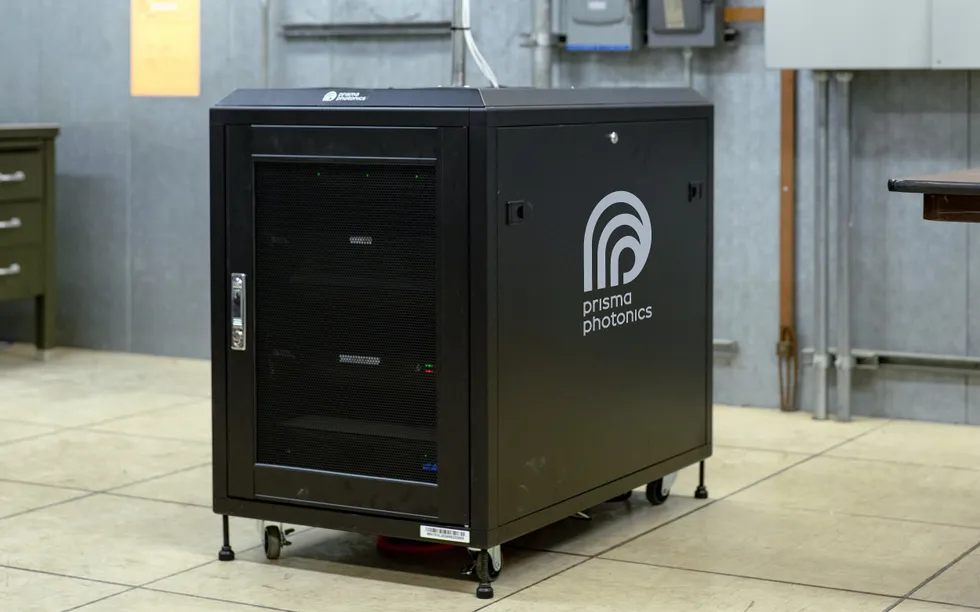 Prisma Photonics deploys fiber sensing technology that uses reflected optical signals to detect perturbations from vehicles and other sources near underground fiber cable.Prisma Photonics
Already, a number of utilities in the U.S. are using AI integrations in their security and monitoring processes. That’s thanks in part to the Tel Aviv, Israel-based Prisma Photonics, a software company that launched in 2017 and has since deployed its fiber sensing technology across thousands of miles of transmission infrastructure in the U.S., Canada, Europe, and Israel. A file-cabinet-sized unit plugs into a substation and sends light pulses down existing fiber optic cables 30 miles in each direction. As the pulses travel down the cables, a tiny fraction of the light is reflected back to the substation unit. An AI model processes the results and can classify events based on patterns in the optical signal as a result of perturbations happening around the fiber cable.
“If we identify an event that we don’t have a classification for, and we get a feedback from a customer saying, ‘oh, this was a car crash,’ then we can classify that in the model to say this is actually what happened,” says Tiffany Menhorn, Prisma Photonics’ vice president of North America.
As preparations get underway for the ninth GridEx in 2027, Ball says participation in the exercises alone isn’t enough to bolster grid security. Instead, he wants utilities to take what they learn from the training and apply it in their own operations. “It’s the action of doing it, versus our statistic of saying, ‘here’s what our growth was.’ That growth should relate to the readiness and capability of the industry.”
I changed the tense on this because the subsequent sentences use past tense. It seemed weird to switch from present tense in the first sentence to past tense in the rest of the paragraph, but I could be mistaken.
From Your Site Articles
Related Articles Around the Web
