


After more than three decades in a career, what keeps someone going? Is it the money, the excitement of the work, or the desire to see what else they can achieve?
For Chizzy Nnamchi, it is the excitement of imagining what is possible and helping others realise their potential. At 61, after decades of working across continents and holding senior positions at multinationals—including 3M and DHL—retirement is still not on his agenda.
“The way people go ‘wow’ sometimes when I say things. It’s the way I go ‘wow’ when I imagine certain things,” he says. “Especially working with young people who are just so brilliant and grounded. And that I can help them see better, and they will go and kill it.”
Today, Nnamchi is building Simvo Africa, an edtech platform that teaches people with little or no prior exposure to technology how to code through structured, project-based training. His broader ambition is to equip young Africans with the skills to compete in the global digital economy.
“It’s really about helping the next generation equip themselves with skills so that they can compete,” he says.
Choosing engineering
But Nnamchi’s interest in technology did not begin with a business idea. It began one afternoon in 1980 while he was walking across the field at the College of the Immaculate Conception in Enugu, south-east Nigeria. An aircraft was flying overhead; he could hear it, but could not see it.
He was in Class Three, and his physics class had just begun studying radar systems.
“I said to myself, if I had a radar, I would be able to tell without seeing this aircraft the type of aircraft it is, the direction it’s going and how fast,” he says.
“Right there at that spot, I decided I was going to study electronic and electrical engineering,” he adds.
His father wanted him to study chemical engineering or medicine, but Nnamchi had made up his mind.
He enrolled at the University of Ife—now Obafemi Awolowo University—in Osun State, south-west Nigeria, in 1982 and graduated with a first-class degree.
Despite the university’s limited resources, Nnamchi remembers his time at Ife as formative. Students learned computer programming in machine language and transferred their code onto punched cards for computers to read, with each card representing a line of code.
“In those days, I tried to write code using as few lines as possible to avoid errors,” he says.
Beyond academics, the university taught students to approach difficult engineering problems with confidence, even when resources were constrained.
“When we were at Ife, we developed the mindset that I can design pretty much anything that I want to if I have access to certain resources. We believed we could compete with anybody anywhere,” he says.
By the time he graduated in 1987, Nnamchi had decided to work rather than pursue postgraduate studies. He set his sights on Schlumberger, now known as SLB, an oilfield services company.
“I had chosen to join Schlumberger because that was one of the very few jobs that would put you on a dollar income track right away,” he says. “Instead of going to do a master’s and doctorate, I felt I needed to go earn money to support the family.”
Finding his way into Schlumberger
By the time he was due for the National Youth Service Corps (NYSC) in 1987, Nnamchi had already decided where he wanted to serve: Schlumberger’s Warri base in what was then Bendel State.
“I pushed to get assigned to Bendel State, as it was called before it was split up. I wanted either Bendel or Rivers State, where I could be in one of Schlumberger’s locations,” he says.
At orientation camp, Nnamchi says he discovered that the commandant’s girlfriend and his own girlfriend were best friends. He used the connection to approach the commandant.
“I convinced him to write a letter to Schlumberger, stating that NYSC would assign me to the company if they agreed to take me,” he says.
Armed with the letter, Nnamchi travelled to Warri and walked into Schlumberger without an appointment, asking to see the location manager. When he noticed the receptionist struggling with calls and visitors, he remarked that her job was not easy.
“She just melted,” he recalls. The receptionist eventually ushered him into the office of the location manager. He says the location manager noticed that Nnamchi had attended the University of Ife, which he had also attended, and asked whether he knew some of his former lecturers and colleagues. The shared alma mater helped open the door, and Nnamchi secured a place at Schlumberger for his service year.
Initially assigned routine tasks usually given to corps members, Nnamchi wanted more challenging engineering work. Within his first week, he approached the manager to ask for the opportunity to work on engineering projects or shadow the field engineers.
He says the manager challenged him: “Who gave you the guts to think you can shadow the field engineers?”
Instead, the manager assigned Nnamchi a project to build an alarm that would alert staff when public electricity was restored, so they could switch off their generators. Nnamchi completed it within a week.
“You hear it everywhere now when NEPA brings light, but then, I did the first one in Warri,” he says.
Impressed, Faiga gave him another assignment to automate the office gate, which Nnamchi also completed.
After finishing his service year in 1988, Schlumberger retained him alongside two other corps members.
“That was how I started my career fully,” he says.

From oilfields to Singapore
Nnamchi says his full-time career at Schlumberger began with a transfer to Egypt, where he spent six months before moving to Pakistan as a field engineer. There, he worked on wireline logging, using specialised tools and computing equipment to take scientific measurements inside drilled wells.
“It was seriously challenging work,” he says.
He was subsequently transferred to Oman, where Schlumberger field-tested new equipment and technologies. Nnamchi says the experience exposed him to some of the company’s most advanced technical work.
His time in Oman, however, was not without difficulties. He clashed with his Thai location manager over equipment allocation and maintenance, a disagreement he later acknowledged was partly due to his own attitude.
“I honestly had an attitude problem. I didn’t know better. I could have managed it differently,” he says.
After just over a year in Oman, Nnamchi moved to India in 1991, where he was promoted to senior field engineer. His responsibilities expanded to include a wider range of technical services, as well as planning and mobilising equipment and teams for remote projects.
By 1993, he was ready for a change. Although he enjoyed the technical challenges of oilfield work, he felt the industry offered limited exposure to the wider business world.
“If I want to be in the company for the long term, then I would stay and fight for promotions. But I wanted to be much more rounded,” he says. “As much as you do such high-tech work, and you’re dealing a lot with oil money, your exposure is very narrow. You don’t know much else going on in the real world.”
Having decided with his wife to settle in Singapore, he saw Asia’s rapid economic growth as an opportunity to broaden his experience and eventually bring some of what he learned back to Nigeria.
“Asia was growing so fast. So it would be ideal to live there, participate in that growth, learn a lot and see what we can bring back to Nigeria later on in life,” he says.
He left Schlumberger for Singapore, taking with him a key lesson: technical expertise alone was not enough.
“It’s not enough to be very good technically; one also has to be very good at dealing with people,” he says.
Taking 3M into oil and gas
Nnamchi settled in Singapore, where he says he provided business-development support to small technology companies supplying components to the hard disk drive industry. He helped get their components specified in new product designs, potentially opening up significant orders.
“We would spec components into new designs. And then if those components get accepted, tested, and work for the small company in the US or in Europe, it would be like massive sales for them,” he says.
He spent about a decade in that line of work, later extending it to mobile phone manufacturers and exploring the emerging internet economy. By 2002, following the dot-com bust, he was ready for something bigger.
In 2003, he joined American industrial company 3M to develop its oil and gas business in Southeast Asia. Despite the company’s extensive technology portfolio, Nnamchi saw an opportunity to bring its products into an industry where it had little presence.
During a presentation to 3M’s CEO in South Korea, he was asked why the company had not entered the oil and gas market.
“I told him point blank, ‘You’ve not hired people like me yet.’ I was born in the industry. I have relationships and contacts. I understand their pain points. I understand how they do business. So I can translate that to how different technologies within 3M can be applied within the industry. Technology doesn’t sell itself. You have to apply it,” he recalls.
After the presentation, Nnamchi says 3M committed resources to the opportunity, which became a global emerging-business initiative. He built technical teams, developed industry applications and helped expand manufacturing capacity, including helping to establish the company’s first factory in India.
“We built that business from less than $20 million to over $750 million in eight years,” he says.
Although his official position was director of oil and gas for Asia-Pacific, Nnamchi says he effectively ran the global business. Despite the growth, however, he felt his career had stalled.
“I was grinding hard, but I was not really flying career-wise,” he says.
When 3M offered him an opportunity to relocate to the United States, he declined, citing the financial and tax implications. He eventually left in 2011 without another job lined up.
“I actually left without another job, which is something I will not advise, but I left because I needed to just step out,” he says.
Nnamchi says his time at 3M taught him the value of a strong global brand and the resources that come with it. It also shaped his thinking about innovation, particularly the need for companies to look beyond developing new products and rethink how existing ones are taken to market.

Turning around DHL’s African operations
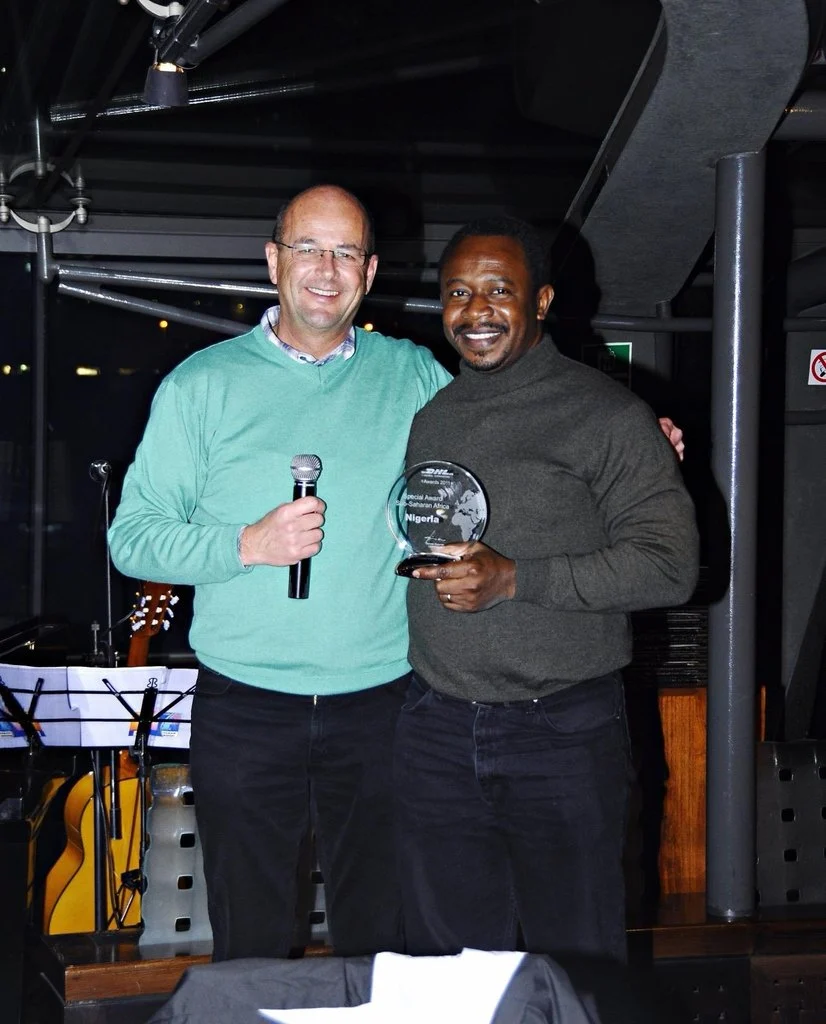
After 3M, Nnamchi says an opportunity to return to Africa came through global logistics firm DHL, which he joined as CEO for Central Africa, overseeing its air and ocean freight business. According to Nnamchi, some of the operations were losing money when he took over, and his task was to turn them around and address other challenges facing the business.
One of the opportunities he pursued was in Angola, where customs had seized three of Schlumberger’s warehouses, holding equipment for almost four years and demanding about $18 million in fines. Nnamchi saw a chance to resolve the dispute and secure a contract for DHL.
“One of my local guys in Angola had been the one training customs officers for quite some time. So I asked him, let’s go make a deal with these guys,” he says.
The negotiations brought the fine down to $3 million. Schlumberger agreed to pay the reduced sum, while DHL secured a contract to manage the movement of its equipment and warehouse operations.
Beyond turning around the business financially, Nnamchi also had to address staff morale, which he says was low when he arrived. He made a point of having lunch with employees to understand their concerns and the challenges they faced.
“People would tell me where they were having difficulties, why they were unhappy and what they thought could be done,” he says. “A lot of it came down to how people were being treated. I had to change that.”
After two and a half years at DHL, Nnamchi decided it was time to move on. The company’s regional headquarters had relocated from Singapore to Basel, Switzerland, complicating his travel arrangements. More importantly, the heavy travel schedule meant he was spending less time with his family.
“I wanted to be a bit more present,” he says.
Returning home and building Simvo Africa
After leaving DHL, Nnamchi began building businesses in West Africa, starting with a franchise from Bata, the global shoe company, covering Angola, Nigeria and Côte d’Ivoire.
“I just needed to build up something so that I could move back home,” he says.
The three-country operation proved challenging, and after four years, he shut down the business in Angola and established his own brands in Nigeria and Côte d’Ivoire.
He also started Simvo Africa in Nigeria, an edtech company built around a coding course developed by his first son, John. Although John initially wanted to introduce the course in the US and Canada, Nnamchi saw an opportunity to bring it to Nigeria.
“I told him, I will start it here in Nigeria,” he says. “I want to train young people, allow them to learn how to code at a level that is not expensive.”
For Nnamchi, the goal goes beyond producing software developers. He sees digital literacy as an increasingly essential skill across professions, from medicine and engineering to finance and law.
“Digital literacy today is currency. It will help you in any field,” he says.
He also sees the venture as part of a wider effort to prepare young Africans for the global economy. With Africans expected to account for one in four young people worldwide by 2050, he believes the continent’s potential will depend partly on how well it equips its young population.
“If we can equip them well enough to compete, you will see amazing things happen in Nigeria and on this continent. I have no doubt about that,” he says.
Building a new generation of coders
Simvo’s training programme is entirely online, combining video lessons, structured chapters and practical projects. Nnamchi says it is designed to take learners from little or no prior exposure to technology to being able to code.
“You can come in with zero exposure to tech, and you will learn to code by the time you’re done,” he says.
The programme’s first student enrolled in March 2025 after approaching Nnamchi for a youth service job. With a background in chemical engineering, she was offered the opportunity to complete the course in three months, with a job at Simvo if she succeeded.
“If you can finish it, learn how to code in three months, I’ll give you a job. And she did,” he says.
She subsequently helped build the company’s website and backend systems. Nnamchi says some other graduates have also joined Simvo, while the company has helped others secure jobs elsewhere.
The platform now has about 105 people studying. Beyond training, Nnamchi says the company also helps graduates find employment.
“It’s not just skills. Oh, we charge you, you study, and we say bye-bye. No, we help you to get a job,” he says.
Over the next year, he hopes to strengthen the platform and expand into other English-speaking African countries before eventually reaching French-speaking markets.
For Nnamchi, however, the bigger ambition is the impact the venture can have on people’s lives and how they see their own potential.
“It’s almost never about me. It’s about the impact I have on people, their careers, their growth and their mindset,” he says. “If I can get somebody to imagine they can do far more than they thought possible, for me, that’s a big deal.”
