

Hundreds of thousands of people in Afghanistan face hunger and poverty. The country suffers from repeated floods and earthquakes, declining humanitarian funding and two crises along its borders.
Logjams and logistics
For many Afghan schoolchildren, the fortified biscuits distributed by the World Food Programme (WFP) are often the most nutritious food they will receive all day. But getting the supplies into the country is a logistical minefield.
Take, for example, the 397 metric tons of this key nutritional boost, intended for some 172,000 students, shipped from Indonesia’s Surabaya port, part of a US$3.5 million contribution from the Government of Indonesia to support WFP school meals in Afghanistan.
The supplies are first sent by boat to the southern Pakistani port of Karachi, but from there things get more complicated.
The original plan was for the shipment to be transferred to trucks for a 7,000 km trip through Pakistan but, amid tensions between the country and Afghanistan, the border was closed.
Hunger cannot wait
A new route has to be found quickly because, as Corinne Fleischer, Director of WFP Supply Chain and Delivery, says, “hunger doesn’t wait for routes to reopen”.
WFP shipping officers reroute the cargo to the port of Jebel Ali in Dubai, with a plan to ship it across the Persian Gulf to Iran and then move it on by road.
Food supplies provided by the UN are offloaded at a warehouse in Kabul, Afghanistan.
However, geopolitics strikes again and, as instability spread across the Middle East, in effect closing the critical Strait of Hormuz since March, WFP is forced to rethink the plan once more.
Inside WFP operations rooms, logisticians go back to basics, poring over maps to see whether the region’s geography might offer a solution.
They find one: an entirely new land corridor from Dubai to landlocked Afghanistan across the Caucasus. It’s costlier, more complex and adds another 8,000 km to the journey, but it is the only remaining option.
New route, new hope
One overcast morning, a 21-truck convoy rumbles out of Dubai and heads out along the desert highways of the United Arab Emirates and Saudi Arabia, up through Jordan, Syria, Türkiye and Georgia before boarding a ferry in Baku, Azerbaijan, and crossing the Caspian Sea to Turkmenistan.
Days later, the trucks cross into Afghanistan through the remote Torghundi border crossing, before continuing on to Kabul. Every country the convoy passes through requires new customs clearances, security assessments, transport permits and coordination across seven borders.
Along the route, truck drivers face long waits at border crossings, signing paperwork and snatching moments of sleep beneath open skies.
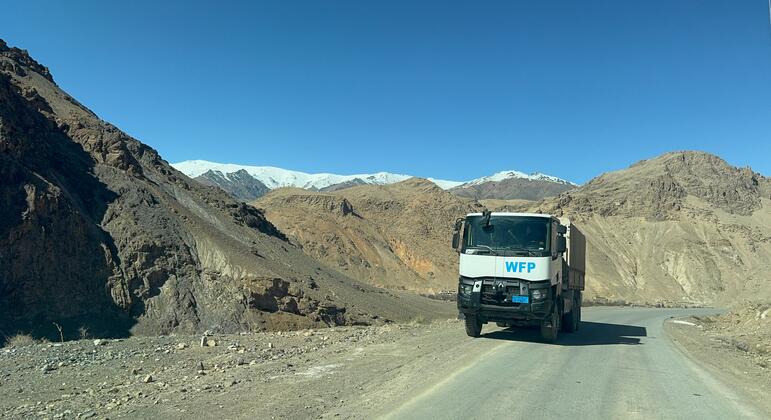
WFP truck in Afghanistan (file)
“I remember the ferry line at Alat port [Baku] where hundreds of trucks were waiting to cross – the line was close to 30 km long,” says Hüseyin Sarraç Ulus, a Turkish truck driver who made the roughly 3,000 km journey from Dubai to the Caspian Sea.
Working day and night
“We drove around 11 hours a day and slept in the truck cabin most nights – it was not always comfortable, but we are used to it,” he recalls. “We ate simple food like soup, bread, rice and tea. But it felt good. Knowing the cargo was helping children made me proud to be part of the journey.”
Inside a World Food Programme (WFP) warehouse on the outskirts of Kabul, Abdul Ahad Monib watches as the trucks slowly back into unloading bays.
“There was a feeling of relief when we saw the trucks arrive,” says Mr. Monib, a WFP Supply Chain and Delivery officer. “We followed every step of the journey closely – every delay, every border crossing, every change of plan.
After weeks on the road, the biscuits reach the hands of girls and boys in schools across Ghor, Nuristan and Paktika provinces, in central, northeastern and eastern Afghanistan, respectively.
“For the children, it’s a packet of biscuits that helps them stay healthy,” says Monib. “For us, it’s a logistics feat. No one sees the thousands of kilometres, the delays or the rerouting behind each packet. But that’s exactly the point – whatever the obstacles, WFP delivers.”
This story was first published on the WFP website.
