

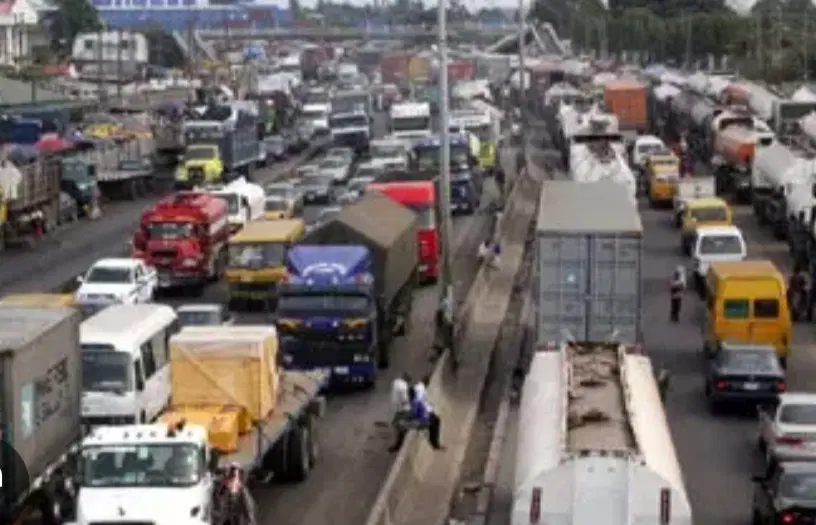
File image.
By Udeme Akpan, Energy Editor
The persistent gridlock caused by petroleum tankers along the Apapa and Kirikiri corridors of Lagos has once again exposed deep-rooted structural deficiencies in Nigeria’s downstream petroleum logistics chain, despite years of government interventions aimed at restoring order to the nation’s busiest fuel distribution hub.
Read Also: APAPA GRIDLOCK: Mayhem as presidential task force, LASTMA abandon road
Every day, thousands of trucks conveying Premium Motor Spirit (PMS), Automotive Gas Oil (AGO), aviation fuel and other petroleum products converge on the Apapa axis, resulting in severe traffic congestion that disrupts business activities, port operations, residential communities and the movement of commuters.
Investigations by Vanguard showed that the recurring traffic crisis has gone beyond a mere traffic management problem and is being driven by inadequate infrastructure, poor logistics planning, weak regulatory enforcement and corruption.
One of the major causes of the perennial congestion is the shortage of functional truck parks and loading bays.
Findings revealed that some petroleum depots do not have adequate holding facilities to accommodate the large number of trucks that arrive daily to lift products.
As a result, hundreds of tankers queue for several kilometres on public roads while awaiting loading instructions, effectively turning major highways into temporary parking lots.
The investigation further showed that dozens of petroleum storage facilities are concentrated within the Apapa and Kirikiri axis, meaning that thousands of trucks compete daily for access to the same depots.
Although the commencement of operations at the Dangote Petroleum Refinery has significantly boosted domestic fuel supply, many independent marketers still obtain products from tank farms located within the Apapa corridor, thereby sustaining the heavy volume of tanker traffic in the area.
Another major factor is Nigeria’s continued dependence on road transportation for petroleum distribution.
Industry operators noted that pipelines, which were originally designed to transport refined petroleum products efficiently across the country, have remained largely underutilised due to years of vandalism, inadequate maintenance and delayed rehabilitation.
Similarly, rail transportation of petroleum products has yet to become a viable alternative.
Consequently, road tankers remain the dominant means of distributing fuel nationwide.
Vanguard also gathered that while portions of the Apapa and Kirikiri roads have been reconstructed in recent years, many connecting roads remain too narrow to cope with the increasing number of heavy-duty trucks servicing the nation’s ports and petroleum depots.
The pressure has intensified as domestic refining capacity increases and economic activities expand, leading to higher volumes of petroleum products being transported to different parts of the country.
The situation is further aggravated by the activities of some tanker operators who park indiscriminately along the roads while waiting to secure customers or loading opportunities instead of proceeding directly to designated loading points.
Industry stakeholders also alleged that corruption has continued to undermine traffic management efforts.
They claimed that some enforcement personnel allow illegally parked trucks to remain on the roads after collecting unofficial payments, thereby obstructing the free flow of traffic and frustrating efforts to decongest the Apapa axis.
A source, who pleaded not to be named, said: “It is obvious because corruption takes place openly every day. We see money exchanging hands between tanker operators and some law enforcement personnel, allowing the trucks to remain on the roads. Many of them are not even going anywhere. They simply park at one spot while looking for customers or waiting to be engaged by those who have petroleum products to lift from the tank farms and depots.”
Also, speaking with Vanguard, the National President of the Oil and Gas Services Providers Association of Nigeria (OGSPAN), Mazi Colman Obasi, attributed part of the problem to Nigeria’s continued reliance on imported petroleum products.
According to him, “The Dangote Petroleum Refinery has repeatedly stated that it has the capacity to meet Nigeria’s domestic fuel demand. However, the Nigerian Midstream and Downstream Petroleum Regulatory Authority (NMDPRA) continues to issue licences for the importation of petroleum products.
“These imported products arrive through the seaports and are discharged into tank farms within the Apapa corridor. Naturally, thousands of tankers have to move into the area to lift the products, thereby increasing traffic congestion.”
Obasi urged the Federal Government to encourage greater patronage of locally refined petroleum products, arguing that reducing dependence on imports would lessen pressure on Apapa’s tank farms and improve traffic flow.
Other stakeholders also called on the government to accelerate the rehabilitation of petroleum pipelines, revive rail transportation for petroleum products, enforce the provision of adequate parking bays by depot operators, and strengthen the electronic call-up system for trucks.
They argued that unless these structural challenges are addressed through coordinated action by the Federal Government, the Nigerian Midstream and Downstream Petroleum Regulatory Authority (NMDPRA), the Nigerian Ports Authority (NPA), the Lagos State Government and security agencies, Apapa and Kirikiri will continue to experience recurring tanker-induced gridlock with significant economic consequences for Lagos and the nation.
Vanguard News
