

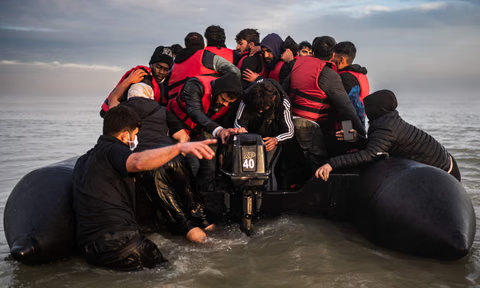
Nearly two thirds of all funding spent patrolling northern France for illegal migrants is provided by British taxpayers, the French government has revealed.
The UK paid £155 million of the total £250 million that goes towards funding police patrols, security equipment, sea rescues and new infrastructure required to combat small-boat crossings and people smuggled in vehicles.
This amounted to 62 per cent of the total, with just 38 per cent provided by the French government.
Laurent Touvet, head of the French interior ministry’s DGEF migration directorate, disclosed the figures at a parliamentary committee in Paris.
It is the first time that the French government has revealed how much it contributes towards illegal immigration patrols in northern France.
Touvet told the Paris committee, which was set up in January to examine Franco-British co-operation on cross-Channel migration: “It is estimated that the United Kingdom’s contribution to the fight against illegal immigration is around 62 per cent of the total, with 38 per cent being France’s responsibility.”
The British contribution is from the £475 million three-year agreement to pay towards combating illegal immigration struck by Rishi Sunak in March 2023. Since then, a total of 107,329 migrants have crossed the Channel in small boats.
The deal expires at the end of this month and a new agreement has yet to be finalised.
Last July, a joint declaration by Sir Keir Starmer and President Macron of France said that a new three-year cycle of funding spanning 2026 to 2029 would be finalised “as soon as possible”.
It comes as uncertainty grows over the success of UK-France co-operation in the Channel.
New figures published by the Home Office on Thursday revealed that just 377 small-boat migrants have been returned to France under the one in, one out deal that was agreed by Starmer and Macron last July.
This accounts for just 2 per cent of the 18,790 migrants who have arrived on small boats since the one in, one out treaty came into effect in August.
France has transferred 380 asylum seekers to the UK under the reciprocal terms of the deal.
French police have yet to implement new tactics that were also agreed at the UK-France summit, which were supposed to enable officers to intercept migrant boats in the water for the first time. Current French law prohibits the authorities from intervening once a boat is seaborn due to fears that it would breach international maritime law governing rescues at sea that are designed to protect lives at sea.
So far this year a total of 3,409 migrants have arrived in small boats, of which 1,200 have arrived this month alone.
Chris Philp, the shadow home secretary, said: “The government’s promises lie in tatters. The gangs have not been smashed, the French are not intercepting boats near the French shore and the one in, one out deal certainly isn’t working.”
New figures published by the Ministry of Justice on Thursday revealed that the number of asylum seekers waiting for an appeal against their rejected claims had almost doubled in the past year and soared fourfold since 2023.
There were 80,333 cases in the asylum appeals backlog at the end of December, up from 41,987 at the same point in 2024. The appeals backlog is bigger than the 64,426 claims awaiting an initial decision. The Home Office blamed the increased appeals backlog on a significant improvement in the productivity of asylum caseworkers, who are processing claims more quickly.
The average asylum seeker is waiting more than a year — 63 weeks — for an outcome on their appeal. The ballooning backlog is frustrating the Home Office’s attempts to move migrants out of hotels because many of those appealing qualify for taxpayer-funded accommodation while they wait.
The Refugee Council has estimated that the 80,333 claims stuck in the appeals backlog relate to nearly 105,000 people, as applications can include more than one person if they are in a family. This has increased fourfold in the past two years.
The ratio of asylum seekers who successfully appealed against their rejected claims fell from 46 per cent to 36 per cent, suggesting that Home Office caseworkers are becoming more accurate in their initial decisions.
However, the Home Office withdrew from 40 per cent of the appeals before they reached a tribunal, which is significantly higher than the 16 per cent rate from the previous year.
This indicates that the Home Office is increasingly acknowledging their initial decision was incorrect and granted asylum.
