

By Udeme Akpan, Godwin Oritse & Efe Onodjae
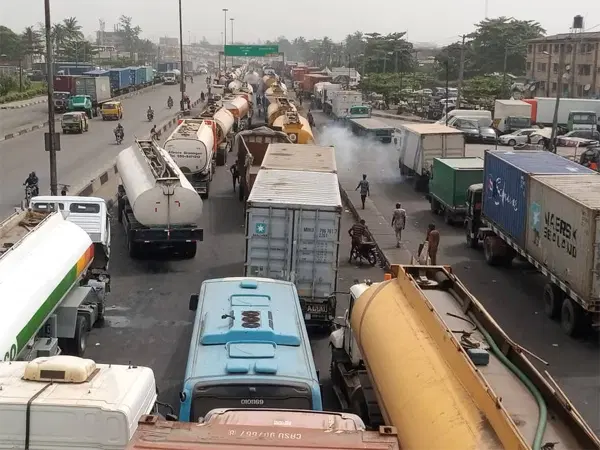
Oil cartels, independent petroleum marketers, tanker owners, drivers, transport unions and some enforcement agencies have been accused of sustaining the perennial traffic gridlock in the Lagos’ Apapa and Kirikiri corridors, crippling businesses, disrupting residents’ daily lives and hampering economic activities.
Read Also: Banks slash lending, cut N5.4trn across key sectors
Findings by Vanguard showed that thousands of businesses, commuters and residents in the Apapa-Kirikiri industrial and commercial axis continue to bear the enormous economic and social costs of the persistent congestion.
At the centre of the crisis are petroleum distribution activities involving marketers, tanker operators and enforcement agencies, whose operations have increasingly spilled onto public roads.
Although the downstream petroleum sector plays a critical role in ensuring the nationwide supply of Premium Motor Spirit (PMS), diesel, aviation fuel and other petroleum products, stakeholders blamed poor logistics planning, inadequate truck holding facilities, indiscriminate roadside parking by tankers, weak enforcement and corruption for turning major roads into permanent truck parks.
The consequences include severe traffic congestion, rising transport costs, deteriorating road infrastructure, delayed cargo evacuation from the ports, disrupted business operations and worsening living conditions for residents.
Vanguard observed that major roads linking Apapa, Kirikiri, Coconut and Tin Can Port are frequently occupied by hundreds of petroleum tankers waiting to load products from depots and tank farms.
Limited holding bays worsen congestion
Instead of remaining in designated holding bays, many trucks queue for several kilometres along the roads, reducing multiple carriageways to a single lane and making movement extremely difficult for other road users.
Findings showed that several petroleum marketers, including TotalEnergies, Conoil, Bovas Oil, Rahamaniyya, Obat Oil, Techno Oil, Aiteo, MRS Oil, Ardova, NIPCO, Integrated Oil & Gas, Folawiyo Energy, Matrix Energy, Eterna and Northwest Petroleum, operate tank farms and depots around the Naval Base section of Apapa and the Mile 2-Kirikiri corridor.
While traffic around the Naval Base section, where companies such as NIPCO and TotalEnergies operate, remains relatively free-flowing, the Mile 2-Kirikiri axis continues to experience chronic congestion.
Investigations further revealed that although some depots have holding bays built years ago to satisfy regulatory requirements, many are no longer adequate to cope with the current volume of tanker traffic.
However, stakeholders also alleged that the available parking facilities are not being optimally utilised because some independent marketers, tanker owners, drivers, unions and enforcement personnel allegedly prefer roadside operations, where illegal payments running into millions of naira are reportedly collected and shared.
NARTO, Police blame tank farms
The National Association of Road Transport Owners (NARTO) blamed tank farm operators for the persistent congestion, accusing them of admitting far more trucks than their facilities can accommodate.
Speaking exclusively to Vanguard, NARTO National Secretary, Mr. Aloga Gbogo, said:
“In Apapa alone, we have more than 60 tank farms, and each has the capacity to load about 300 trucks daily. How many of them have holding bays that can accommodate that number of tankers?
“Sometimes, when a tank farm has products requiring about 300 trucks, it collects money from 500 or 600 trucks. The first 300 trucks load, while the remaining trucks stay on the roads waiting for products they have already paid for.
“Is that situation not enough to cause traffic gridlock? Do not forget that Apapa is also home to Dangote, BUA, Honeywell and many other industries.”
Another NARTO official, Alhaji Inuwa Mohammed, said the Electronic Call-Up System has been effective around the Lekki Deep Sea Port because tanker operators were fully integrated into the system before operations commenced.
He recalled that NARTO had repeatedly expressed its willingness to integrate into the Apapa Electronic Call-Up System without incurring additional costs, but said the proposal was opposed by Truck Transit Parks (TTP), the operator of the platform.
The Ports Authority Police (Western Command) also distanced itself from the recurring gridlock along the Mile 2-Apapa-Kirikiri corridor, insisting that the underlying causes lie beyond the police’s responsibilities.
Speaking with Vanguard, the Police Public Relations Officer of the command, ASP Isaac Hundeyin, said the section of the expressway between Mile 2 and Apapa Wharf does not fall under the operational jurisdiction of the Ports Authority Police.
He said: “The traffic was not caused by the police. Part of our mandate is to maintain order on the roads. We are collaborating with the Lagos State Police Command, the Nigerian Ports Authority and the unions to manage the situation.”
Responding to suggestions that the congestion should fall within the responsibility of the port police because it originates from port activities, Hundeyin said attention should instead focus on the actual causes.
“The police cannot provide loading bays or transit truck parks. Those are the responsibilities of terminal operators and the Nigerian Ports Authority.
“Our physical presence is to manage traffic and deter crime. We cannot solve infrastructure problems that belong to private operators.”
On allegations that enforcement personnel contribute to the gridlock through misconduct, Hundeyin said:
“The police would not intentionally create traffic or hardship for members of the public. Whatever disputes exist often involve the unions and terminal operators. What is required is a permanent solution because the police are also overstretched.”
DAPPMAN, IPMAN, AIG, CP Maritime, NPA keep mum
Efforts to obtain the reaction of tank farm owners through the Depot and Petroleum Products Marketers Association of Nigeria (DAPPMAN) were unsuccessful, as calls placed to its Executive Secretary, Mr. Olufemi Adewole, were neither answered nor returned as of the time of filing this report.
The situation contrasts sharply with developments around the Lekki Deep Sea Port, where dedicated truck parks and strict implementation of the Electronic Call-Up System have significantly improved truck movement and traffic management.
Unlike in Apapa, operators on the Lekki corridor have largely embraced the electronic scheduling system, resulting in smoother traffic flow.
Stakeholders said refusal by many truck operators in Apapa to fully integrate into the electronic call-up platform continues to frustrate efforts to eliminate the perennial congestion.
Similarly, the National Public Relations Officer of the Independent Petroleum Marketers Association of Nigeria (IPMAN), Mr. Chinedu Ukadike, did not respond to Vanguard’s enquiries.
Repeated efforts to obtain comments from the Assistant Inspector-General of Police in charge of Maritime, AIG Okunade Ronke Nurat, the Commissioner of Police, Ports Authority (Western), CP Oluwatoyin Agbaminoja, and the Nigerian Ports Authority (NPA) were unsuccessful.
Need for shared responsibility — MEMAN
Responding to Vanguard, the Major Energies Marketers Association of Nigeria (MEMAN), which represents major downstream operators including 11 Plc, TotalEnergies Marketing Nigeria Plc, Conoil Plc, Ardova Plc, NNPC Retail Limited and MRS Oil Nigeria Plc, said its member companies were not responsible for the roadside congestion.
In an email response, MEMAN Chief Executive Officer, Mr. Clement Isong, said: “All MEMAN member depots have designated truck parking and holding areas where trucks remain until they are scheduled to load at the terminal. This process is supported by automated call-up and scheduling systems, which regulate truck movement and prevent unnecessary queuing around the depots.”
On the way forward, Isong stressed the need for collective responsibility.
He said: “With respect to the reported resurgence of petroleum tankers on roads within the Apapa and Kirikiri areas, MEMAN believes sustained collaboration among government, regulators, terminal operators and transport unions remains essential.
“Practical measures should include strengthening the electronic truck call-up system, expanding transit and holding bays, ensuring that only trucks with valid loading tickets are permitted into depot corridors, maintaining strict enforcement against indiscriminate parking, and continuously engaging transport operators and drivers on compliance with established traffic and safety protocols.”
Vanguard News
