

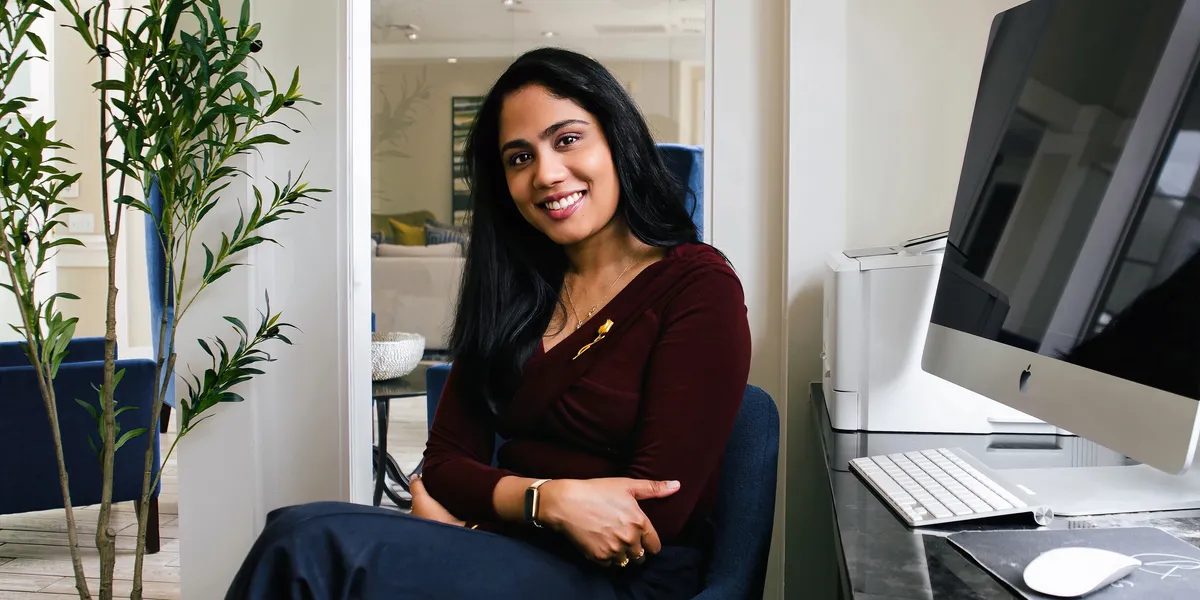
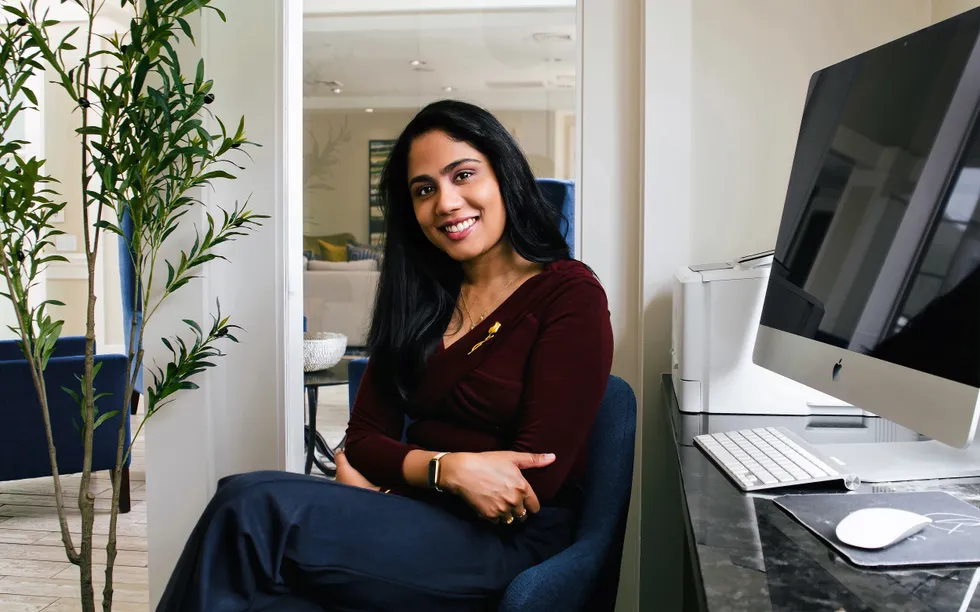
Many engineers are more comfortable working behind the scenes developing technology than speaking to consumers about products. But Preethi Ashwath has learned to take center stage, talking about the “hearable” and wearable devices she has had a hand in developing as an analog integrated circuit designer in the consumer electronics division at Analog Devices of Wilmington, Mass.
The IEEE member is one of the few women who work in the specialized field, where about 11 percent are female, according to career platform Zippia.
Preethi Ashwath
Employer
Analog Devices, in Boston
Title
Integrated circuit designer
Member grade
Member
Alma maters
SJB Institute of Technology in Bengaluru, India; University of California, Irvine
Ashwath stepped out from behind the scenes last year to meet with attendees at the Consumer Electronics Show (CES) in Las Vegas. She demonstrated Analog’s new earbuds, which track people’s heart and lung health through vibrations in their ear canals.
After she demonstrated her ability to explain the technology to consumers in simple terms, Analog selected her to represent the company at other events. She says she has “come to see speaking as part of contributing to the field, rather than something separate from technical work.”
She also gives technical talks on various aspects of electrostatic discharge (ESD) and other topics, as well as participates in panel discussions, she says, because they “reach engineers well beyond my immediate team.”
Ashwath is an active volunteer with the IEEE Circuits and Systems Society.
“Whether through designing semiconductor products, publishing technical articles, reviewing conference papers, or speaking at industry events, I try to contribute to the growth of the engineering community and the advancement of the field,” she says.
Discovering circuit design at Intel
Ashwath, who grew up in Bengaluru, India, learned about electronics engineering from her high school physics tutor.
That introduction led her to take electronics as one of her core courses in her final years there. At the time, Ashwath’s older sister was pursuing an engineering degree.
“Between my interest in electronics and seeing her already on that path, it became clear to me that engineering was the way to go,” Ashwath says.
After earning a bachelor’s degree in electronics and communications engineering at the SJB Institute of Technology, in Bengaluru, she wanted to pursue a career in very-large-scale integration. But that changed once she moved to the United States and began her master’s program in electrical engineering at the University of California, Irvine.
She discovered her passion for circuits and devices during an internship at Intel in Santa Clara, Calif. She learned about circuit design, package design, and reliability verification tools such as Ansys Totem.
“Seeing every layer of the chip development process gave me a more complete picture of what goes into building a semiconductor product,” she says. “Through that experience, I realized I felt most connected to design.
“It was the hard work and creativity that drew me in. You start with a specification, build a circuit, simulate it, then wait for the chip to come back from fabrication. When your design works, it’s a real feeling of satisfaction. It teaches you patience and perseverance.”
After attaining her master’s degree, she was hired by Intel as an analog design engineer. She gained experience in mixed-signal circuit design before joining Analog. In her current role, she works on consumer hearables such as earbuds and wearables including fitness trackers and health monitors.
Her main focus is designing ESD pad rings, the borders of specialized circuits built around a microchip’s outermost edge to protect it from the discharge, which can damage circuit paths or introduce latent defects that lead to failures later in the chip’s life cycle.
“On a chip with multiple voltage domains, you have to plan how the protection structures are placed and connected across the whole pad ring—and get it right,” Ashwath says. “A mistake there could cause a chip to fail in the field in ways that are very hard to debug afterward.
“It’s detailed work that requires understanding both the device physics and how the whole chip fits together.”
Part of the job is designing and creating an integrated circuit’s building blocks, including ESD protection structures and other mixed-signal blocks. Ashwath conducts rigorous checks to verify they work as intended before being integrated into a chip.
She collaborates with ESD advisors, layout designers, and the digital team that designs the chip’s digital logic.
“I work with them to make sure my analog circuits and their digital blocks work together correctly,” she says. “No two days look exactly the same.”
In 2024 she was recognized with the company’s Impact Award for her “exceptional work on a critical project with significant cross-functional business impact.”
Presenting the final product
Ashwath was selected to represent Analog at events after a senior leader encouraged her to ask for high-visibility opportunities, she says.
“Most of my time is spent on designing circuits and simulations,” she says. “At CES, I stood in front of customers, engineers, and members of the press, explaining our technology and answering questions on the spot.”
The earbuds she demonstrated monitor minute vibrations from a user’s heart and lungs, according to the Analog website. The vibrations can detect arrhythmia, a leaky heart valve, or fluid in the lungs.
“Hearables are evolving from playing back audio to becoming health-monitoring platforms,” she says. “The ear turns out to be a good location for picking up physiological signals, so these devices can capture vital signs while someone is simply wearing them normally.
“The hard part is achieving high signal quality. The signals you’re trying to detect are very small and buried in the noise from the person’s movements and the surrounding environment.
“That’s where analog front-end design becomes critical. Extracting a meaningful signal from a noisy real-world environment is fundamentally an analog problem.”
Being face-to-face with customers at the conference was new to her.
“What struck me most was seeing how people react to the technology,” she says. “When you’re designing a block, you’re focused on specifications and margins. At CES, after explaining what the product does, I had a better understanding of why it matters to them.
“That connection between the circuit work and the final product is something you don’t always see from the design bench.”
Since the CES, Ashwath has presented other technologies she’s worked on. At the annual National Association of Music Merchants show in Anaheim, Calif., she demonstrated the A2B Automotive Audio Bus to the audio industry. The bus uses a low-cost unshielded twisted-pair cable to carry multichannel digital audio, control data, synchronized clock signals, and power in fewer than 50 microseconds, according to Analog.
“IEEE connects you with academia, which you don’t get much exposure to once you’re in industry. That connection between industry and academic work is valuable in both directions.”
At the company’s Global Technology Conference—an internal event held in Boston that draws engineers from the company’s more than 50 sites around the world—Ashwath led a demonstration of its solutions for augmented reality smart glasses.
“Each of these events has a different audience,” she says. “Learning to explain my technical work to different people has become a skill I’ve acquired.”
The most rewarding part of her job, she says, is seeing the end result of her work.
“You spend months on a design, and there’s a long wait between finishing it and finding out whether your instincts were right,” she says. “When the measurements match what you simulated, that’s the most satisfying moment in this job.
“The other part is knowing my work ends up in a real product. The circuits I design go into devices people actually use every day.”
Giving back to the community
Like many engineers, Ashwath joined IEEE to access research published in the IEEE Xplore Digital Library. It keeps her current in a field that keeps moving, she says.
During her first year of membership, in 2021, she discovered other perks including networking and educational opportunities.
“IEEE connects you to a community outside your own company,” she says. “Attending lectures and technical talks exposes you to approaches and problems you wouldn’t encounter in your own work.”
She eventually began seeking out volunteer opportunities, specifically with IEEE conferences and journals, because they are “how you stay current with what’s happening in circuits and systems beyond your own day-to-day work,” she says.
“As an analog designer,” she says, “being connected to that broader community matters. The field moves, and you need a way to keep learning from it.”
She serves as a peer reviewer of papers for several IEEE conferences including the IEEE International Symposium on Circuits and Systems and the IEEE International Midwest Symposium on Circuits and Systems. ISCAS is the flagship conference of the IEEE Circuits and Systems Society. MWSCAS is the oldest U.S. conference on the technologies.
“Someone has to assess whether submitted work is technically sound and worth presenting,” she says, “and that only happens if practicing engineers are willing to put in the time.”
The combination of learning from the community and contributing to it is what makes her membership worthwhile, she says.
“Analog design is a field where you’re always learning. Just when you feel you understand one architecture, there’s another one to learn,” she says. “Being an active learner isn’t optional in this field; it’s the requirement, and being part of the IEEE community helps with that.
“IEEE also connects you with academia, which you don’t get much exposure to once you’re in industry.
“Reviewing papers means reading what researchers are working on, which is often quite different from how the same problems get approached in a product environment. That connection between industry and academic work is valuable in both directions.”
From Your Site Articles
Related Articles Around the Web
