

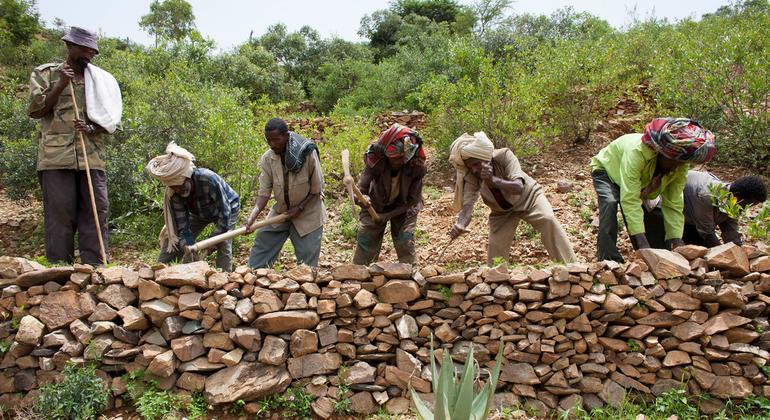
Desertification, the phenomenon whereby fertile land becomes unproductive and desert-like, is spreading at alarming rates across the globe due to rising temperatures, droughts and deforestation.
Alarming Sword of Damocles
“Land is our most vital infrastructure — underpinning food security, water, livelihoods and stability,” stressed UN Executive Yasmine Fouad ahead of a major UN conference to tackle desertification, COP17, taking place in Mongolia this week.
In that vast land-locked nation dominated by the Gobi Desert and semi-arid grassland, land degradation is very tangibly threatening livelihoods.
Housebuilding in Mongolia: lacking access to open seas, landlocked countries must rely on other nations for many imports and exports, including construction materials.
Around one third of Mongolians are dependent on pastoralism, yet nearly 77 per cent of their country’s land – sandwiched between Russia and China – is degraded.
In 2023 and 2024, Mongolian farmers lost more than seven million livestock due to severe summer droughts followed by extremely cold dzud winters.
“For Mongolia, land is inseparable from our people, our livelihoods and our future. We know that the health of our land has direct consequences for people’s lives,” highlighted Mongolia’s Minister for Foreign Affairs Battsetseg Batmunkh, as the conference got underway.
3.2 billion livelihoods at stake
And the phenomenon extends far beyond Mongolia. 40 per cent of the world’s land is currently facing land degradation and drought, threatening the livelihoods of 3.2 billion people worldwide.
Rangelands are a particularly serious source of concern. They are vast, natural land areas that are unsuited for farming crops, but that provide vital food for nearly 70 per cent of the world’s livestock feed.
Despite being seldom talked about, two billion people rely on them for food, and they are facing the brunt of land degradation and drought.
“[These issues] are no longer distant environmental concerns,” underscored Ms. Fouad.
“They are already affecting the food we produce, the water we depend on, the resilience of our economies and the ability of communities to build secure futures,” she went on.
The financial cost of these environmental changes is also quantifiable. Degradation and drought are currently costing the global economy nearly $900 billion every year. Droughts, in particular, which have increased by almost one-third since 2000, are estimated to cause $300 billion in losses yearly.
Turning words into action
Monday saw the opening day of the two-week long COP17 conference hosted by Mongolia in its capital city, Ulaanbaatar.
Building on the progress made at COP16 in Riyadh, parties will discuss measures to strengthen drought resilience, sustainable agriculture and protect soils.
These include early warning systems, vulnerability assessments and international cooperation.
“The greatest change we want to see from COP17 is a shift from talk to action, from targets to implementation, and from commitments to measurable results,” stressed Mongolia’s Prime Minister Nyam-Osoryn Uchral.
A multibillion finance gap
One of the key priorities of the conference is to mobilise greater investment from the private sector for land restoration and drought resilience.
There is currently an estimated $278 billion finance gap. An estimated $355 billion is needed every year to restore land and resilience-building, yet current investment stands at only $77 billion.
Public resources alone are unlikely to close the gap, and despite depending heavily on reliable land and water supplies, the private sector provides only around six per cent of global land restoration and drought resilience funding.
Organisers of the COP17 conference are hoping to strengthen collaboration between governments, development banks, businesses and investors through initiatives like Business4Land Forum.
“I am confident that COP17 will mark an important step towards stronger international cooperation and accelerated global action,” said Mongolia’s Minister of the Environment and Climate Change, and Chair at COP17 Sandag-Ochir Tsend.
