

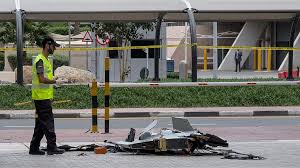
Britain has accused Russia of having a “hidden hand” in Iranian strikes across the Gulf after British troops came under attack for the third time since the conflict began.
A swarm of 20 missiles and kamikaze drones were fired at a joint base in Erbil, in the Kurdish region of Iraq, where UK and US troops are stationed, as well as at a separate Italian military training base, the local Kurdish commander said.
Specialist UK soldiers used surface-to-air missiles to destroy two of the Iranian Shahed suicide drones, the British side said, and others were intercepted by the Americans. An unknown number made it through their air defences, striking the base and injuring US personnel. There were no British casualties.
The same camp was hit on the first day of the conflict almost two weeks ago, when UK personnel were within 400 metres of an Iranian missile strike. The next day a suicide drone believed to have been fired by Iranian proxies targeted RAF Akrotiri, Britain’s airbase in Cyprus, blowing a hole in a hangar housing US spy planes.
John Healey, the defence secretary, said that analysis of Iranian strikes showed that tactics developed by the Russians in the war in Ukraine were being deployed to target allied military bases in the region. After being briefed by military chiefs on Thursday, Healey said that Moscow was aiding Tehran by refining the regime’s drone tactics, making their air assaults “more problematic” to tackle. He said: “No one will be surprised to believe that Putin’s hidden hand is behind some of the Iranian tactics and potentially some of their capabilities as well.”
The same camp was hit on the first day of the conflict almost two weeks ago, when UK personnel were within 400 metres of an Iranian missile strike. The next day a suicide drone believed to have been fired by Iranian proxies targeted RAF Akrotiri, Britain’s airbase in Cyprus, blowing a hole in a hangar housing US spy planes.
John Healey, the defence secretary, said that analysis of Iranian strikes showed that tactics developed by the Russians in the war in Ukraine were being deployed to target allied military bases in the region. After being briefed by military chiefs on Thursday, Healey said that Moscow was aiding Tehran by refining the regime’s drone tactics, making their air assaults “more problematic” to tackle. He said: “No one will be surprised to believe that Putin’s hidden hand is behind some of the Iranian tactics and potentially some of their capabilities as well.”
The Kurdish commander, Sirwan Barzani, leader of Peshmerga forces in the Erbil sector of Iraq, joined in condemnation of the attack. Barzani, a cousin of Nechirvan Barzani, the president of the Kurdish region, said: “We don’t know what the reason for this is.”
He said that Kurdistan had stayed out of the war and the base was not being used for the present attacks on Iran — Tehran’s justification for its aerial onslaught on its neighbours across the region.
“It’s a very stupid excuse,” he said in an interview. “We don’t understand it.”
The Times reported last week that the small British unit operating in Iraq had been downing more Iranian Shahed-style drones than squadrons of RAF fighter jets defending the airspace above Qatar and Jordan. Although not publicly identified, the soldiers are believed to belong to the RAF Regiment’s specialist counter-drone unit. These troops use Rapid Sentry, a turret-like missile launcher which obliterates targets with “fragmentation” warheads at ranges of up to 8km. They are considered the “last line of defence” against unmanned aerial attacks. A small number of personnel from 2 Rifles are understood to be stationed at the base, which has also reportedly been used by UK special forces.
During the briefing, Lieutenant General Nicholas Perry told Healey that the British soldiers in Iraq were resupplied last week and were “up to a reasonable stock” of missiles. He added: “All our people remain safe, touch wood. The Americans took some casualties last night but nothing too serious, fortunately.”
Asked by Healey if there was any sign of a link between Russia and Iran from analysis of attack patterns, Perry said: “Definitively, there is.” He added: “We have definitely seen the Iranian tactics of the use of their drones has [been] learnt from the Russians. They are flying them much lower and therefore they are more effective. There is no doubt that those tactics have changed and [are] being more effective and proving problematic. It’s the drones that are causing the biggest damage across the region for our allies.”
A military source told The Times last week that the single suicide drone that slipped past British defences in Cyprus was able to do so due to its small size and because it was flying low and close to the water at night during electronic interference. It later emerged that the drone contained Russian hardware, specifically a Kometa-B navigation system.
The Kremlin is believed to be passing intelligence to Iran to help it attack American forces in the region, including the locations of US warships and aircraft.
After the briefing Healey told reporters that the Russian president was “the one world leader that is benefiting from the sky high oil prices” triggered by Iranian forces shutting down the Strait of Hormuz, through which a fifth of the world’s oil and liquefied natural gas passes. Healey added that “evidence of Iran mining the strait is becoming established” and that the UK was considering how it could help secure the waters. Two oil tankers used in ship-to-ship transfers of Iraq’s domestic oil supplies were left burning in the Gulf on Thursday morning after being struck by a missile.
In his first statement since being appointed Iran’s new supreme leader, Ayatollah Mojtaba Khamenei showed no sign of compromise on this or any other issue.
“Certainly the lever of blocking the Strait of Hormuz must continue to be used,” his statement said. He threatened to expand the war further.
His statement was read out by a presenter on state television, indicating that he himself is still unfit to be filmed. Iranian officials have confirmed that he was injured in the Israeli bombing raid at the outset of the war that killed his father, Ayatollah Ali Khamenei, along with Mojtaba’s mother, sister, wife and son.
He promised revenge and warned the world not to underestimate Iran’s resilience.
“The insight and intelligence of the great nation of Iran in the recent events and its perseverance, courage and presence astonished friends and enemies alike,” the statement said.
In the US, President Trump returned to the issue of how long the war would last, claiming victory and also that the war must continue.
“You never like to say too early you won,” he told a rally in Kentucky. “We won. In the first hour it was over.” He added: “We don’t want to leave early, do we? We got to finish the job.”
he recent discovery of Russian hardware inside the drone that struck a British airbase in Cyprus has fuelled fears about Moscow’s growing footprint in the war with Iran (Charlie Parker writes).
Even before British military intelligence had dismantled what remained of the Iranian-style kamikaze device last week, the Kremlin was accused of passing targeting intelligence to Tehran.
Now UK analysis of Iranian attack patterns has revealed that the regime is using Russian methods to make drone strikes “more effective” across the Gulf.
Military chiefs at Northwood Headquarters, the main base of operations for the UK armed forces, believe that Russia has helped Iran to refine its air assaults so they are increasingly “problematic” for allied forces. The main giveaway was that the Iranians changed their tactics, flying drones much lower to the ground to evade detection. This means the munitions do not get picked up by traditional, long-range radar systems, which are typically positioned to scan for higher altitude threats such as aircraft or missiles.
The Times understands that the one-way suicide drone that hit RAF Akrotiri, Britain’s airbase in Cyprus, on March 1 evaded air defences on the island by doing just that. Due to its small size and because it was flying very close to the water at night during electronic interference, it managed to score a direct hit on a hangar housing American spy planes.
Russia has been deploying near-identical tactics and weapons to a devastating effect in Ukraine. It first deployed waves of Iranian-built Shahed 136 drones on the battlefield in 2022 but it has since built its own, more sophisticated, version of the fixed-winged dive-bombers, known as Gerans. These weapons have undergone several upgrades to compete with Ukraine’s evolving, multilayered air-defence network. They now integrate relatively simple autopilot boards, inertial navigation sensors and satellite receivers into a low-cost airframe.
At first, large waves of Gerans were sent in low-flying formations to attack Ukrainian positions and military assets. Many hit their targets by zooming beneath the radar horizon and simply overwhelming air defence systems.
In response, Ukrainians installed a dense network of cheap acoustic sensors, as well as mobile spotting teams and a digital map that allowed all their units to retain “a common air picture”, according to Jack Watling, a land warfare expert at the Royal United Services Institute think tank. They then deployed mobile firing teams armed with heavy machine guns and search lights, who could move their vehicles onto the projected path of incoming Gerans and shoot them down. Helicopter gunships are used to hunt the drones and blast them out of the air.
This was initially effective, Watling said, but it soon prompted the Russians to start flying higher — up to 13,000 feet — “above the engagement ceiling of mobile machine guns”.
The Ukrainians developed a smarter solution: drone interceptors. These explosive devices can fly to speeds of up to 300km per hour and use AI-enabled tracking to lock onto a Geran at higher altitudes before destroying them kinetically.
Britain and its allies in the Gulf have not needed to innovate at the same pace as Ukraine, meaning that they do not have similar solutions readily available. Instead they are relying on fighter jets, ground or warship-launched missiles and various electronic warfare systems to neutralise incoming threats. This allows Iranian drones to have relative success by reverting to the initial low-flying tactics used by Russians in the earlier stages of the Ukraine war.
