

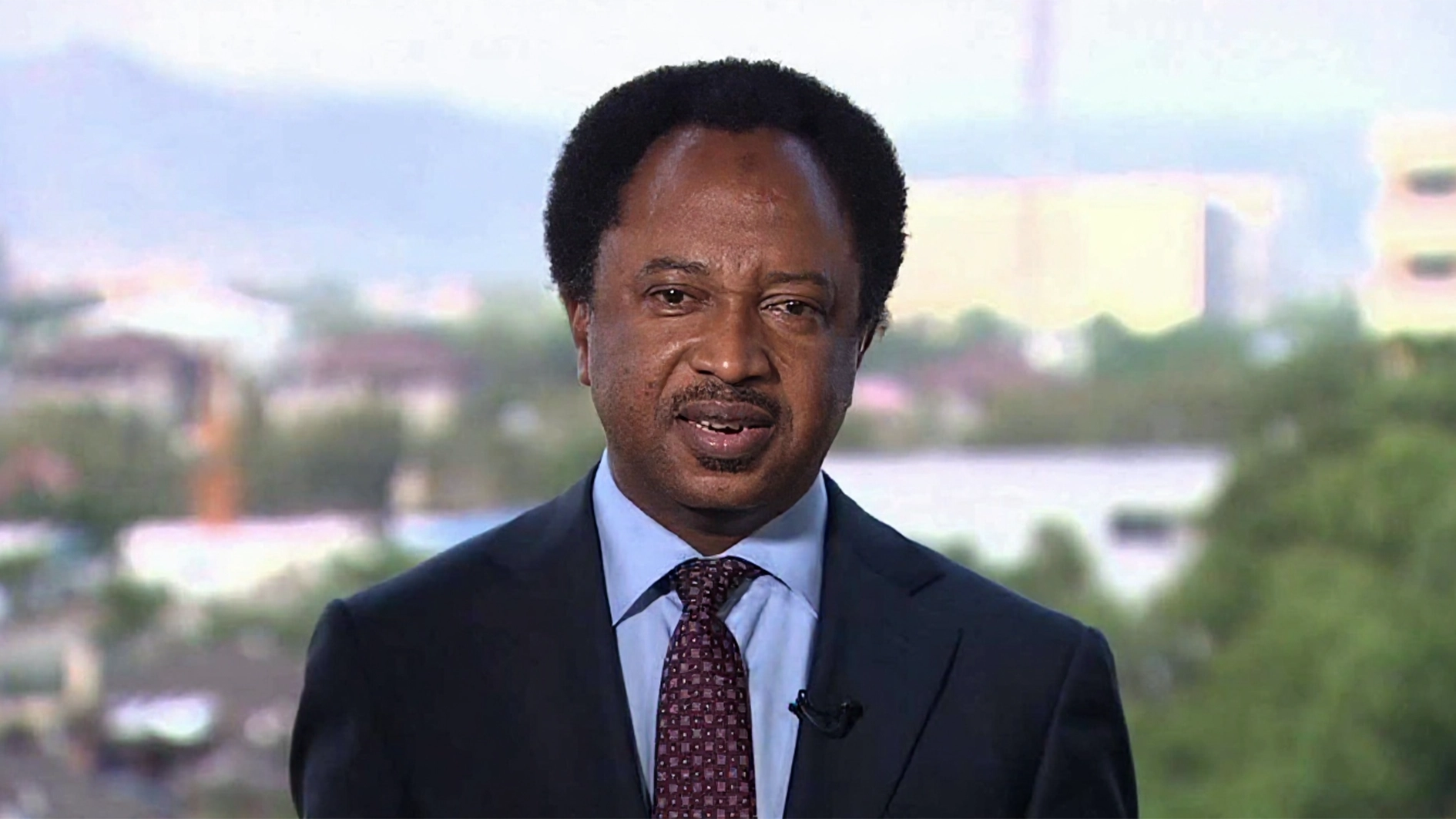
Former Kaduna senator Shehu Sani has defended the Emir of Katsina’s right to criticise political leaders over insecurity, recalling a 2022 controversy in which the Katsina Emirate Council queried a senior traditional titleholder for speaking about similar security concerns.
Mr Sani’s intervention followed remarks by the Emir, Abdulmumini Usman, during a visit to his palace by a political delegation led by Senator Abdulaziz Yari, Director-General of President Bola Tinubu’s campaign organisation.
The delegation included Katsina Governor Dikko Radda and other prominent political figures who visited the palace as part of consultations ahead of the 2027 presidential election.
In a video shared by former Kaduna Governor Nasir El-Rufai on X and Facebook, the emir addressed Mr Yari directly before criticising political dishonesty, divisions among northern leaders and the neglect of problems affecting communities.
“Director General, you are on board now. Not just here in Katsina, the whole country,” the emir said, according to a translation of his Hausa remarks.
He urged politicians to persuade people rather than humiliate them.

“Politics is not madness,” he said. “Convince me, into conviction. That is politics.”
The monarch criticised dishonesty towards the public, warning that political leaders would ultimately be accountable for their conduct.
He also appealed for unity, citing the Quranic injunction against division and using a Hausa proverb about a cracked wall to illustrate what he considered the consequences of disunity.
Turning to northern Nigeria, the emir questioned the proliferation of regional forums while insecurity continued to prevent people from farming.
“We have been stopped from farming,” he said.
He pointed to the decline of industries in Kaduna, including DIC and Peugeot, and questioned why northern leaders remained silent.
“Where are our elders? We have to talk. We have to talk. We must stand up,” he said.
The emir also argued that helping people should take precedence over personal wealth and status.
LEADERSHIP reported that the monarch also raised concerns about school closures, ransom payments and economic hardship. Those specific claims do not appear in the supplied video excerpt.
Trust Radio reported that the emir urged politicians to avoid witch-hunting and personal attacks.
In a statement attributed to Governor Radda’s spokesperson, Ibrahim Kaula Mohammed, the governor expressed support for Mr Tinubu’s re-election. At the same time, Mr Yari said the delegation came to seek the emir’s and the people of Katsina’s support.
Shehu Sani recalls former Waziri’s experience
In a Facebook post on Thursday, Mr Sani defended the emir’s right to speak about insecurity. Still, he recalled the treatment of a professor, Sani Lugga, who resigned as Waziri of Katsina in February 2022.
“The Emir of Katsina has the constitutional right to speak the truth about insecurity in his domain. Leaders should be held accountable for the safety and security of the citizens they govern,” he wrote.
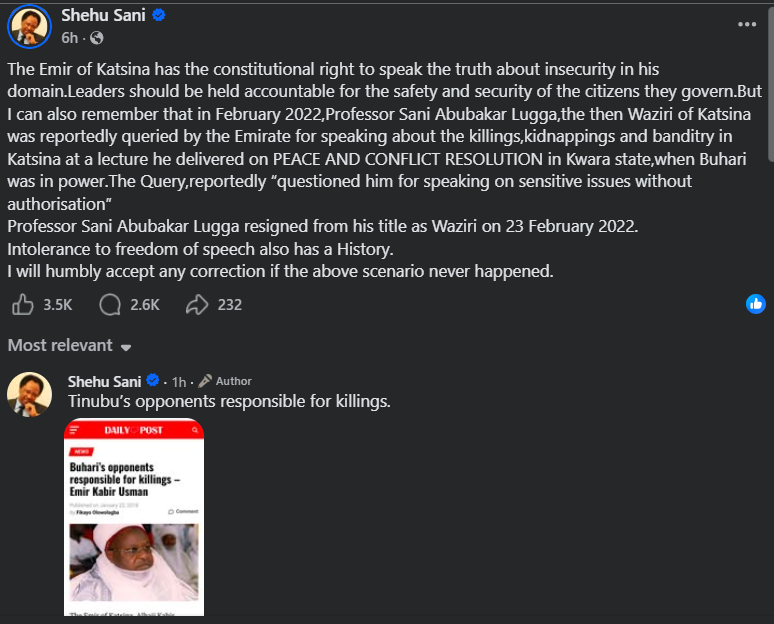 Mr Sani recalled that Mr Lugga had been queried by the Katsina Emirate Council after discussing killings, kidnappings and banditry during a peace and conflict resolution event in Kwara State.
He said the query reportedly questioned the former Waziri for speaking on sensitive issues without authorisation.
Mr Sani noted that Mr Lugga resigned on 23 February 2022, while former President Muhammadu Buhari was in office.
“Intolerance to freedom of speech also has a History,” he wrote.
“I will humbly accept any correction if the above scenario never happened,” he added.
How the 2022 dispute unfolded
The controversy followed Mr Lugga’s participation in a strategic management retreat organised by the Institute for Peace and Conflict Resolution in Ilorin on 14 and 15 February 2022.
During the event, he discussed insecurity in Katsina and criticised aspects of the Buhari administration’s response to terrorism.
The Guardian reported that Mr Lugga questioned the government’s security strategy and advocated using military contractors.
In his published account of the dispute, Mr Lugga said he received a telephone call on 16 February asking him to explain his public comments.
He said the emirate council later issued him a written query dated 21 February, seeking explanations for remarks about insecurity in eight local government areas, school closures, and the relocation of district heads.
Mr Lugga maintained that he participated in the retreat as an academic, not as a representative of the emirate council.
He also challenged the procedure for issuing the query, alleging it was not signed by the appropriate council official and did not comply with the relevant rules.
Emir’s role in the dispute
Mr Lugga’s account also raised questions about the emir’s role in the disagreement.
He alleged that the monarch told the Etsu Nupe, Yahaya Abubakar, who was involved in efforts to resolve the dispute, that then President Buhari had complained about his public discussion of insecurity.
According to Mr Lugga, members of the Katsina Emirate Council were instead informed that the complaint came from then Governor Aminu Masari.
Neither allegation has been independently corroborated, and public records do not show whether either political leader complained to the emir.
Mr Lugga further alleged that the controversy reflected a broader disagreement between him and the monarch over the administration of the emirate.
Several prominent traditional rulers reportedly intervened, including the Sultan of Sokoto, Muhammad Abubakar; the Etsu Nupe; the Emir of Argungu, Samaila Mera; and the then Emir of Kano, Aminu Ado Bayero.
The PUNCH reported that Mr Bayero visited Katsina and held a two-hour closed-door meeting with the emir as part of efforts to resolve the dispute.
Mr Lugga nevertheless resigned on 23 February 2022.
The emir subsequently accepted his resignation, according to a letter signed by the Secretary of the Katsina Emirate Council, Mamma Ifo.
The resignation took effect on 28 February 2022.
Although available records confirm the emir’s involvement in discussions about the dispute and his acceptance of the resignation, they do not conclusively show that he personally ordered the query.
Emir also criticised insecurity under Buhari
The emir had himself publicly criticised insecurity during the Buhari administration, including attacks that prevented farmers from accessing their land.
On 6 May 2019, while receiving then Agriculture Minister Audu Ogbeh and Central Bank Governor Godwin Emefiele at his palace, the monarch urged the federal government to prioritise security over agricultural programmes.
THISDAY reported that the emir complained about killings, kidnappings and the abandonment of farms in rural communities.
He argued that agricultural interventions would achieve little without adequate protection for farmers.
The emir also alleged at the time that some politicians were involved in the violence, although that accusation was not established as fact.
His criticism was documented again in a June 2020 account by journalist Olusegun Adeniyi, following a visit to the palace during which the monarch discussed killings and the limited capacity of traditional institutions to address insecurity.
The emir’s earlier statements establish that he had spoken publicly about security failures before the current administration.
However, the circumstances of his interventions and Mr Lugga’s academic presentation were not identical, and the available records do not establish that the Emir personally authorised the query issued to the former Waziri.
Discover more from Premium Times Nigeria
Subscribe to get the latest posts sent to your email.
