

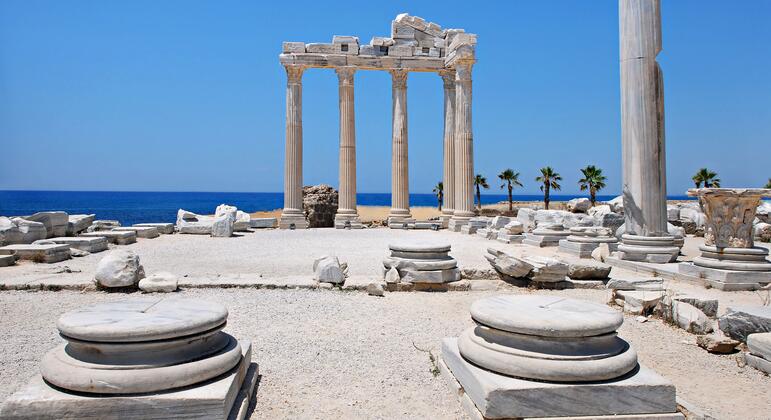
Since Homer’s day, the Mediterranean has been much more than a beautiful body of water, where Odysseus journeyed home, encountering six-headed monsters, bewitching sirens and unpredictable gods.
Situated between Africa, Asia and Europe, the Mediterranean has been a highway connecting cities, civilisations and commerce, providing food and livelihoods while being central to culture, spirituality and the spread of ideas.
With its shores now home to more than 500 million people, including some 25 coastal metropolitan areas, the Mediterranean’s importance has only grown. Home to the world’s busiest shipping lanes, it currently supports massive fishing and tourism industries, with a growing list of others.
Ecological treasure chest
The Mediterranean is also an ecological treasure chest. Covering just one per cent of the world’s ocean surface, it contains up to 18 per cent of all known marine species, more than a quarter of which are found nowhere else on Earth.
Underwater meadows of Posidonia oceanica – an endemic seagrass named for the Greek god Poseidon and commonly known as Neptune grass – cover more than 1.2 million hectares, providing a vital habitat for troves of marine life, sequestered carbon and nutrients.
Other ecosystems such as marshes, wetlands and dunes, buffer the Mediterranean’s approximate 46,000 kilometres of coastline and keep communities safe from erosion and storms. These landscapes provide food, water, jobs and identities – but they’re coming under increasing strain.
Different fish species swim in a marine protected area outside the coast of Malta.
New monsters
While Odysseus largely tackled his monsters one by one, the modern-day obstacles in the Mediterranean work together to erode the overall health of the region.
These new monsters are posing grave threats. Every day, an estimated 730 tonnes of plastic waste alone enters the sea, much of it carried there by rivers: single-use plastics account for more than 60 per cent of rubbish on Mediterranean beaches.
Wastewater, industrial chemicals, agricultural run-off and pollutants from ships are affecting the sea’s waters, alongside newer threats like pharmaceutical waste, microplastics, plastic additives and a rise in underwater noise levels that disrupts wildlife.
The Mediterranean Sea has long been an attraction for tourists and locals, including this beach in Italy.
From heatwaves to pollution
The Mediterranean region is warming 20 per cent faster than the global average temperature rise, indicated recurring summer heatwaves. Changes in rainfall, sea-level rise and ocean acidification, are also heightening threats of drought, wildfire, flooding, erosion and water shortages.
Construction, pollution and various industries are unsettling and damaging the sea’s vibrant biodiversity, from loggerhead sea turtles and striped dolphins to swordfish, octopus and the rare Mediterranean monk seal.
The challenges are often self-reinforcing. When larger predatory fish become scarce, fishers catch smaller species lower down the food chain, disrupting the food web.
Damaged coastal ecosystems provide less protection from storms and floods. Warmer water temperatures can make it easier for invasive species to spread, affecting native biodiversity and ecosystems. Irresponsible tourism produces increasing waste and places pressure on fragile habitats.
Gidaki Beach in Ithaca, Greece.
A modern MAP forward
Fortunately, the sea has a hero. The Mediterranean Action Plan of the UN Environment Programme (UNEP), established in 1975, is the first if its kind under the agency’s broader regional seas programme, which now brings 145 countries together to protect the world’s saltwater bodies.
Known as UNEP/MAP, it:
- Supports marine protected areas and action plans for threatened biodiversity and habitats
- Promotes restoration of damaged ecosystems
- Helps countries identify and control inbound avenues of invasive species, to keep them at bay
- Helped establish special protected areas covering more than eight per cent of the sea and species-specific protection plans
- Advises on smart coastal planning for countries, focusing on the restoration and health of natural defences like dunes and wetlands
- Helps Mediterranean economies grow while safeguarding the ecosystems that have underpinned prosperity since ancient times
More heroes
Landmark agreements are now leading to action, with the Barcelona Convention, adopted by Mediterranean countries in 1976, serving as the region’s primary legally binding framework for protecting its marine and coastal environment. It contains seven protocols tackling such critical issues as pollution, hazardous waste, biodiversity, offshore activities and coastal development.
Through UNEP/MAP and the Barcelona Convention, 21 Mediterranean countries and the European Union are now working together, with the UN environment agency supporting countries to establish collective rules, monitor the sea’s health and turn regional commitments into national action.
This includes helping nations reduce plastic and chemical pollution, improve wastewater management and prepare for potential hazards like oil spills.
The legally binding Regional Plan on Marine Litter, adopted by MAP members in 2013 and updated in 2021, is the first of its kind, committing parties to reduce and remove marine litter and integrate circular economy approaches.
Vision for the future
Unlike Odysseus’s return to his home island of Ithaca, the Mediterranean doesn’t have a single destination in view – but there is a clear vision for its future.
“What we’re pursuing is a healthy, thriving sea whose magnificent wildlife, ecosystems and industries can sustainably support the millions of people across a multitude of cultures who call the region home,” said UNEP programme coordinator Tatjana Hema.
A key to achieving this? Like Odysseus on his epic journey, just follow the MAP.
Learn more about UNEP’s regional seas programmes here.
