


The Federal Government has said it has achieved a reasonable degree of price stability and economic growth, adding that the country is gradually moving towards economic and social development.
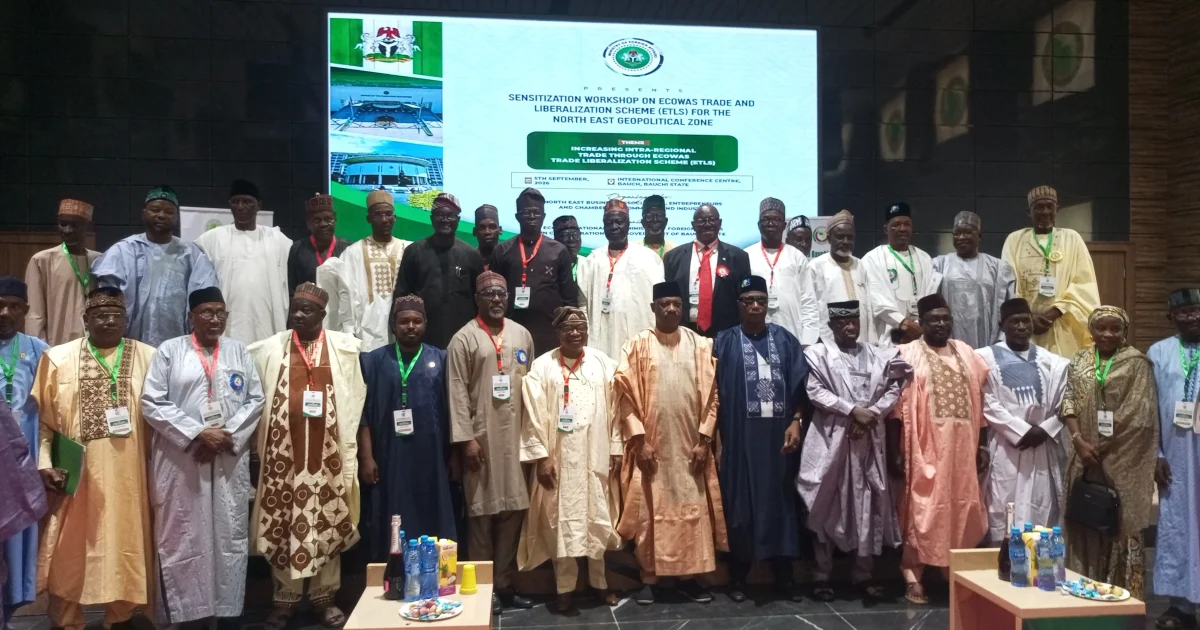
The Minister of State for Foreign Affairs, Ambassador Sola Enikanolaiye, stated this on Saturday while speaking with journalists on the sidelines of a sensitisation workshop on the ECOWAS Trade Liberalisation Scheme for the North-East geopolitical zone, held in Bauchi.
The workshop, with the theme, “Increasing Intra-Regional Trade Through ECOWAS Trade Liberalisation Scheme,” was organised by the ECOWAS National Unit of the Ministry of Foreign Affairs in collaboration with the Bauchi State Government.
Enikanolaiye said the programme was part of efforts to bring Nigeria’s foreign policy closer to the people and create economic opportunities for businesses, entrepreneurs and other stakeholders.
He said, “One of the main reasons we decided to organise this workshop is in line with our 4D foreign policy framework, which places the Nigerian people at the centre of our foreign policy.
“We are looking at ways and means of bringing foreign policy closer to Nigerians at the grassroots in a manner that enhances their prosperity and expands economic opportunities within the West African region.”
According to him, the workshop was designed to encourage Nigerian businesses, including small and medium-sized enterprises, large-scale companies and agricultural enterprises, to explore opportunities within the West African sub-region and the wider African market.
He added that the initiative would also help businesses understand the opportunities available under the African Continental Free Trade Area Agreement.
“We believe that not much information is available to the public about this scheme. Therefore, through these zonal workshops, we intend to raise awareness about the ECOWAS Trade Liberalisation Scheme, its scope and the requirements Nigerian companies must meet to register and benefit from it,” the minister said.
He said the sensitisation programme would be held across the six geopolitical zones before concluding in Abuja.
“We are starting with the North-East. We will move to the North-Central, North-West, South-South, South-East and South-West before concluding in Abuja.
“We believe that by the time we complete this process, awareness about the scheme and the opportunities available under it will have increased substantially.”
Enikanolaiye said the Federal Government was also focusing on improving Nigeria’s productive base through industrialisation and value addition.
He said, “We want to focus on industrial value addition. We believe that the productive base of the Nigerian economy has to improve so that we can produce more, generate more jobs and create opportunities for our growing youth population.”
Speaking on the state of the Nigerian economy, the minister said the economic reforms of President Bola Tinubu’s administration had contributed to a greater degree of stability and growth.
He said, “Price fluctuations are a function of the macroeconomic and microeconomic policies of every country, but I can only speak for Nigeria on this occasion.
“I can say, without fear of contradiction, that the economic reforms of President Bola Tinubu have achieved a great degree of stabilisation and growth.
“You cannot promote economic development without growth. If you have an economy suffering from zero growth or negative growth, there is no way we can talk about the benefits of development.
“So, we have attained that stage, and we are moving progressively towards economic development, social development and prosperity.”
The minister acknowledged that inflation remained high but said it was declining, adding that other economic indicators were showing signs of improvement.
“Inflation is coming down, even though it is still high. We admit that. But we have achieved a reasonable degree of economic stability, and all of us must now work together to ensure that we move towards development, economic prosperity and shared prosperity for the people of Nigeria,” he added.
In his remarks, Bauchi State Governor, Bala Mohammed, said the state government was committed to supporting local investments and expanding opportunities for businesses.
The governor, who was represented by his deputy, Auwal Jatau, stated this while declaring the workshop open.
Mohammed said the ECOWAS Trade Liberalisation Scheme was aimed at facilitating legitimate trade in qualifying products originating within the ECOWAS region, promoting investment, expanding markets, strengthening production and deepening economic cooperation among member states.
He said, “The North-East is richly endowed with agricultural, livestock, mineral and industrial resources. We have hardworking farmers, innovative entrepreneurs, manufacturers, processors, traders, cooperatives, women-owned businesses and a growing community of young people seeking productive economic opportunities.
“The ETLS sensitisation programme should therefore serve as a bridge between knowledge and opportunity, between local enterprise and regional prosperity.”
The governor said participants should leave the workshop with a clear understanding of the scheme, the opportunities available, registration requirements, relevant institutions and the standards their products must meet to compete in the regional market.
He said, “By the end of this engagement, stakeholders should not merely have heard about ETLS; they should understand it.
“They should know the opportunities it presents, the requirements that must be met, the institutions they need to engage, the standards their products must satisfy and how they can position themselves to participate legitimately and competitively in the regional market.”
Mohammed said the state government remained committed to economic diversification, employment creation and the expansion of opportunities for residents.
He added that the government alone could not create sustainable prosperity, stressing the need to empower the private sector to produce, process, innovate and create jobs.
“We must produce more, process more, add more value and sell to larger markets,” he said.
“We must begin to see regional integration not as an abstract diplomatic concept but as an economic pathway through which a farmer in Bauchi, a producer in Gombe, a trader in Borno or an entrepreneur in Adamawa can connect to consumers and businesses across West Africa.”
The governor also called for stronger economic cooperation among the North-East states, noting that the region possessed complementary economic strengths.
He said stakeholders must address challenges such as delays at borders, multiple checkpoints, inadequate transportation infrastructure, non-tariff barriers, limited access to accurate trade information and other procedural difficulties.
According to him, such challenges disproportionately affect small businesses and entrepreneurs who may lack the resources to navigate complex procedures.
Mohammed said, “We expect that this sensitisation programme will produce practical outcomes.
“First, it should deepen awareness and understanding of ETLS among businesses and relevant government institutions. Second, it should improve compliance by helping businesses understand the procedures and documentation required.
“It should also identify practical barriers confronting our businesses and provide a platform for addressing them through stronger institutional coordination.”
He pledged the commitment of the Bauchi State Government to work with the Ministry of Foreign Affairs, the ECOWAS Commission, regulatory agencies, neighbouring states, development partners and the organised private sector to address obstacles preventing businesses from fully benefiting from regional trade arrangements.
The governor urged participants to move “from conversation to implementation, from potential to productivity and from local production to regional competitiveness.”
He added, “Let us ensure that our farmers, manufacturers, women entrepreneurs, young entrepreneurs, cooperatives, processors and traders are not spectators in the process of regional integration.
“Let them be its beneficiaries. Let them be its drivers, and let them be its success stories.”
