

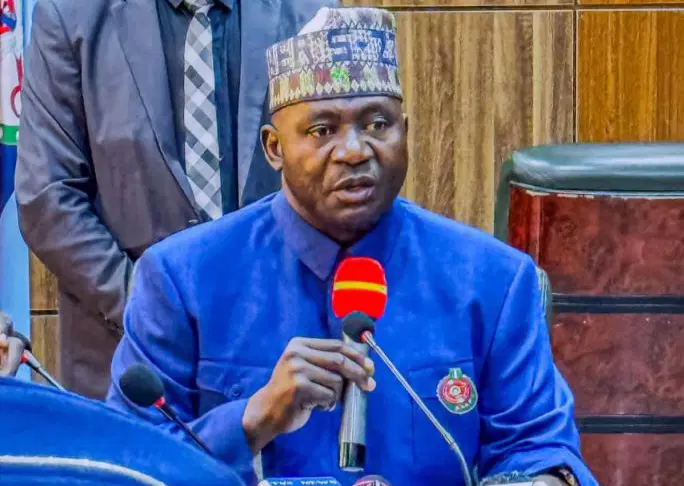

The Minister of Defence, Gen. Christopher Musa (retd.), has warned security agencies against relying on last-minute deployments for election security.
According to him, securing elections cannot be achieved through last-minute security deployments, insisting that lasting election security requires months of intelligence-led planning and coordination.
Musa stated this on Tuesday while delivering the keynote address at the Blueprint newspaper seminar on security.
The minister said election security must not be treated as an event limited to election day, but as a continuous process requiring early preparation and assessment of emerging threats.
“The lesson is clear: successful election security is not achieved through last-minute deployments. It is achieved through months of planning, intelligence-led operations, inter-agency coordination, effective communication and continuous assessment of emerging threats and, above all, through the confidence that citizens place in the institutions established to serve them.
“Security should never be viewed as an event. It is a process that begins long before campaigns commence and continues long after the final vote has been counted,” he said.
He said the changing nature of security threats had made it necessary for election preparations to go beyond the physical protection of polling units.
According to him, threats to elections could emerge through cyberspace, misinformation, economic hardship and the manipulation of ethnic and religious divisions.
He warned that the greatest threat to the integrity of an election might no longer be a person carrying a weapon at a polling unit, but an anonymous actor operating online to manipulate information and undermine public confidence.
The minister also proposed a six-pillar framework for strengthening election security.
He said, “The first pillar: Strategic Intelligence should form the foundation of election security planning.
“Modern election security must be intelligence-led rather than incident-driven, with threat assessments, early warning systems and real-time information sharing among security, intelligence and electoral institutions.
“On the second pillar: As elections become increasingly technology-enabled, protecting digital infrastructure is no longer optional, and electoral systems, communication networks and information platforms must be safeguarded against cyber intrusion, digital sabotage and malicious interference,” he said.
Musa listed Civil-Military Coordination as the third pillar, stressing the need for collaboration among security agencies without institutional rivalry.
“The constitutional roles of all security agencies must continue to be respected, while strengthening coordination, interoperability and joint planning; experience has shown that seamless collaboration, not institutional competition, delivers the best outcomes during national emergencies and major public events,” he said.
The fourth pillar, Unified Strategic Communication, he said, was critical to countering misinformation.
“In today’s information environment, silence often creates space for misinformation, and timely, accurate, coordinated public communication is essential to sustaining public confidence before, during and after elections,” he said.
On the fifth and sixth pillars, a Responsible Information Environment and Engaged Citizens, Musa said government alone could not defeat misinformation, describing the fight as a shared national responsibility.
“Government alone cannot defeat misinformation; the media, technology companies, civil society organisations, educational institutions and citizens all share responsibility for promoting fact-based public discourse and rejecting narratives designed to incite violence or undermine confidence in democratic institutions,” he said.
Speaking, former Governor of Zamfara State, AbdulAziz Yari, warned politicians against using insecurity as a tool to win the hearts of citizens.
Yari said the fight against insecurity was a collective national responsibility that went beyond government and security agencies.
“Let us encourage all political parties to understand that insecurity is not something to be traded with for the purpose of winning the hearts of citizens. The citizens are aware that we are in trouble. From Obasanjo, Yar’adua and Jonathan to Buhari and today. We need to be fair and just,” he said.
Drawing from his experience as governor between 2011 and 2019, during which he witnessed the security challenges surrounding the 2015 and 2019 general elections, Yari said insecurity had remained a lingering national problem across successive administrations.
