


This article was originally published by Canary Media.
America’s energy supply crunch is driving a surge of federal and private investment in new electricity generation — from polluting gas turbines to cleaner developments like solar farms and geothermal plants. But gigawatts of power are already available for the taking across the U.S. economy in the form of wasted energy from an unexpected source: motors.
Some 50 million electric motors drive the fans, pumps, and compressors found in virtually every factory and building. Together, they gobble enough electricity to equal nearly a third of total U.S. power demand. Often, the motors use far more energy than they actually need to keep America’s machines humming.
Companies can install devices known as variable frequency drives, or VFDs, to make motors run super efficiently. Yet adoption remains relatively low, in part because of the perceived hassle of retrofitting equipment and because they’re typically not required. On average, only 16 percent of motor systems at industrial facilities and 4 percent of commercial-sector motors use VFDs, according to a 2021 market report by Lawrence Berkeley National Laboratory.
However, there are now more reasons than ever to equip the nation’s motors with power-saving devices, energy experts and device manufacturers say. They’re urging federal agencies, utilities, and deep-pocked tech giants to spur a wider rollout of VFDs through financial incentives and efficiency standards.
For one, slashing motors’ power use would free up grid capacity for large electricity users like data centers and electric vehicles, they argue. It would help curb costs for factories that are switching from fossil-fueled heating systems to electrified, motor-based solutions like heat pumps — all at a time when industrial power prices are climbing fast. Plus, VFD technology has become far more sophisticated and less expensive to install than earlier iterations.
“This is low-hanging fruit that gives a lot [of energy] back and is reasonably simple,” Nik Sawe, a senior policy analyst at the nonpartisan think tank Energy Innovation, says of the technology.
What are variable frequency drives?
Energy-wise, the main problem with electric motors is that they’re always running at full capacity. Consider an office building, which empties out in the evening. The heating, ventilation, and air-conditioning system can wind down in those hours, with dampers and valves restricting the flow of cold or hot air. But the motors and fans that drive the whole setup are still working in the background, wasting energy.
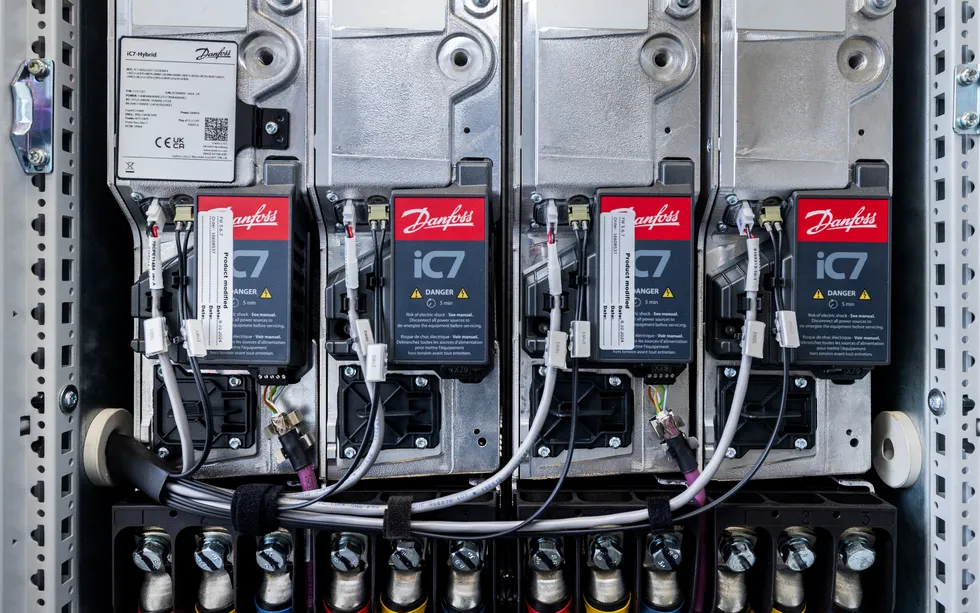 VFD technology, such as the Danfoss iC7 series has gained some momentum in recent years among factories and buildings trying to combat rising electricity costs. Danfoss Drives
VFDs are electronic controllers with temperature sensors that continually adjust the speed of motors, automatically ramping up or down to match demand. The technology, which is also called adjustable speed drives, has the potential to curb a motor’s energy use by around 40 to 60 percent, says Neal Elliott, director emeritus of the American Council for an Energy-Efficient Economy.
All those energy reductions add up. Toyota, for example, installed VFDs on over 200 motors inside the HVAC system at its auto manufacturing plant in Georgetown, Kentucky, as part of a US $1.25 million pilot project in 2015. The automaker saved more than $700,000 in annual electricity costs thanks to the VFDs, and it continues to use the technology at other manufacturing facilities across the U.S., the company said by email.
“We’ve known for many, many years that there’s a huge opportunity for energy savings by varying the speed of the motor,” says Elliott, who noted that he literally wrote the book on energy-efficient motor systems in 2002.
Electric Motors in Nearly Every Factory
Certain aspects of the technology have historically held the drives back since they debuted in the late 1960s. Measuring the flow of water, air, refrigerant — whatever is moving through the system that the motors are driving — was for decades an expensive engineering process. Accurately controlling motors to deliver the right amount of juice, at just the right time, faced similar issues.
But recent advances in sensors and machine-learning algorithms have significantly slashed the cost and complexity of using drives, Elliott says. Modern VFDs have also benefited from the increased production of advanced power chips that are used in high-voltage applications such as electric vehicles and solar power inverters.
Another long-standing challenge has been that commercial and industrial building developers often prioritize reducing up-front costs over netting long-term energy savings, and so don’t always build to the highest efficiency levels, says Zack Valdez, senior director of regulatory and industry affairs at the National Electrical Manufacturers Association, whose members include drive and motor makers.
“If the facility that you’re putting it into doesn’t require it, then oftentimes people will overlook [VFDs], because they’re just trying to build to a minimum set of energy requirements,” he says. And if companies don’t install drives from the start, they’re likely less inclined to take time to retrofit an operating system.
The trade association recently launched a pilot program with manufacturers, utilities, and energy-efficiency groups to collect real-world data about how VFDs reduce motors’ electricity use and lower utility bills. The goal is to demonstrate how the technology can benefit not only individual facilities but also the wider grid — giving utilities a concrete reason to provide rebates for industrial customers.
VFDs Slash Motors’ Electricity Use
Proponents say they hope the results will help the U.S. Department of Energy shape future efficiency measures and incentives that encourage adoption of the drives, including in federally owned buildings. Despite the Trump administration’s open hostility toward home appliance and equipment mandates, agency staff have apparently been receptive to discussing solutions that could meet the soaring power needs of data centers.
“If you added a drive to all the motors that are out there, you could provide [power for] up to five years of data center growth without having to build any new generation,” says Kirk Anderson, director of government relations and public affairs for ABB. The global manufacturing giant makes VFDs domestically near Milwaukee.
Anderson floated the idea of having tech companies help pay for factory owners to install VFDs to free up room on the grid. After all, hyperscalers are already spending many billions of dollars to revive shuttered nuclear plants, support next-generation geothermal projects, deploy fleets of grid-scale batteries, and supercharge the buildout of gas turbines and power plants.
“Instead of ‘bring your own power,’ it should be ‘offset your own power,’” he says, referring to a growing effort by states to get data centers to secure their own power resources and prevent rising costs for regular customers.
Michael Reckamp, the director of enterprise strategy for Danfoss Drives, North America, another VFD manufacturer, said that despite the traditionally low adoption rates, the technology has gained some momentum in recent years among factories and buildings as rising electricity costs and other grid-wide challenges make it harder to justify wasting energy.
Still, “it hasn’t permeated enough to get everyone utilizing it,” he says. “In the current situation, where we’re having so many issues with grids, brownouts, and now data centers wanting to take the load, I think there should be a renewed focus on putting drives out there to really reduce the stress on the grid and improve energy savings.”
From Your Site Articles
Related Articles Around the Web
