

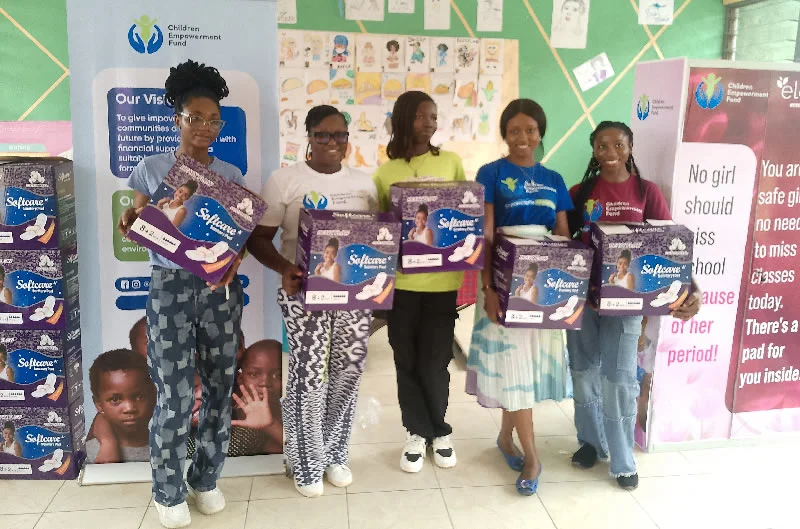

The Child Empowerment Fund, on Thursday, donated a six-month supply of sanitary pads to 100 girls at the Children Correctional Centre for Girls, Idi-Araba, Lagos, as part of activities marking the 2026 Menstrual Hygiene Day.
The donation, carried out under the “Project Red Bloom Box 2026,” was organised in collaboration with the Tarfs Foundation and Elora Foundation.
Menstrual Hygiene Day is observed globally every May 28 to eradicate the stigma and shame associated with menstruation and to highlight the importance of proper menstrual hygiene management.
Speaking during the event, the Programmes Manager of the Child Empowerment Fund, Temitope Akinrotimi, said the initiative was aimed at promoting menstrual hygiene awareness and improving access to menstrual products for underserved girls.
She emphasised the programme’s theme of “Empowered Girls, Hygienic Period and Brighter Future,” noting that access to menstrual hygiene products and education remains critical to the health, dignity and confidence of young girls.
Akinrotimi said the organisation had continued to expand its outreach across several states, stressing that many girls still lack access to basic menstrual products.
“We stand for the girl child at Child Empowerment Fund, and we desire to ensure that menstruation is never a barrier to dignity or education. From distribution of free sanitary materials to sensitisation and advocacy, period poverty remains a major challenge in Africa, and Nigeria is not exempt,” she said.
She lamented that some girls still rely on unsafe alternatives during menstruation.
“In many of the places we visit, we still find girls using newspapers, rags and even cotton wool for their periods. We do not think that is the right thing for the girl child. Our advocacy is that every girl should have access to sanitary materials, even if it is free,” she added.
Akinrotimi said the group’s interventions were designed to support girls through their menstrual years, while calling for stronger collaboration with government institutions.
“This is why we collaborate with other organisations from time to time to ensure that sanitary materials are distributed to girls in schools and facilities where they are needed,” she said.
She noted that the initiative had received support from relevant government agencies.
“We have the support of the Ministry of Health, and at different times the Ministry of Education also partners with us. What we are saying is that there is a need for government to pay more attention to period poverty and work with NGOs like ours,” she said.
She also highlighted health risks associated with poor menstrual hygiene practices, citing cases of infections and complications from unsafe materials.
The event featured menstrual hygiene education sessions, empowerment conversations, and the distribution of sanitary pads and specially packaged boxes designed to ensure sustainability.
Some of the girls at the correctional centre also shared personal experiences about menstruation, including challenges relating to cramps, ovulation and menstrual management.
Delivering a lecture, a Community Health Worker and Health Educator with the Lagos State Government, Aladejare Omolade, stressed the importance of maintaining proper menstrual hygiene.
She advised the girls to clean their private parts regularly with clean water and to change sanitary pads every six hours.
Omolade also encouraged the girls to monitor their menstrual cycle and maintain proper personal hygiene, while warning against improper disposal of sanitary materials in toilets to prevent blockage of sewage systems.
She further urged the girls to adopt healthy grooming habits and remain attentive to their overall reproductive health.
