

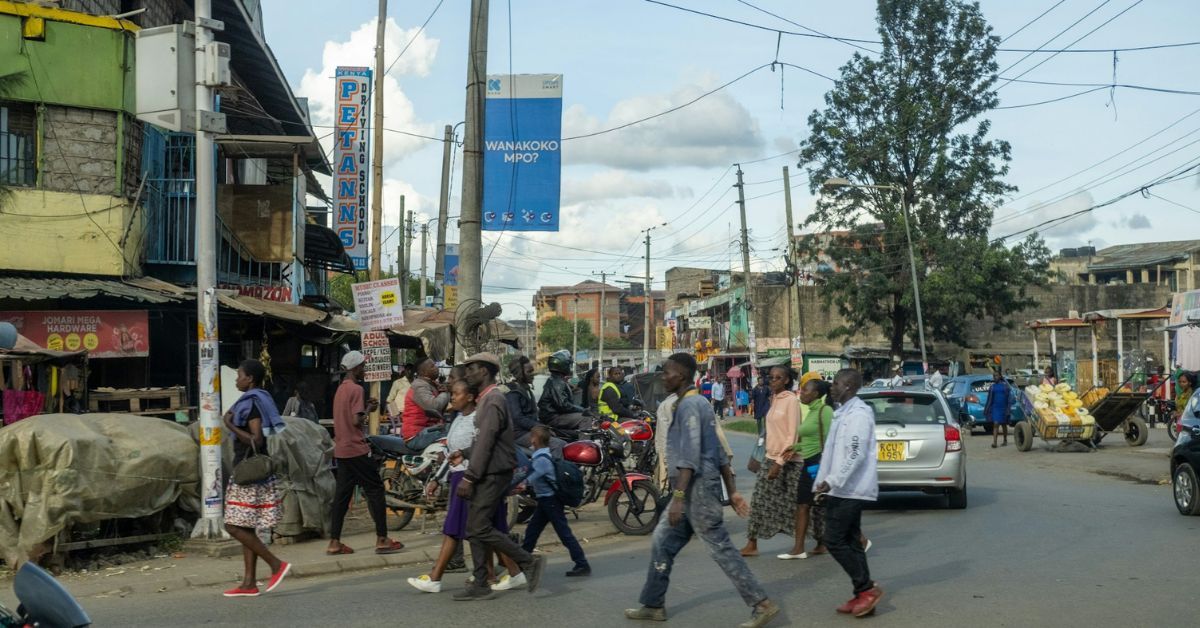
Every evening in Nairobi, a transaction happens that no algorithm has ever improved upon.
Njeri watches the day thin out. The sukumawiki that was KES20 (roughly $0.15) at noon becomes KES10 ($0.08) at dusk. The bread that didn’t sell moves quietly to the woman two stalls away. The pig farmer swings by on Tuesdays. The broker takes the remainder at a price that has a thin margin but wastes nothing.
No app. No notification. No ESG carbon offset report.
What the tech industry calls food waste, Nairobi’s informal economy calls secondary inventory.
The pig farmer on Nairobi’s periphery, documented by the International Livestock Research Institute as dependent on urban surplus feed, is not a beneficiary of food waste. He is part of the supply chain. The broker redistributes near-expiry produce to the city’s price-sensitive consumers. Mama Mboga, too, with her handwritten credit book, sells single eggs to customers who cannot afford six.
This is not a broken system waiting to be fixed. It’s a fifty-year-old circular economy that has functioned without an app. Yet a growing number of digital platforms are arriving to disrupt it without understanding the system they are entering.
The assumption behind surplus-food platforms launched in Africa is simple: food waste is a market failure, and technology is the correction. It makes sense if you are looking at the problem from Copenhagen, London, or San Francisco, where unsold food at the end of the day goes into a bin.
In Nairobi, it goes into a network.
A 2024 study by Jeremy Wagner for the Hungry Cities Partnership found that the ‘supermarket revolution model’ fails to account for Nairobi’s reality. Informal vendors remain central to food security for low-income residents. Supermarkets cater to middle and upper-income groups.
The informal economy is not a primitive version of the formal one. It is a parallel system with its own logic, trust infrastructure and way of finding a fair price before sunset. Every platform that has attempted to digitise it has learned this at a high cost.
Twiga Foods raised over $60 million but restructured in May 2025, cut more than 300 jobs and retreated to an asset-light model after years of friction with the informal supply chain it was trying to formalise. Marketforce, built to bring digital tools to small-scale food traders, shut down in 2023 after burning through its runway against the same wall.
The wall is not logistics. It’s not connectivity. It is an assumption that arrived before the product did.
When a digital platform enables a supermarket to push near-expiry bread at 60% off, something happens that the carbon metrics will never capture. The supermarket absorbs the discount as a loss leader, a rounding error against its monthly revenue. The kiosk owner next door runs on a 10% daily margin. Njeri does not absorb anything. She loses a customer to a platform she cannot join.
India watched this play out in real time. Between 2024 and 2025, quick commerce platforms like Blinkit and Zepto grew by 280%. 82% of buyers shifted at least a quarter of their purchases to these apps. Nearly $1.28 billion in annual sales moved from small traditional retailers to digital platforms in a year. Nearly 200,000 Kiranas closed. The Indian government built an open digital commerce network (ONDC) to bring informal traders onto a level playing field.
There is a third option. It is hiding in plain sight.
Njeri the Mama Mboga is the infrastructure they need to build on, if they are willing to see her that way.
Any platform touching the informal economy needs to do what Systems Architects do: study the terrain. The behaviour of the buyer. The logic of the supply chain. The trust networks that have sustained it for fifty years. You cannot onboard a new system into a complex environment and call it disruption. You are just adding chaos with better branding.
Njeri already has the last-mile presence in neighbourhoods formal retail has never entered, a trust network built over decades and a surplus problem of her own.
M-Pesa did not ask Kenya to behave like a Western banking customer. It asked what Kenya trusted and built from there. Formalisation was the outcome, not the premise. That’s the architectural lesson every platform entering this space should inherit.
Disruption and displacement are distinct concepts.
Kenya’s next five years of food tech will depend on whether founders know the difference. The informal economy will not announce the verdict. It will simply route around every platform that was not designed for its terrain, the way it always has.
The food is not wasted in Nairobi. It is moving. The question is whether the next generation of platforms moves with it or against it.
____
Carolyne Manyeki is a Nairobi-based Learning and Development Practitioner and writer who tracks what happens when global models land in environments they were never designed for. She is also a lecturer in Communications who publishes Strategic Insights on LinkedIn.
